
Insights
PLC Platform Migration: A Plant Engineer's 2026 Guide
PLC platform migration planning for plant engineers: obsolescence signals, like-for-like vs re-architecture, code conversion, downtime, cost, and sequencing.
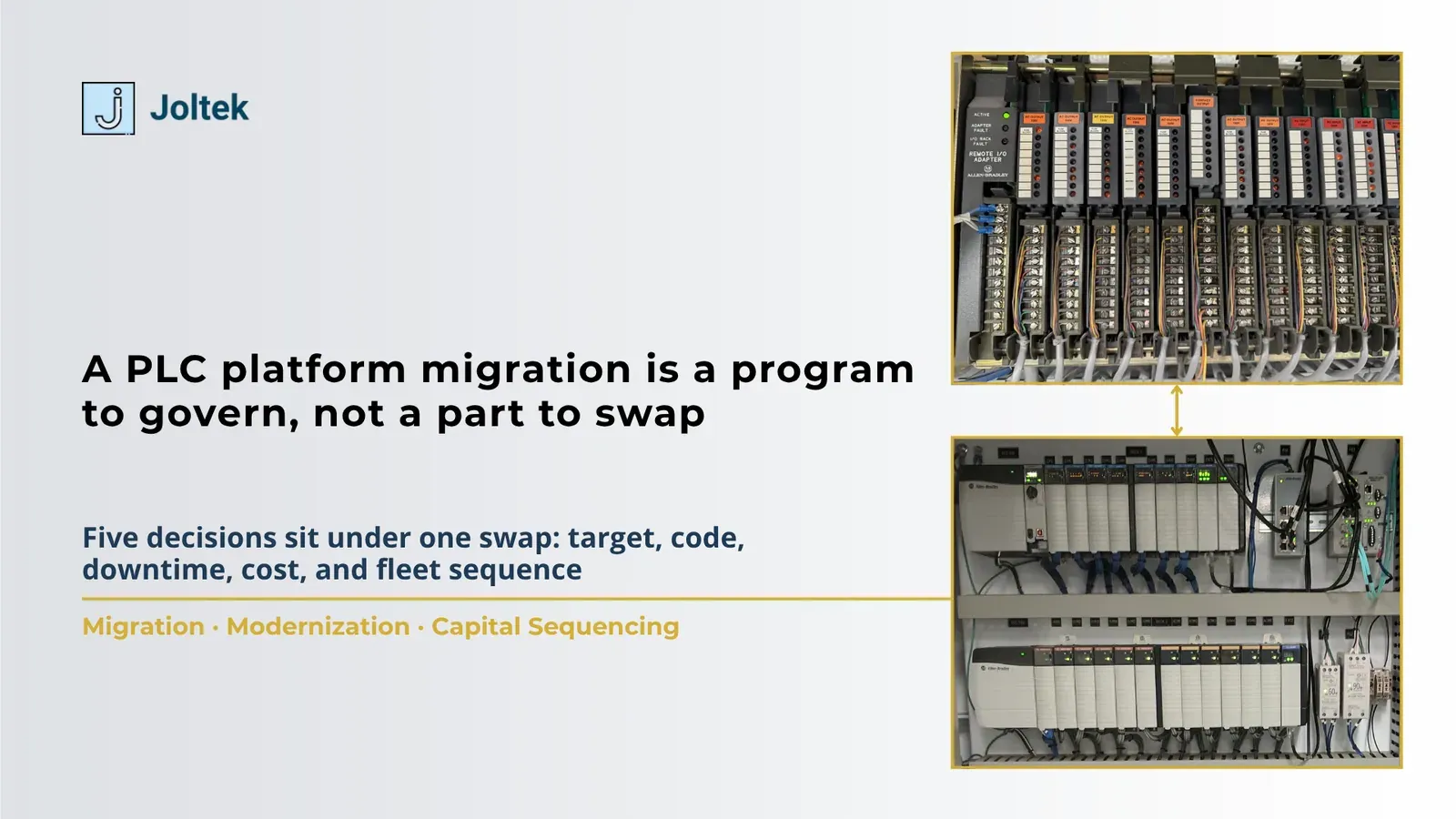
A maintenance lead pulls a failed processor from a 22-year-old packaging line and finds the only spare listed on an auction site at four times its original price. The line is down, the auction ends in two hours, and the Engineering Manager now owns a decision she did not schedule. She can buy the gray-market part and keep the failure clock running, or she can treat this as the moment to move off a platform that has been telling her it is finished for years.
That decision is a PLC platform migration, and it is rarely a clean swap. The reader has to choose what to migrate to, decide whether to convert the existing code or rewrite it, plan how much downtime the cutover needs, defend what it costs, and sequence the work across one plant or a fleet without spending capital in the wrong order. Vendor pages answer one platform. Integrator pages sell a service. Neither governs the decision. This guide does. By the end, a plant engineer can read the obsolescence signals, choose between a like-for-like move and a re-architecture deliberately, set honest expectations for code conversion and validation, plan a cutover that fits the plant’s shutdown window, and sequence a multi-site program so capital lands where the risk is.
What a PLC Platform Migration Actually Involves
A PLC platform migration moves control logic, I/O, and field connections from an obsolete or unsupported controller family to a current one. It preserves the process function while changing the hardware, the firmware, the programming software, and often the network underneath. The process keeps making product the same way; almost everything that makes it do so changes.
Three things get conflated in the same conversation, and separating them is the first management decision. A part swap replaces a failed board with a like board and changes nothing about the platform. A migration moves the line to a new supported platform. A modernization is a migration plus a re-architecture of the control and data design. The reader who treats all three as the same project will either over-scope a board swap or under-scope a re-architecture, and both errors are expensive.
A migration touches far more than the controller. It changes the programming software the team uses every day. It forces an I/O addressing change and often new I/O modules. It breaks and re-establishes the tag references that the HMI and SCADA layers depend on. It can change the field network from a legacy bus to EtherNet/IP or PROFINET. It resets the validation paperwork, because the line has to be proven safe to restart. The code itself is defined by IEC 61131-3, the standard that names the five PLC languages, and the shape of that code is a large part of what makes a migration easy or hard.
The management point is this: the size of the decision is set less by the controller and more by how much of the surrounding system the plant chooses to change at the same time. An Allen-Bradley PLC-5 or SLC 500, or a Siemens S7-300, can move to a current platform as a tight like-for-like job or as the first step of a full plant redesign. The controller is the same starting point. The scope is the choice.
When to Migrate: Reading the Obsolescence Signals
The worst time to decide is the day a processor dies. The signals that a platform is aging out are visible years ahead, and reading them turns an emergency into a planned project. The clearest signs that a PLC platform migration belongs on the capital plan are:
- The vendor has placed the platform in End of Life or Discontinued status.
- Spare parts are scarce, and the parts that exist carry gray-market prices.
- Mean time to repair is rising because failures take longer to source and fix.
- The programming software or its host operating system is no longer supported.
- The controller cannot be patched, which leaves a security exposure on the plant floor.
- The platform’s tribal knowledge sits with a shrinking group, and no one is hired into it anymore.
The lifecycle facts that justify a PLC platform migration are concrete. Rockwell Automation discontinued the PLC-5 in 2017 and placed the SLC 500 family into End of Life and Discontinued status in 2018. Siemens set the final discontinuation of the S7-300 and S7-400 for October 1, 2025. Each of those dates moved a large installed base from “supported” to “on borrowed time,” and the plants that planned ahead of the date controlled their own schedule.
The risk axis is where the business case lives. The cost of an unplanned failure, the lost production during an emergency cutover with no staged spares and no tested program, usually dwarfs the capital cost of a planned migration. The migrate-now decision is not really about the controller. It is about who controls the timing, the plant or the failure.
A migration that crosses the controller and network boundary is also the natural moment to address OT security posture. Standards such as IEC 62443 and NIST SP 800-82 describe the segmentation and hardening a modern controller and network can support, and folding that work into the migration costs far less than bolting it on afterward.
One caveat: not every aging PLC needs migrating this year. A stable, well-stocked platform on a non-critical line can be sequenced later. The signals tell the reader where each line sits in the queue, not that everything moves at once.
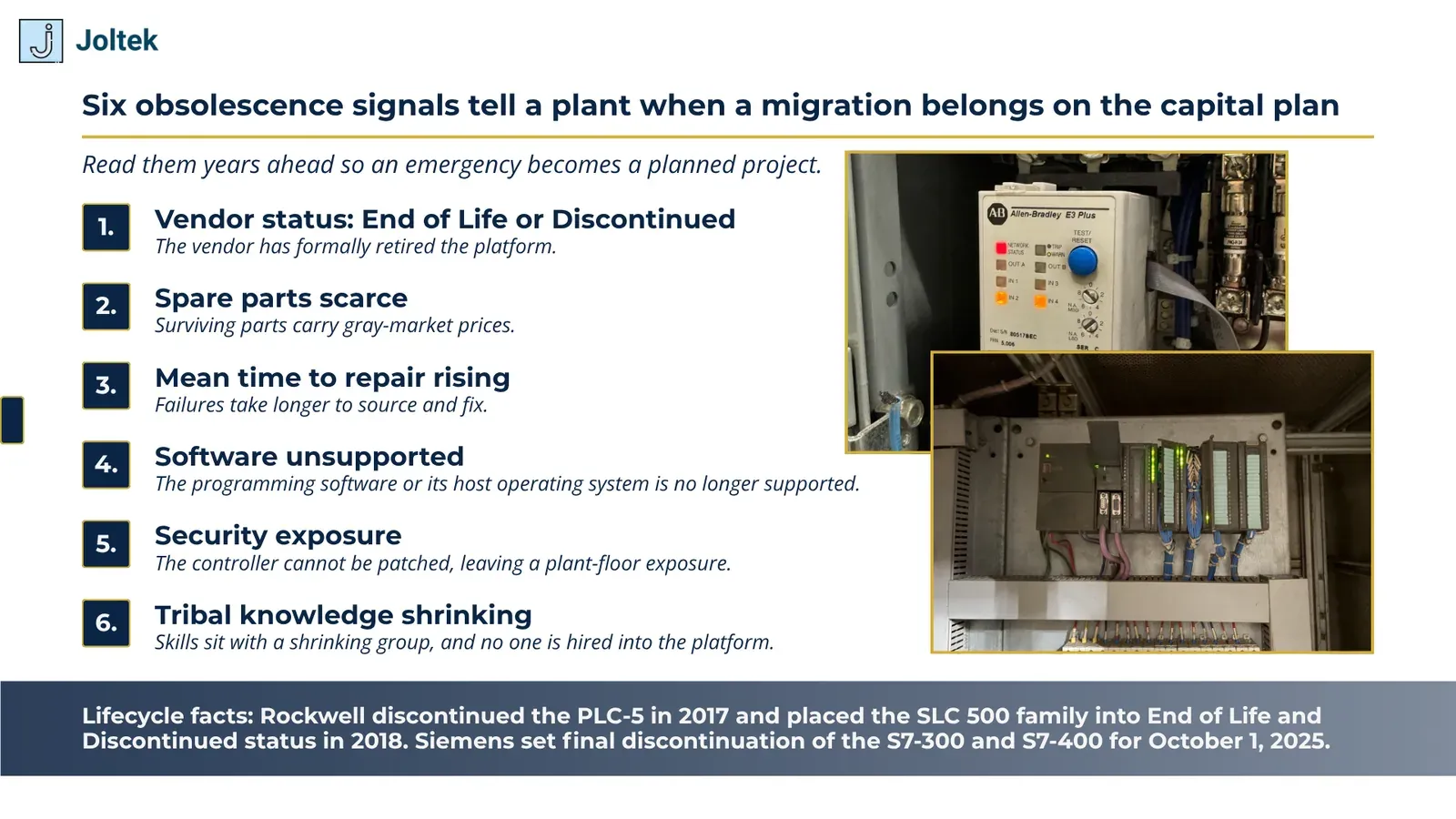
Six obsolescence signals tell a plant when a migration belongs on the capital plan
Like-for-Like vs Re-Architecture: The Central Fork
Every PLC platform migration resolves to one fork, and choosing that fork by default rather than deliberately is the most common planning mistake in the whole project. The two paths are like-for-like and re-architecture, and they buy different things at different prices.
A like-for-like migration maps the old platform to the new one as directly as possible. It preserves the control philosophy, converts the existing code, and reuses field wiring wherever adapters allow. The payoff is shorter downtime, lower engineering hours, and lower risk, because the process logic that the operators already trust carries forward. The cost is that the original design’s limitations come along for the ride. If the legacy program was a tangle of indirect addressing and undocumented interlocks, a like-for-like migration produces a faster tangle on supported hardware.
A re-architecture takes the migration as the chance to redesign the control and data structure. It standardizes code into reusable modules, moves to a current network, restructures tags, and often refreshes the HMI and historian at the same time. The cost is higher engineering hours and a longer schedule. The payoff is that legacy debt is removed and the design is set up for the next 15 years rather than the last 15.
The honest tradeoff: a like-for-like migration is the lower-risk, lower-cost path, and for a stable process that is meeting its targets, it is often the right one. Re-architecture earns its premium in three situations. The legacy design is itself the problem and is blocking reliability or throughput. The plant is standardizing across sites and wants one design to replicate. A data or analytics requirement, OEE reporting, batch genealogy, or a unified namespace feed, cannot be met on the old structure.
There is a trap worth naming. A like-for-like migration framed as “no functional change” still requires full validation, because the hardware, firmware, and scan timing change underneath identical-looking logic. “Same code” does not mean “same behavior” when the platform underneath is new.
The choice is also not all-or-nothing across a fleet. A plant can run a like-for-like migration on stable lines and re-architect the one line that blocks a business goal. The fork is decided line by line, not once for the whole program.
Vendor Lifecycle and Migration Paths
The two platforms a plant engineer is most likely to be migrating from are Allen-Bradley and Siemens, and both vendors publish a real path with real tooling. Knowing the specifics lets a manager talk credibly to integrators instead of taking their scope on faith.
On the Rockwell side, the PLC-5 and SLC 500 migrate to the Logix family. ControlLogix 1756 is the target for chassis-based applications, and CompactLogix 5380 is the target for compact DIN-rail applications, both programmed in Studio 5000 Logix Designer. Rockwell publishes automated code-conversion tools and 1771-to-1756 I/O wiring conversion systems that reuse existing field wiring rather than forcing a full rewire. Rockwell’s lifecycle runs through four phases, Active, Active Mature, End of Life, and Discontinued, and knowing which phase a platform sits in tells the reader how much runway is left. The vendor documents the path and tooling on Rockwell’s PLC-5 migration resources, and the controller-side lifecycle decisions are covered in depth in the Joltek Rockwell PLC lifecycle migration guide.
On the Siemens side, the S5 and S7-300/400 migrate to the S7-1500 family, programmed in TIA Portal. The TIA Portal migration tool converts most STEP 7 code, but the conversion is not free of manual work. S5-era timer and counter constructs and certain data types must be converted to IEC-compliant equivalents, and I/O and module mapping has to be validated rather than assumed automatic. Siemens documents the path and the caveats in its Siemens migration guide for S7-300/400 to S7-1500.
The neutral point holds for both. Each vendor provides a genuine migration path and genuine tooling, and each understates the manual rework that the conversion leaves behind. In practice the plant’s existing platform, its fleet standard, and the local integrator ecosystem decide the target more than a feature comparison does. A Rockwell-standardized plant migrates to Logix, a Siemens-standardized plant migrates to S7-1500, and the cross-vendor switch is a re-architecture decision, not a migration default.
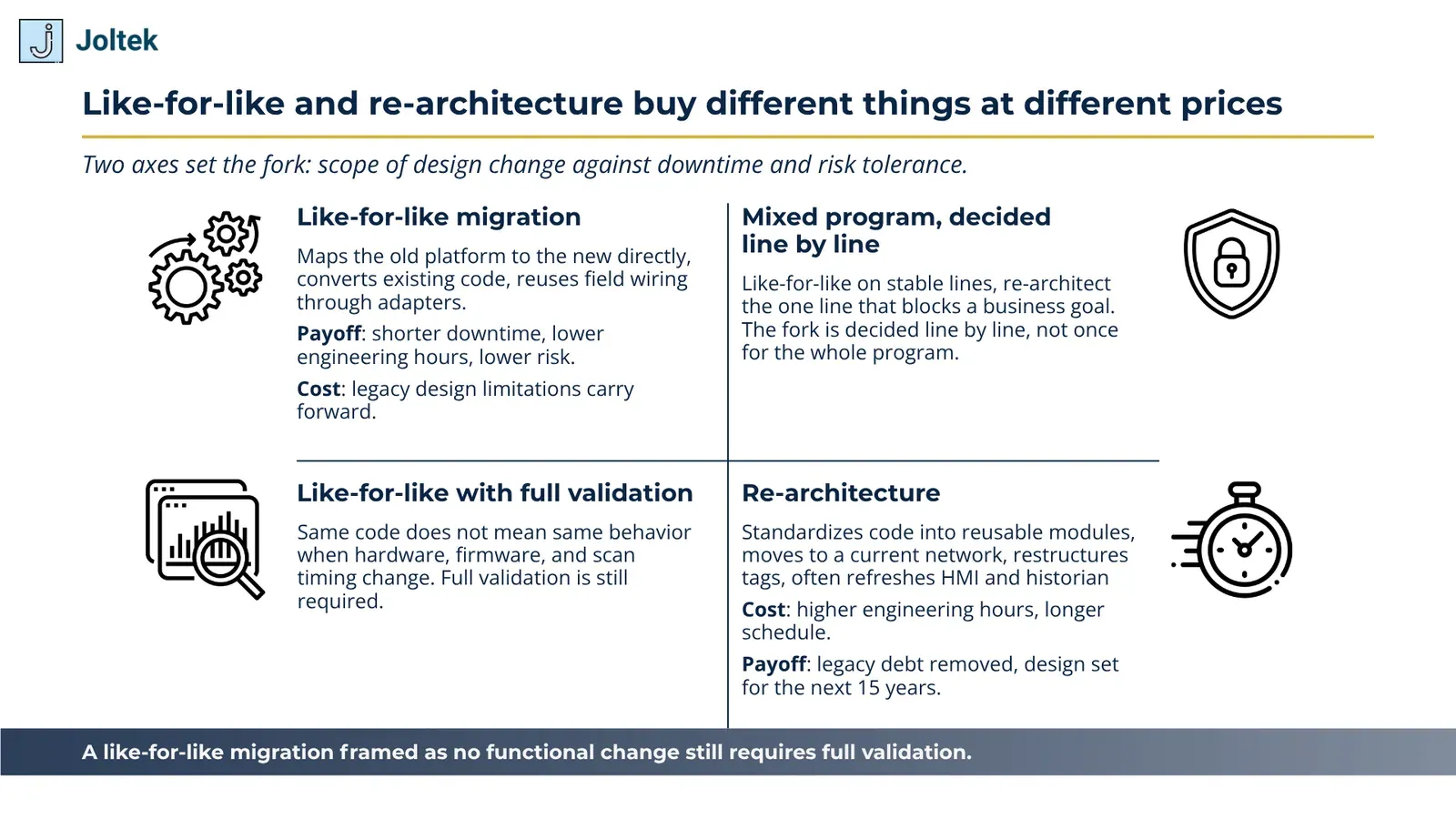
Like-for-like and re-architecture buy different things at different prices
Code Conversion Realities
Code conversion is the single most over-promised part of a PLC platform migration, and budgeting it honestly separates a project that lands on schedule from one that overruns by months. The marketing says the tool converts the program. The engineering says the tool produces a starting point.
The accuracy reality is well documented. Automated converters reach roughly 50 to 70 percent accuracy on simple logic, and teams should expect to manually rework 30 to 50 percent of the converted code before it is fit for production. Branch and rung reconstruction is the primary failure mode: the converter handles arithmetic and tag mapping well and stumbles on the branching structure that encodes the real control intent.
The reason is structural. IEC 61131-3 defines the language families, ladder, function block, structured text, instruction list, and sequential function charts, but legacy instruction sets, indirect addressing, and timer and counter idioms do not map one-to-one across platforms. Instruction-list-heavy and vendor-specific legacy code converts worst, because the constructs that made it efficient on the old platform have no clean equivalent on the new one.
The schedule expectation follows directly. Plan 1.5 to 2 times the original development time for a full migration that includes conversion, manual rework, and validation. Treating conversion as a one-click step is the most common budget miss in the entire project, and it is the miss that turns a planned shutdown into an extended one.
The practical method protects against it. Convert the program to produce a starting point, then run structured code review and functional workshops against the original program’s documented behavior, not against the converted code in isolation. The question is never “does the converted code match the conversion output.” It is “does the new program reproduce what the process actually did.”
One caveat: a clean, well-documented legacy program converts far better than an undocumented one. The conversion estimate depends on the quality of the input as much as on the tool, which is why the first hour of a migration is often spent recovering documentation that should have existed all along.
I/O, Field Wiring, and the Physical Cutover
The physical layer decides the downtime, and downtime decides whether the plant agrees to the project. Three mechanics drive it: I/O remapping, field-wiring reuse, and the cutover method.
The controller change forces an I/O addressing change. Every point that the old platform read or wrote has to be remapped to the new platform and then verified, and the verification is where the schedule goes. Point-to-point checks confirm that each physical input and output lands at the right address, and loop checks confirm that each signal travels the full path from field device to logic to actuator. On a line with several hundred points, this is the work that fills the shutdown window.
Field-wiring reuse is the largest downtime lever in a like-for-like migration. Vendor wiring-conversion systems, such as Rockwell’s 1771-to-1756 conversion with swing-arm and pre-wired interface module adapters, let the plant reuse existing field wiring instead of pulling and re-terminating hundreds of conductors. Reusing sound wiring can compress a multi-day cutover into a single shift, which is often the difference between a project the plant approves and one it refuses.
The cutover method sets the rest. A cold cutover takes the line down, swaps the platform, and recommissions, which is the simplest plan and the longest single outage. A phased cutover stages the new controller in parallel and moves I/O in groups, which trades a longer overall schedule for shorter production downtime. A rip-and-replace can require multiple days of shutdown; a phased plan can fit inside scheduled maintenance windows. The right method depends on how much downtime the process can absorb at once.
Contingency planning is not optional. Design fall-forward and fall-back plans before the shutdown, keep the legacy system recoverable until the new one is proven on product, and stage spares for the new platform before the cutover rather than after. The plant that cuts over with no path back is one defect away from an unplanned multi-day outage.
One caveat: field-wiring reuse assumes the existing wiring is sound. Aged, brittle, or undocumented wiring can erase the time savings and introduce faults that the cutover then has to chase. The wiring condition should be assessed before the plan commits to reuse, not discovered during the shutdown.
Validation, FAT, and Commissioning
Validation is the step that protects the production restart, and on a PLC platform migration it carries a specific risk: the assumption that converted code behaves identically to the original. Identical-looking logic on new hardware, new firmware, and a new scan rate can behave differently at the edges, and the edges are where the line stops.
A factory acceptance test runs the migrated program on the new platform with simulated or emulated I/O before the controller ever reaches the plant. Finding logic defects on the bench keeps them off the critical path, where every hour is a shutdown hour. The FAT is the cheapest place to catch a conversion error, and skipping it moves that catch to the most expensive place.
Site acceptance testing and commissioning happen on the floor. The team runs point-to-point and loop checks, verifies interlocks and safety functions, and confirms sequence behavior against documented acceptance criteria before the line carries product. Each check answers a question the operators will otherwise ask the hard way during the first production run.
The migration is also the moment to capture current, accurate documentation: as-built drawings, a verified I/O list, and a tested program. That documentation closes the tribal-knowledge gap that made the old platform risky in the first place, and it turns the next migration, years from now, into a far smaller job.
One caveat: validation effort scales with how much was re-architected. A like-for-like migration still needs full validation of the converted logic, but a re-architecture needs validation of new logic and new design intent both, which is part of the premium that path carries.
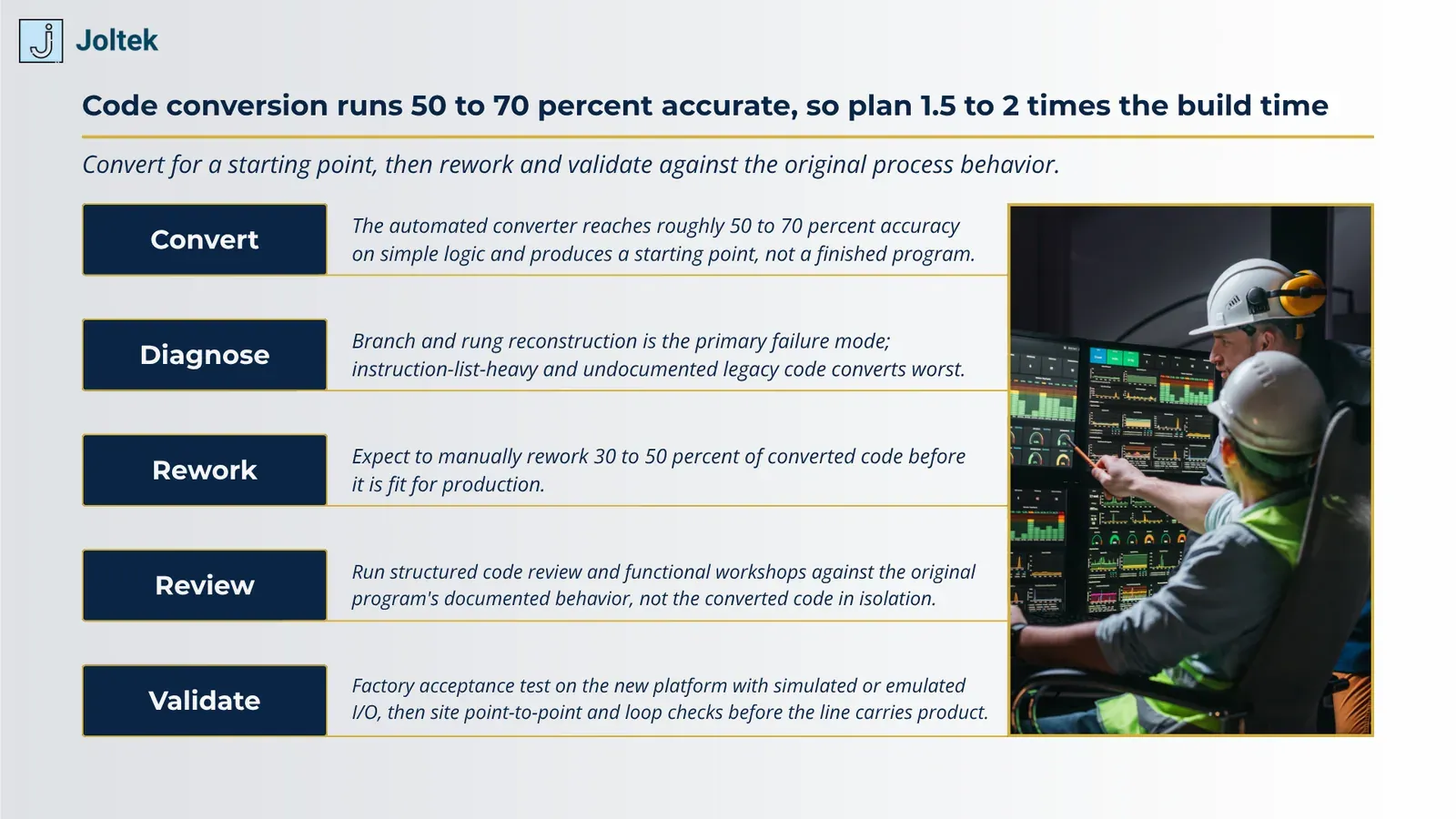
Code conversion runs 50 to 70 percent accurate, so plan 1.5 to 2 times the build time
Cost Framing and Fleet Sequencing
Cost is where a PLC platform migration becomes a capital decision, and the most useful thing a plant engineer can carry into that decision is a framework rather than a number. A migration has no single price because it is the sum of several components, and which components dominate depends on the path chosen.
The cost components are controller and I/O hardware, code conversion and the engineering hours to rework it, field-wiring conversion or replacement, HMI and SCADA updates, validation and commissioning, the cost of downtime itself, and spares for the new platform. A like-for-like migration concentrates cost in hardware and downtime. A re-architecture shifts cost toward engineering hours, because the savings on rushed downtime are spent instead on design and validation.
Treat published ranges as a negotiation tool, not a quote. A single-line like-for-like migration commonly lands in an order-of-magnitude planning range of roughly $150,000 to $400,000, depending on I/O count, code complexity, and downtime tolerance. That figure is a planning anchor for pricing a specific proposal, not a price. A multi-line or re-architecture program scales with engineering hours and validation rather than with hardware, so a fleet program is estimated bottom-up from scope, not multiplied from a single line. When a vendor or integrator quote arrives, the components above are the line items to interrogate.
The downtime-cost point belongs in management terms. The cost of an unplanned failure, lost production during an emergency cutover, usually exceeds the premium of doing the migration on a planned schedule. That comparison is the core of the migrate-now business case, and it is the number that moves a capital committee more than the hardware line ever will.
Sequencing a fleet is its own discipline, and no vendor page covers it because no vendor sells it. Rank sites by obsolescence risk and business criticality, then migrate the highest-risk, highest-criticality lines first. Standardize the target platform and the code modules on the first site so that later sites reuse the design instead of re-engineering it. Stage the capital across fiscal years so the program is fundable rather than a single unaffordable request. Done this way, a ten-site program funds the riskiest plant first, proves a repeatable design, and spreads the spend, which is exactly the logic the Joltek control system modernization strategy post develops into a capital plan.
Frequently Asked Questions
How much does a PLC platform migration cost?
Cost is set by I/O count, code complexity, whether the plant goes like-for-like or re-architects, and downtime tolerance, not by the controller price. A single-line like-for-like migration is an order-of-magnitude planning figure in the low-to-mid six figures, roughly $150,000 to $400,000, while a multi-line or re-architecture program scales with engineering hours and validation. These figures are a framework for pricing a specific proposal, not a quote.
How long does a PLC migration take?
Engineering and conversion run weeks to months depending on code volume and whether the plant goes like-for-like or re-architects. The on-site cutover can fit a single shutdown window for a phased migration or require multiple days for a rip-and-replace. Plan 1.5 to 2 times the original development time when full conversion and validation are included.
What is the difference between PLC migration and modernization?
Migration moves control logic and I/O from an obsolete platform to a current one while preserving the process function. Modernization is a migration plus a re-architecture of the control and data design. A like-for-like migration is the smaller, lower-risk subset of the broader modernization decision.
Can you convert PLC code automatically, and how accurate is it?
Vendor and third-party tools convert much of the code, but accuracy runs roughly 50 to 70 percent on simple logic, and teams should expect to manually rework 30 to 50 percent for production. Branch and rung reconstruction is the main failure mode, and instruction-list-heavy or undocumented legacy code converts worst. Treat conversion as a starting point that still needs review and validation.
Do you have to rewire field I/O during a migration?
Not always. Vendor wiring-conversion systems, such as Rockwell’s 1771-to-1756 conversion and pre-wired interface modules, let the plant reuse existing field wiring and avoid pulling hundreds of conductors, which is the biggest downtime saver in a like-for-like migration. Reuse assumes the existing wiring is sound, so an assessment should confirm its condition before the plan commits to it.
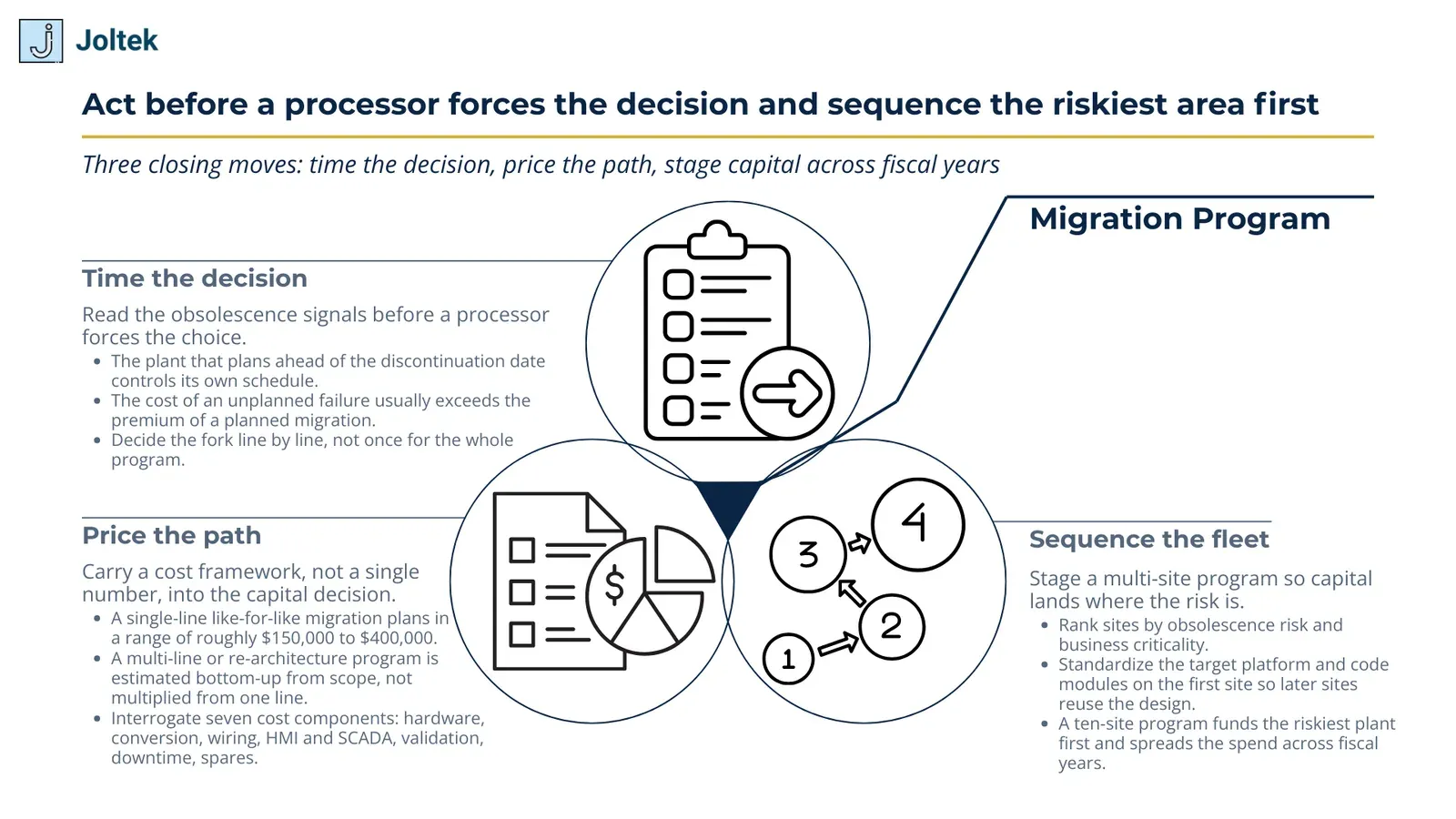
Act before a processor forces the decision and sequence the riskiest plant first
A PLC Platform Migration Is a Program to Govern, Not a Part to Swap
The plant engineer who controls the timing of a migration controls its cost. Read the obsolescence signals before a processor forces the decision. Choose between a like-for-like move and a re-architecture deliberately, line by line, with the tradeoffs named. Set honest expectations for code conversion and the validation it demands. Plan the cutover around the shutdown window the process can actually absorb. Sequence the fleet so capital lands on the riskiest plant first and the repeatable design follows.
That is the whole of a PLC platform migration: not a single swap, but a program with a decision at each layer. For the sequencing and capital logic that turns it into a fundable plan, the control system modernization strategy walks the same ground in more depth. And for an independent migration roadmap that ranks the risk, prices the paths, and sequences the spend, Joltek’s Systems Modernization and Risk Management service is built for exactly this question.