
Insights
Building Quality Into Manufacturing: How MES Powers Traceability and Compliance
MES traceability and compliance: in-process quality checks, forward and backward genealogy, non-conformance handling and Part 11 audit trails explained.
Table of contents
MES traceability means the Manufacturing Execution System records every material lot, machine, operator, process parameter and inspection result as the work happens, so any unit or batch can be traced back to its inputs and forward to its customers. Combined with in-process quality checks, structured non-conformance handling and audit trails with electronic signatures, it turns quality from an after-the-fact inspection into part of production, and it produces the records that auditors and regulators ask for.
Introduction: Why Quality and Traceability Are Non-Negotiable
In today’s manufacturing environment, quality failures aren’t just costly; they’re business-critical. A single recall can result in lost contracts, regulatory scrutiny, brand damage, or worse. In regulated industries like pharmaceuticals, medical devices, or food and beverage, even a minor compliance gap can trigger audits, fines, or product holds. But even outside those sectors, customers expect consistency, traceability, and confidence in every unit that leaves your facility.
That’s why quality and traceability aren’t just the responsibility of the quality department. They’re fundamental to your production system. And this is where MES proves its deeper value.
A well-implemented MES doesn’t wait for problems to surface after production. It catches them early, enforces standards as work is being done, and creates a digital trail of every action, inspection, and deviation. It connects quality checks directly to execution, ensures traceability at every step, and provides the documentation required to pass audits and resolve customer complaints with confidence.
This article explores the core MES features that support high-integrity manufacturing, from in-process quality control and product genealogy to non-conformance management and electronic records. Whether your facility is in a regulated space or not, the ability to build traceable, reliable processes at scale is no longer optional. It is a competitive necessity. For where MES sits in the wider plant architecture, see our overview of MES and batch systems.
The four capabilities this article covers each replace a paper habit. The table summarises the change before each is explained in detail.
| Capability | On paper | In an MES |
|---|---|---|
| In-process quality control | Inspections done when someone remembers; results on a clipboard, entered later if at all | Inspections prompted at the right step, results captured immediately, out-of-spec values alert at once and feed SPC |
| Traceability and genealogy | Lot numbers copied by hand between forms; a trace takes days of searching | Lots, equipment, operators and parameters linked automatically; a trace is a query |
| Non-conformance management | Paper NCR forms waiting in a tray for a supervisor signature | Non-conformance logged at the terminal, quality alerted, downstream steps locked until disposition |
| Audit trails and signatures | Handwritten initials, reconstructed history during an audit | Time-stamped record of every action, with authenticated electronic signatures where required |
In-Process Quality Control and SPC Integration
What It Is
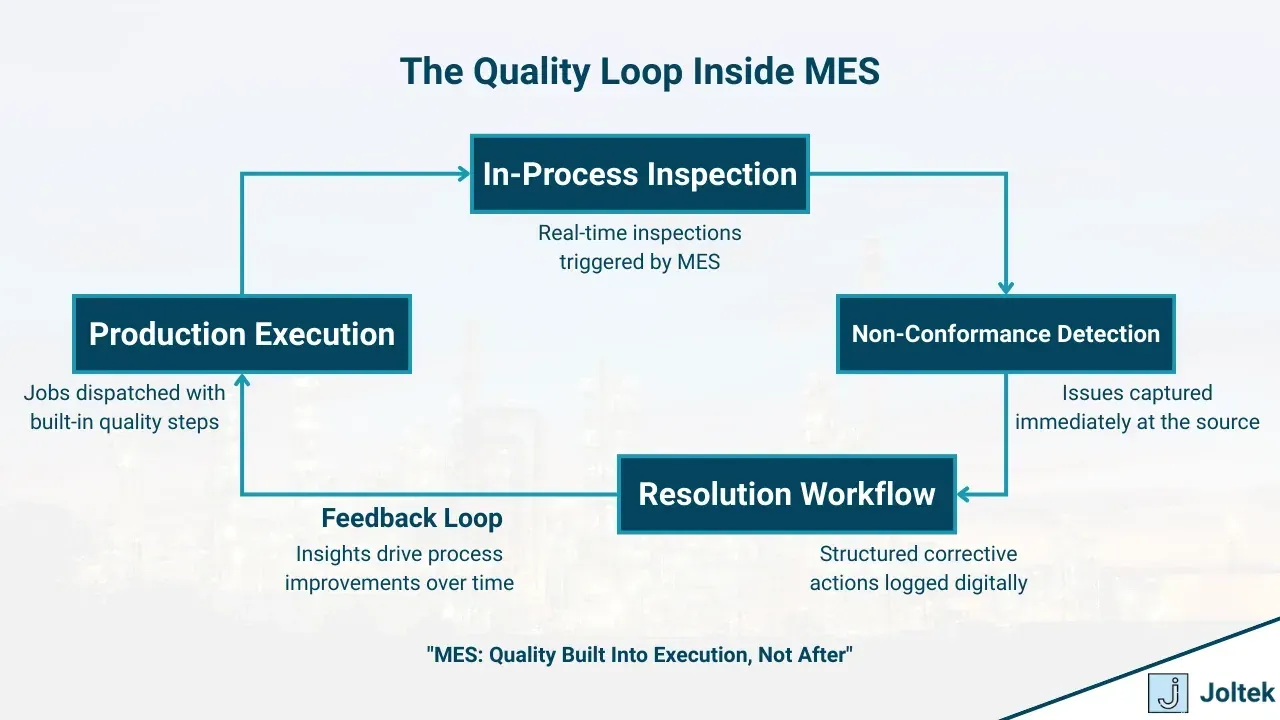
In-process quality control is one of the most valuable, yet often underutilized, capabilities of an MES. Rather than relying solely on end-of-line inspections to catch defects, MES embeds quality checks directly into production workflows. It ensures that inspections happen at the right time, on the right product, by the right person, with immediate capture of results.
When paired with Statistical Process Control (SPC) tools, MES doesn’t just detect defects. It monitors trends in real time to catch process variations before they result in scrap or rework.
How It Works
As a job progresses through the production line, MES prompts operators or automated systems to perform specific inspections based on part numbers, lot numbers, or process steps. This could include dimensional checks, visual inspections, torque measurements, or even inline sensor readings.
Each inspection point is digitally logged in the MES:
- Pass/fail results, measured values, and defect types are recorded.
- Results can trigger immediate alerts if out-of-spec conditions are detected.
- Data feeds SPC systems, enabling real-time control charting, trend analysis, and early warnings for process drift.
More advanced MES systems allow dynamic sampling plans: increasing inspection frequency when issues are detected, or tightening tolerances for critical lots.
Operational Impact
The operational impact of integrating in-process quality control into MES is significant. Problems are caught at the source, not downstream after value has been added. Scrap and rework are minimized, shift-to-shift variability is reduced, and customers experience fewer defects.
For regulated industries, this digital traceability is not just a best practice; it’s often a regulatory requirement. Automated prompts, required data entry, and locked workflows ensure that inspections aren’t skipped or completed out of sequence. That last point maps directly to Part 11, which calls for “operational system checks to enforce permitted sequencing of steps and events, as appropriate” (21 CFR 11.10(f)).
Beyond compliance, early detection leads to more stable processes, higher first-pass yields, and stronger continuous improvement efforts, because now you have the data to see where and when variation creeps in. That inspection data becomes part of the plant’s wider plant data layer, alongside historian and machine data.
MES Traceability and Product Genealogy
What It Is
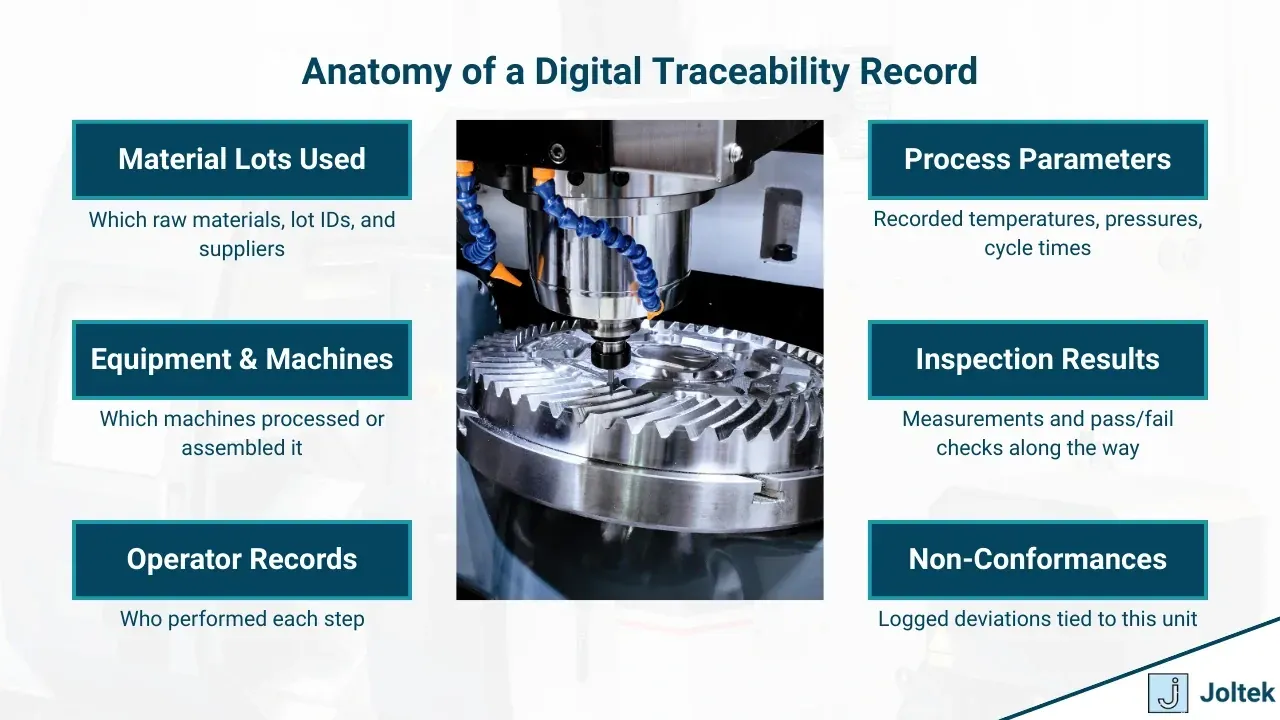
Traceability is the ability to track every product, lot, or batch throughout its entire production lifecycle: from raw materials and components, through processing, assembly, and final shipment. Product genealogy takes this a step further, creating a detailed digital history of everything that touched or influenced that product along the way: materials, machines, operators, process parameters, inspections, and environmental conditions.
In today’s manufacturing landscape, traceability is no longer a “nice-to-have”. It is essential for regulatory compliance, customer trust, and operational risk management.
How It Works
MES captures traceability data automatically as work is executed on the shop floor. As each unit moves through its route:
- Raw material lot numbers are linked to the finished product
- Machine IDs and operator badges are logged at each workstation
- Key process parameters (such as temperature, torque, cycle time) are recorded
- In-process inspection results and non-conformance events are tied to specific parts or batches
This information forms a complete, structured genealogy that can be queried instantly. If a defect is detected, a single click can reveal which batch it came from, what materials were used, what equipment was involved, and what process conditions existed at each step.
In more advanced implementations, MES integrates with ERP and warehouse systems to extend traceability upstream (to suppliers) and downstream (to customers). The ISA-95 standard describes that boundary: MES operates at the manufacturing operations level, between the control systems below it and the business planning and logistics systems above it. Getting the lot identifiers to match across that boundary is one of the first design decisions in any genealogy project. Plants that are adding genealogy as part of a broader upgrade usually sequence it inside a modernization roadmap, because it depends on scanning, controls and ERP work landing in the right order.
How MES Traceability Works During a Recall
A recall or a serious customer complaint tests the genealogy in a fixed order:
- Start from the evidence. The investigation begins with a finished lot or serial number: the one the customer returned, the one that failed a release test, or the one a regulator asked about.
- Trace backward to the cause. The MES lists every input lot, the work order or batch, the equipment, the operators and the process conditions recorded for that lot. Quality looks for the common factor: a supplier lot, a machine, a shift, a parameter out of its normal range.
- Trace forward to the exposure. Once the suspect input or condition is known, the MES lists every other work order that consumed it, every finished lot those orders produced, and, through ERP or warehouse integration, every shipment and customer.
- Contain. Lots still on site are placed on hold in the MES so they cannot be consumed or shipped while the investigation continues.
- Document. The trace itself, the holds and the decisions become part of the record, with the audit trail showing who did what and when.
Food manufacturers face a regulatory version of this exercise. Under the FDA’s Food Traceability Rule, firms handling foods on the Food Traceability List must keep key data elements for defined critical tracking events, assign a new traceability lot code when they transform a food, link it to the input lot codes, and produce the records within 24 hours of an FDA request. As of October 2026, FDA states that Congress has directed it not to enforce the rule before July 20, 2028. An MES that already links input lots to output lots does most of that work as a by-product of production.
Operational Impact
The benefits of real-time, digital traceability are immediate and far-reaching.
In the event of a quality issue, manufacturers can isolate affected lots in hours instead of days, reducing recall costs, protecting brand reputation, and minimizing disruption. Instead of pulling all units from a month’s production, you can surgically target only the products at risk.
Even without a crisis, traceability provides everyday operational value. It supports warranty claims, strengthens supplier accountability, improves root cause analysis, and satisfies even the most demanding customer or regulatory audits.
For manufacturers in industries like automotive, aerospace, electronics, and pharmaceuticals, the absence of dependable traceability is not just a vulnerability; it’s a potential showstopper. MES makes traceability a byproduct of execution, not an afterthought.
Where MES Traceability Breaks
Genealogy fails in predictable places. Knowing them is the fastest way to judge whether an existing system would survive a real trace:
- Consumption is assumed, not recorded. When material use is back-calculated from the bill of materials instead of scanned at the point of use, the genealogy shows what should have been used, not what was.
- Bulk and continuous transfers. Silos, tanks and hoppers mix lots. Unless the system models what was in the vessel and when, the link from input lot to output lot becomes an estimate.
- Rework and partial lots. Material that is reworked, split or blended back into production needs its own transactions, or it disappears from the genealogy.
- Lot identifiers that do not match across systems. If ERP, MES and the warehouse each use their own lot numbering, a forward trace stops at the system boundary.
- Shared logins. A generic operator account records that “someone” acted. Part 11 requires that each electronic signature be unique to one individual and not reused by or reassigned to anyone else (21 CFR 11.100(a)).
- Manual overrides without a reason. An override that bypasses a hold or a check, without a recorded reason and approver, leaves a gap exactly where an auditor will look.
Non-Conformance Management and Exception Handling
What It Is
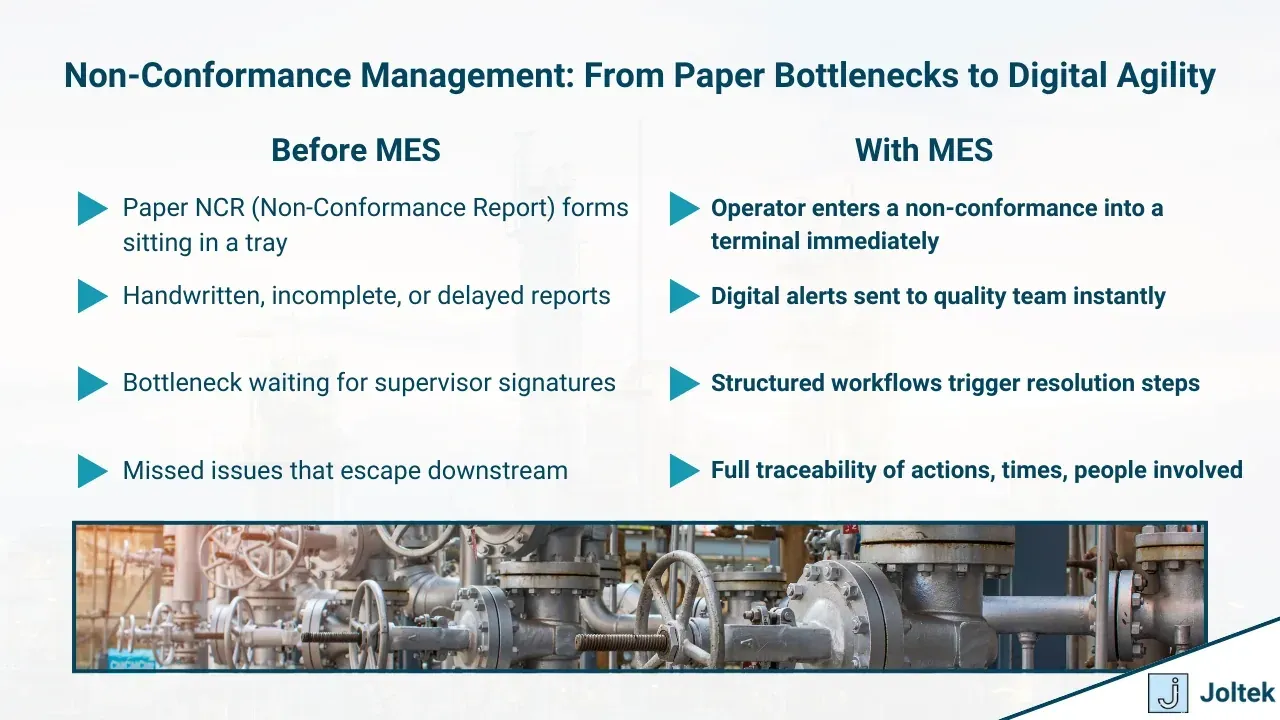
Even in the best-run factories, deviations from standard processes happen. Materials fall out of spec, equipment drifts, operators encounter unexpected conditions. Non-conformance management is the MES capability that brings structure to how these deviations are identified, recorded, escalated, and resolved.
Rather than relying on paper forms, ad-hoc emails, or delayed reporting, MES builds non-conformance detection and handling directly into the production workflow, ensuring that every issue is captured immediately and managed systematically.
How It Works
When a defect is detected or a process condition falls outside of acceptable limits, MES can automatically or manually trigger a non-conformance event. The system captures:
- The nature of the issue (e.g., out-of-spec measurement, failed inspection, missing material)
- The part, lot, or work order affected
- The responsible station, machine, or operator
- Time and context of the event
MES can then enforce preconfigured workflows, such as:
- Requiring supervisor review before proceeding
- Locking downstream processes until disposition is decided (e.g., rework, scrap, quarantine)
- Escalating high-severity issues to quality or engineering teams
- Linking corrective actions, re-inspections, or deviation approvals
All actions are digitally logged with timestamps, user IDs, and audit trails, ensuring full traceability for future analysis or compliance needs.
Operational Impact
The operational benefits of embedding non-conformance management into MES are significant.
First, it ensures that no issue slips through the cracks. Problems are addressed at the source, before they flow downstream into larger batches, final products, or, worse, customer shipments. This reduces the cost of poor quality (COPQ), protects brand reputation, and accelerates root cause resolution.
Second, structured non-conformance data becomes one of the most useful inputs to continuous improvement. Patterns emerge: recurring material defects from a supplier, repeated operator errors at a certain station, specific machines that trend toward failures. Instead of reacting to problems, manufacturers can proactively eliminate their root causes.
Finally, in highly regulated industries, electronic non-conformance records are essential for demonstrating compliance with standards such as ISO 9001, AS9100, or GMP guidelines. MES ensures that every deviation is documented, traceable, and part of a closed-loop quality system.
Audit Trails and Electronic Signatures
What It Is
In industries where compliance is non-negotiable, proving that the right actions were taken, by the right people, at the right time, is just as important as the actions themselves. Audit trails and electronic signatures are MES capabilities designed to create that proof automatically. They provide a secure, tamper-evident record of every interaction with the system, turning execution into defensible evidence for regulators, auditors, customers, and internal stakeholders.
Electronic signatures go a step further, enabling authenticated digital approvals that meet strict regulatory standards like FDA 21 CFR Part 11 for pharmaceuticals and medical devices.
How It Works
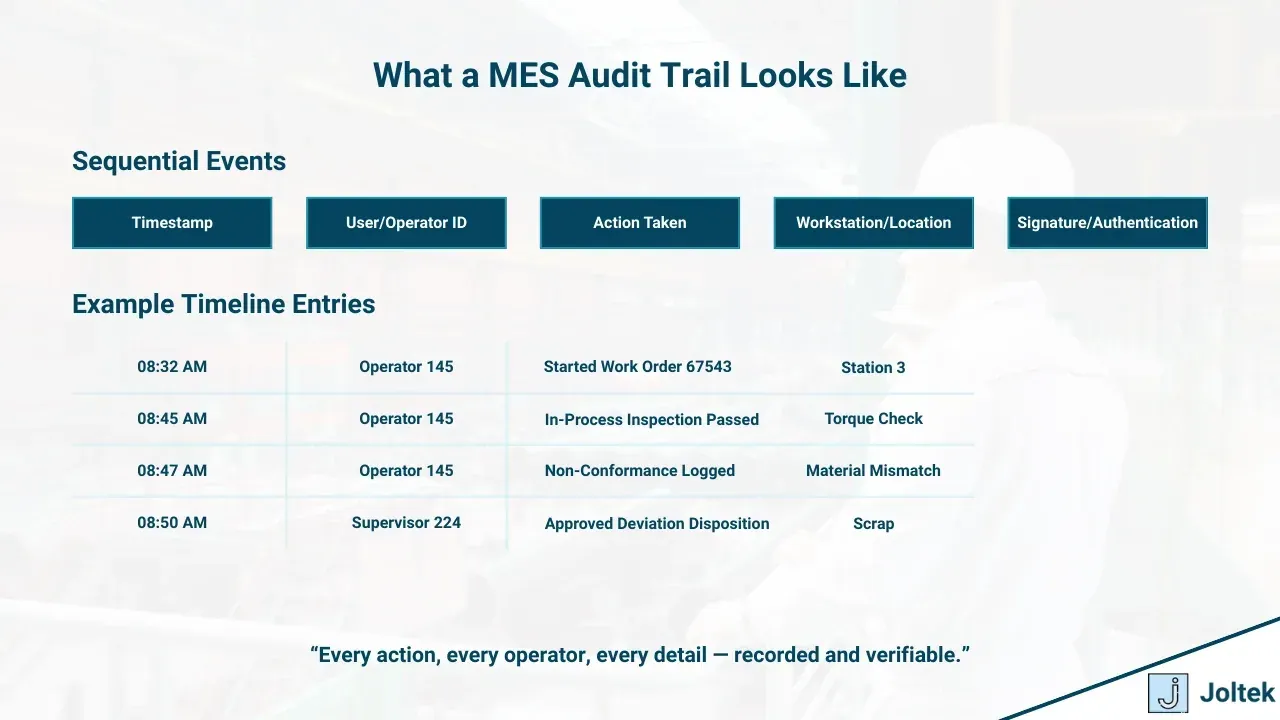
Every meaningful action performed through MES (starting a job, completing a quality inspection, logging a non-conformance, or changing a recipe) is automatically recorded with:
- Who performed the action (linked to a user account or operator badge)
- What action was taken
- When it occurred (with an exact timestamp)
- Where it happened (station, machine, device)
For critical actions, the system may require an electronic signature: a digital credential (password, badge scan, biometric input) confirming the identity of the person performing or approving the step. In regulated environments, electronic signatures are often paired with a reason for change or action, adding further context to the record. Under 21 CFR 11.50, a signed electronic record must show the printed name of the signer, the date and time of signing, and the meaning of the signature, such as review, approval, responsibility or authorship.
All of this information is stored securely and made easily searchable, creating a complete and tamper-evident execution history.
What Each Regulation Expects From the Records
The requirements differ by industry and region, but they ask similar questions of an electronic record. The table summarises the rules most MES projects meet, in their own terms.
| Rule | Applies to | What it expects of electronic records | MES features that answer it |
|---|---|---|---|
| 21 CFR Part 11 (FDA) | FDA-required records kept electronically in place of paper, or relied on for regulated activities | Validation; secure, computer-generated, time-stamped audit trails of entries and actions that create, modify or delete records (11.10(e)); operational sequence checks (11.10(f)); authority checks (11.10(g)); signatures showing name, date and time, and meaning (11.50); signatures unique to one person (11.100(a)) | Audit trail, enforced workflows, role-based access, electronic signatures with meaning |
| EU GMP Annex 11 (European Commission) | Computerised systems used in GMP-regulated activities for medicinal products | Risk-based audit trail of GMP-relevant changes and deletions with the reason documented, regularly reviewed; electronic signatures with the same impact as handwritten ones, permanently linked to the record, with time and date | Audit trail with reason for change and review reports; signature binding |
| FSMA Food Traceability Rule (FDA, 21 CFR Part 1 Subpart S) | Firms that manufacture, process, pack or hold foods on the Food Traceability List | Key data elements for critical tracking events; a new traceability lot code at transformation, linked to input lots; records to FDA within 24 hours, for most firms as an electronic sortable spreadsheet; kept for two years. These records are exempt from Part 11 | Lot genealogy, lot code assignment, exportable trace reports |
FDA’s guidance on the scope and application of Part 11 matters here: the agency interprets Part 11 narrowly and has said it intends to exercise enforcement discretion on some provisions, including validation and audit trails, while the underlying predicate rules (for example the drug and device manufacturing regulations) remain fully enforceable. In practice, regulated manufacturers still validate MES and keep audit trails, using the risk-based approach of ISPE GAMP 5 to decide how much testing each function needs. The same audit-trail questions apply to the automation layer below MES; our independent overview of audit trails for 21 CFR Part 11 in automation change management covers how they are handled for PLC and device projects.
What an Auditor Asks For
An inspection or customer audit tends to follow the same path through an MES, and each request maps to a capability described above:
- “Show me the record for this batch, and every change made to it.” The auditor expects the audit trail to show original values, changed values, who changed them, when, and why.
- “Who signed this, and what did the signature mean?” A signature that does not show the name, date and time, and meaning will draw a finding.
- “How do you know only authorised people can do this?” Role definitions, user lists, and evidence that accounts are personal and reviewed.
- “How do you know the system works as intended?” Validation documents scaled to the risk of each function.
- “When did you last review the audit trail?” Annex 11 expects audit trails to be regularly reviewed, so a report nobody reads is a gap.
- “Trace this lot.” A live forward and backward trace, run in front of the auditor, is the quickest way to show the genealogy is real.
Operational Impact
Well-designed audit trails and electronic signatures transform compliance from a painful, manual exercise into a built-in strength.
Instead of scrambling to reconstruct actions during audits or investigations, manufacturers with strong MES records can simply pull verified reports, demonstrating not only what happened, but also who authorized it and why. This greatly reduces audit preparation time, avoids costly documentation errors, and increases confidence during inspections.
Moreover, audit trails aren’t just for regulators. They help internal teams quickly investigate issues, understand workflows, and improve processes. Having transparent, trusted execution data supports faster root cause analysis, better training, and stronger operational discipline.
In a world where supply chains are under scrutiny and regulatory standards are rising, MES audit trails and electronic signatures are not only about compliance. They are how a plant’s operational technology earns resilience and customer trust.
Frequently Asked Questions About MES Traceability and Compliance
What is MES traceability?
MES traceability is the ability of a Manufacturing Execution System to record, as work is executed, which material lots, equipment, operators, process parameters and inspection results went into each unit, batch or lot. The result is a product genealogy that can be queried in both directions: backward from a finished lot to its inputs, and forward from a suspect input to every lot and shipment it reached.
What is the difference between forward and backward traceability?
Backward traceability starts from a finished product, often after a complaint or failed test, and finds everything that made it: material lots, suppliers, machines, operators and process conditions. Forward traceability starts from a suspect input, such as a supplier lot or a drifting machine, and finds every product and shipment it affected. A recall usually needs both, run one after the other.
Does an MES need to comply with 21 CFR Part 11?
Part 11 applies when FDA-required records are kept electronically instead of on paper, or when electronic records are relied on to perform regulated activities. An MES that holds batch records or quality records for a pharmaceutical or medical device manufacturer usually falls in scope. Compliance depends on configuration and procedures as well as the software: validation, audit trails, access controls and signature controls must all be in place.
What does an audit trail in MES record?
A Part 11 audit trail is secure, computer-generated and time-stamped, and independently records the date and time of operator entries and actions that create, modify or delete electronic records. In practice an MES audit trail captures who acted, what they did, when, at which station, and the old and new values, plus a reason for change where procedures require one.
How does MES support a product recall?
During a recall, the MES genealogy narrows the scope. A backward trace identifies the root input or process condition, a forward trace lists every lot and shipment that contains it, and quality records show which lots were inspected or quarantined. Instead of pulling all product from a period of production, the manufacturer can target only the lots at risk and give regulators and customers a documented trace.
Conclusion: MES as the Digital Backbone of Quality
In manufacturing, quality is no longer a department; it’s a system. It’s a set of practices and controls that must be embedded into every step of production, from material receipt to final shipment. Manufacturing Execution Systems (MES) provide the digital backbone that makes this possible. A plant systems assessment is a practical way to find where quality and traceability data still live outside that backbone.
By integrating quality checks into daily operations, enforcing real-time traceability, structuring non-conformance handling, and maintaining tamper-evident audit trails, MES transforms quality from a reactive exercise into a proactive, continuous process. It ensures that problems are caught early, deviations are documented and resolved systematically, and every product carries with it a verifiable, trustworthy history.
For manufacturers competing in regulated industries, MES isn’t optional; it’s a necessity for survival. But even outside strict compliance environments, the ability to detect issues early, prove process integrity, and build traceability into the flow of work is a lasting competitive advantage. Our guide to manufacturing execution systems covers what an MES does, what it costs and how to start a project that delivers, and when the decision is which system to buy, our MES selection service runs the requirements and vendor evaluation independently of any vendor.
As you look at your own operations, ask yourself: is your quality system truly integrated with your production processes? Or is it still riding alongside, disconnected and delayed?
In future articles, we’ll continue exploring how MES supports broader manufacturing excellence, from downtime reduction to inventory control and production scheduling. But wherever you are in your journey, remember this: building a culture of quality starts with building a system that enforces and elevates it. MES is that system.
References and further reading
- 21 CFR Part 11: Electronic Records; Electronic Signatures · Electronic Code of Federal RegulationsThe regulation itself: audit trails (11.10(e)), authority checks (11.10(g)) and signature manifestations (11.50).
- Part 11, Electronic Records; Electronic Signatures: Scope and Application, Guidance for Industry · U.S. Food and Drug AdministrationHow FDA interprets the scope of Part 11 and where predicate rules still govern.
- EudraLex Volume 4, Annex 11: Computerised Systems · European CommissionThe EU GMP expectations for audit trails and electronic signatures.
- ISPE GAMP 5: A Risk-Based Approach to Compliant GxP Computerized Systems (Second Edition) · ISPE
- FSMA Final Rule on Requirements for Additional Traceability Records for Certain Foods · U.S. Food and Drug AdministrationLot-level traceability records for foods on the Food Traceability List.
- ISA-95 Standard: Enterprise-Control System Integration · International Society of Automation (ISA)Where MES sits between control systems and ERP, and the vocabulary for the interface.