
Engineering and Integration
Commissioning Support for Automated Lines
From the day the crates arrive to the day the line runs at rate, with nothing left open that your team cannot close.
Bringing new machinery into a running plant is harder than buying it. Joltek provides commissioning support for automated lines: controls commissioning, SAT support and startup support for new equipment, from pre-commissioning readiness through an OEM line startup and ramp-up to rate, to a handover your operators and maintenance team can actually run.
Proof. Before founding Joltek, Vladimir Romanov led the controls and information systems commissioning of three production lines at the P&G plant in Auburn, Maine, each a capital investment of more than $20,000,000. The commissioning ran for nearly three months across day and night shifts, through installation, operational and performance qualification, and the third line was recognized as the fastest line turnaround in the plant’s history (case study). At Joltek, we stabilized an OEM converting line where three Omron spoolers fed a Rockwell cartoner with no direct network path between them: we deployed drive current telemetry with zero production stops, connected the controllers across two address translation boundaries and built downstream-aware speed control. The site reported its best line OEE in six months, and the engagement was extended from two weeks to three months (case study).
For the background, see our guide to the challenges of bringing new machinery into a plant, our owner’s engineer service for FAT witness and integrator oversight, and OEE and downtime improvement for the losses that remain once the line is running.
Why it matters
What this costs when it is left alone
The reasons this work gets deferred are usually the reasons it gets expensive.
The machine passed FAT. The line has not.
A machine that ran well on the builder's floor still has to connect to your power, your network, your upstream and downstream equipment and your operators. Most startup delays live in those connections, not in the machine.
Commissioning is where scope hides
Undocumented I/O, interlocks nobody agreed on and handshakes with existing equipment that were never specified all surface at startup, when the schedule has no slack left to absorb them.
Running is not the same as running at rate
A line that makes good product at half speed on handover day can stay there for months. Ramp-up needs the same discipline as the installation, with losses measured and closed one by one.
The OEM leaves after startup
Once the builder's technicians fly home, every fault, parameter and program change belongs to your team. If they cannot read the code or find the documentation, the support cost has only moved.
Our approach
How the work runs
We work on site with your team, the OEM and your integrator to get new equipment from installed to running at rate. The work follows the same four stages on every startup, sized to what you are bringing in.
Prepare before power-on
- I/O checkout and loop testing against the drawings, point by point
- Network addressing, switch configuration and connections to plant systems verified
- Safety circuits, guarding interlocks and emergency stops validated before any motion
Integrate into the line
- Handshakes with upstream and downstream equipment defined, built and tested
- OEM controls connected to plant networks, SCADA and data collection
- Mixed platforms bridged where the OEM standard differs from the plant's
Start up and ramp to rate
- SAT run against the agreed acceptance criteria, with results recorded
- Punch list tracked to closure, each item owned and retested
- Losses measured during ramp-up and worked down until the line holds rate
Hand over and stay close
- As-built drawings, source projects, backups and parameter records collected
- Operator and maintenance training on the actual machine
- Hypercare support through the first weeks of production
A system we have commissioned
Inside a peanut butter batching room
Before founding Joltek, Vladimir Romanov commissioned a peanut butter batching system. This model rebuilds the kind of room that system lives in, so you can see what is being brought to life and what commissioning it involves.
Roasted, blanched peanuts arrive from the roaster room on an inclined cleated belt and drop into a surge hopper watched by a high level switch. A rotary feeder meters them into the mill, which grinds them into paste at around 70 °C. An inclined screw conveyor lifts the paste into T-200, a jacketed batch tank sitting on four load cells.
Around the tank, the dry ingredients (sugar, salt, cocoa) come from bag dump hoppers on their own load cells, through screw feeders and slide gates. The liquids (melted stabilizer, molasses, honey) come from heated day tanks, through gear pumps, Coriolis mass flowmeters and on/off valves at the tank. A radar level transmitter, high-high and low level switches and a temperature element watch the tank, and the hot water jacket holds the batch warm so the stabilizer stays liquid. When a batch is mixed and released by QA, a rotary lobe pump sends it on to deaeration, cooling and filling.
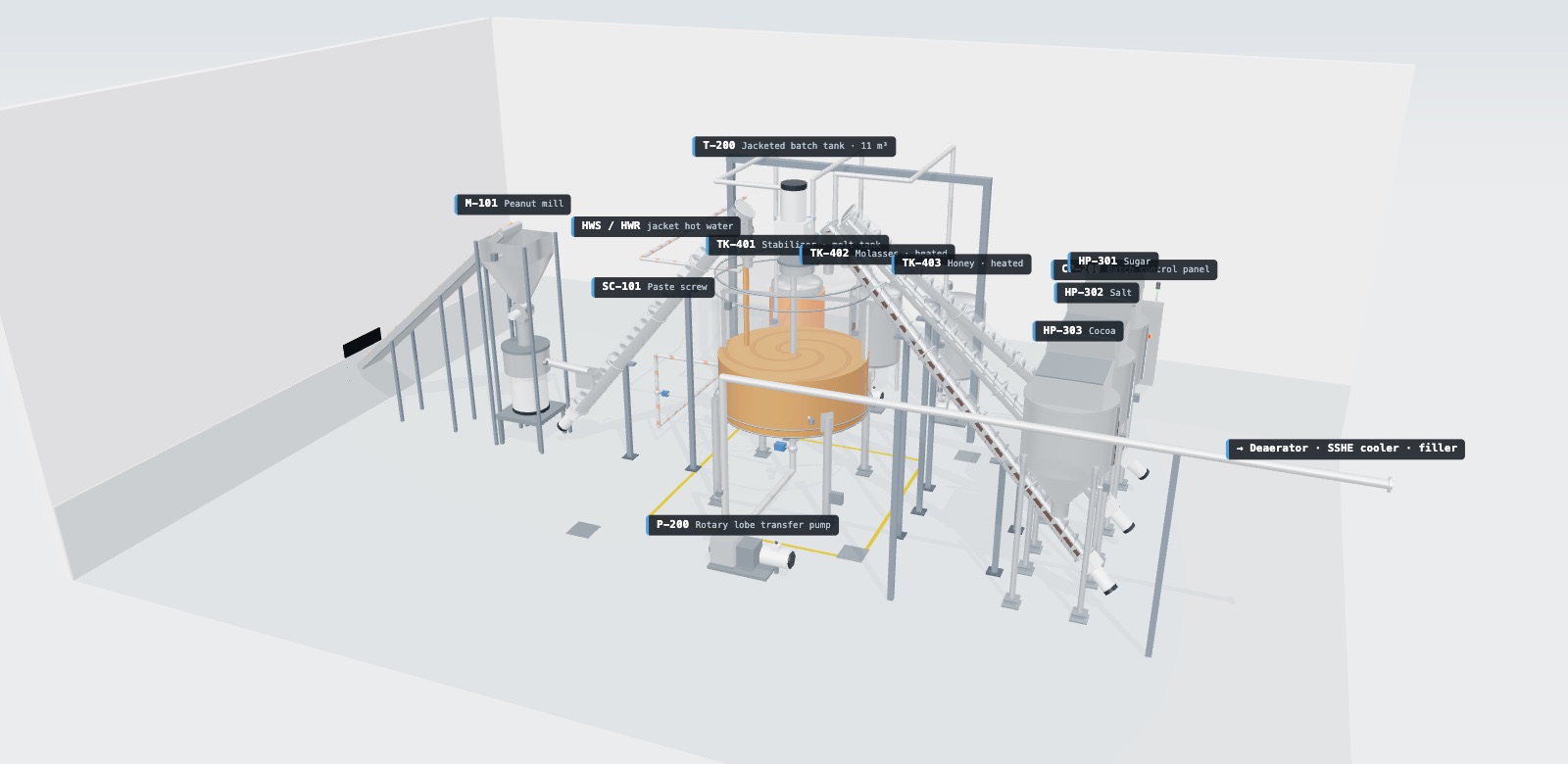
Simulated environment. This is an illustrative 3D model generated with AI to show the type of system and the commissioning steps involved. It is not a representation of the actual grind room: the layout, equipment, recipes and rates are generic, and some details are deliberately simplified.
Commissioning a room like this is far more than switching it on. Every load cell is calibrated with test weights before a recipe is allowed to trust it, and every flowmeter is checked against the scale. Every valve is stroked and every interlock is proven: the high-high level switch stops every feed, and the bottom valve cannot open while an ingredient is charging. Then the batch sequence runs test batches until fast feed, dribble and in-flight compensation land each ingredient inside its tolerance, and the temperature loop holds the product where it needs to be. Sanitation, operator training and the handover documentation close it out.
In the model, the example batches charge, mix, hold for a QA sample and transfer on their own. Use Show batch panels to watch each ingredient land against its target, or start, hold and abort a batch yourself. It is the same discipline we bring to every line we commission, and to owner's engineer oversight when an integrator is doing the work.
What we deliver
What you end up holding
- Pre-commissioning readiness checklist covering I/O, network and safety
- Integration specification for handshakes with existing equipment
- SAT protocol, results record and signed acceptance
- Punch list with owners, status and retest evidence
- Handover package with as-builts, source, backups and parameter records
- Training sessions for operators and maintenance, with reference material
Who we support
Who this is for
- Plant engineering and maintenance teams
- bringing in new machinery or an OEM line on top of their day jobs, who need experienced hands on site for the weeks it takes to start up.
- Operations and plant leaders
- who are measured on output from day one and need the new line at rate, not just installed.
- Project and capital managers
- who own the startup schedule and need someone to hold the OEM, the integrator and the punch list to a single standard.
Why Joltek
What you are actually buying
We have run startups around the clock
Our approach comes from commissioning production lines on day and night shifts under fixed deadlines, not from a checklist written at a desk.
Comfortable across platforms
OEM equipment rarely matches the plant standard. We work on Rockwell, Siemens and Omron control and bridge them when the line needs them to talk.
Handover is part of the job
We measure a startup by whether your team can run and support the line after we leave, so documentation and training are scoped from the first day.
Questions
Answered before you ask
What does commissioning support include?
Controls commissioning support covers the work between mechanical installation and steady production: I/O checkout, network and safety verification, integration with existing equipment, the SAT, ramp-up to rate, punch list closure, handover documentation, training and support through the first weeks of production.
Do you also witness the FAT at the machine builder?
Yes, through our owner's engineer service. A strong FAT is the best preparation for a fast startup, so on many projects we attend both and carry the FAT punch list straight into commissioning.
Can you integrate an OEM machine that runs on a different PLC platform from ours?
Yes. It is one of the most common startup problems. We have connected Omron OEM machines to a Rockwell line across separate machine networks, and the same approach applies to Siemens and other platforms. The key is defining the handshake and the fault behaviour before anyone writes code.
Can you work with the OEM and our integrator on site?
Yes. We do not take over their scope. We coordinate the startup on your behalf, keep one punch list for everyone, and step in hands-on where a problem sits between two suppliers and neither owns it.
How long do you stay after startup?
As long as the line needs. Hypercare usually runs through the first weeks of production, on site at first and then remotely, until the punch list is closed and your team is handling faults on its own.
Do you travel to plants in the United States?
Yes. Joltek is based in Laval, in the Montréal area, and supports startups at plants across Canada and the United States.
Have a project that needs technical ownership?
Send us the situation. If it is not something we should take on, we will say so.