
The Plant-Side Brief · Issue 001
Unsupported Windows on the plant floor: why it is still there, and what it exposes
The Windows PCs under HMIs, SCADA servers and engineering workstations are often the oldest and least managed part of a plant's control systems. Why plants keep them, what they expose, and how to fund the fix.
Table of contents
The Brief
The Windows PCs that run operator screens, SCADA servers and engineering workstations are often the oldest and least managed part of a plant’s control systems, and many stopped receiving security fixes years ago. This issue explains why plants end up there, why it is more urgent this winter, what an unsupported PC exposes, and how to put every one on a funded path.
This week in 60 seconds
- Industry News: Microsoft fixed 1,094 vulnerabilities in one release, one already exploited; a critical Siemens Industrial Edge flaw has no complete fix yet; NIST’s draft OT guide closes for comment November 30; Mars commits $1,400,000,000 to US operations, and manufacturing added jobs in October.
- Deep Dive: equipment outlives its operating system, so plants still run Windows XP and older, while Microsoft fixed more than a thousand flaws in each of the last two months that those PCs never receive. Three paths for every PC: bridge, replace or rethink.
- Field Kit: five checks for every plant-floor PC.
- Lifecycle Watch: Windows Server 2016 and Windows 10 Enterprise LTSC 2021 lose free fixes January 12, and Schneider Electric’s own pages disagree on when Modicon Quantum service ends.
- Financials: Honeywell’s first standalone quarter, with process automation projects up 14%.
Industry News
What moved, and what it means for your plants
Nov 10: Microsoft fixed 1,094 vulnerabilities in one release, and one was already being exploited.
November’s security release fixed 1,094 vulnerabilities across Microsoft’s products, 63 of them rated critical, including an Outlook flaw that leaks hashed credentials and was being exploited before the fix shipped (CSO Online).
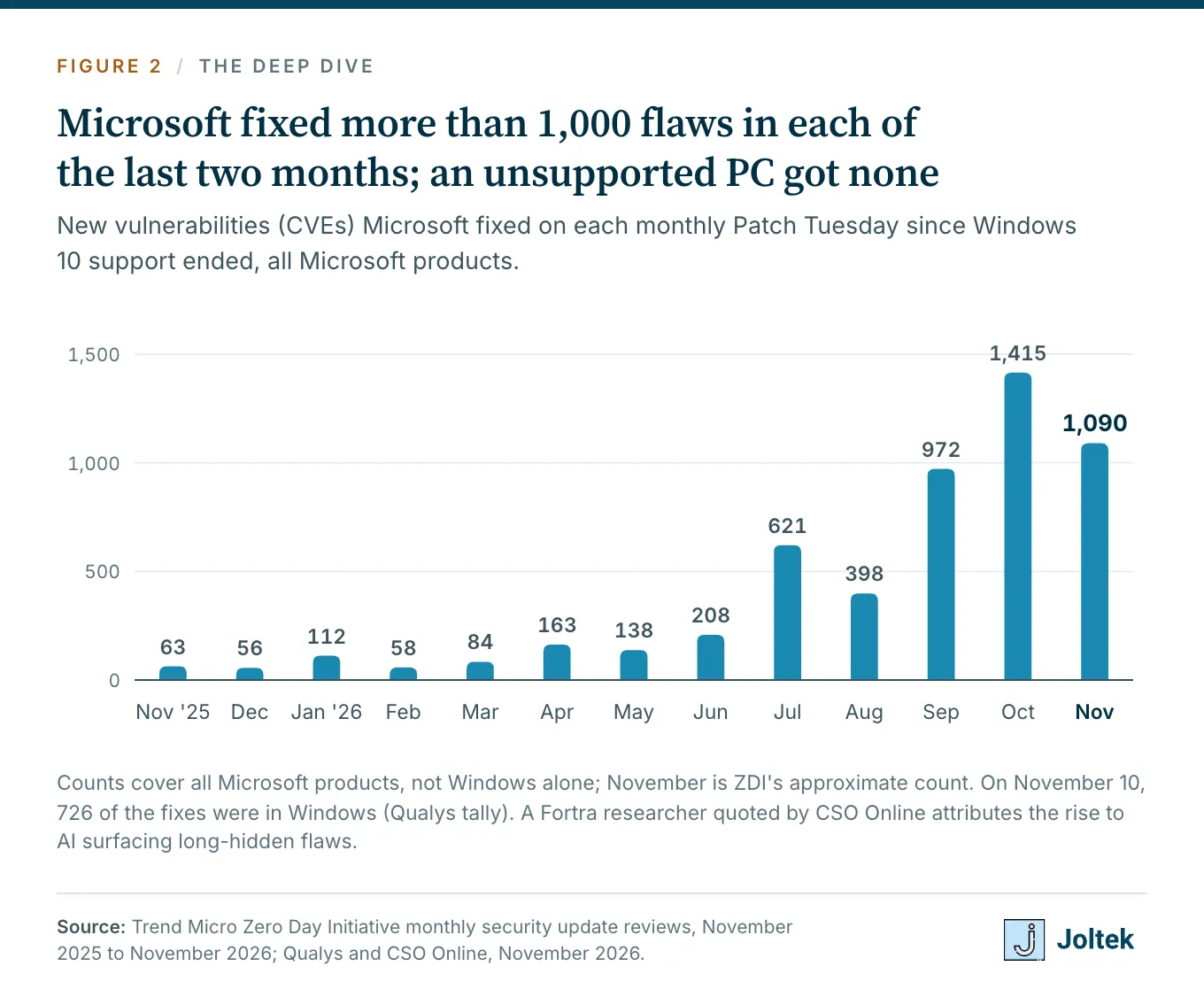
Why it matters: 726 of those fixes were for Windows itself, by Qualys’s count, and a Windows 10 PC that is not enrolled in paid updates received none of them. That gap is the subject of this week’s Deep Dive.
Nov 12: CISA republished five Siemens advisories, including a critical flaw in Industrial Edge Management.
The Industrial Edge advisory covers a flaw rated 9.8 out of 10, and Siemens says it is “currently assessing the impact” on its Industrial Edge products, which means there is no complete fix yet (CISA ICSA-26-316-03).
Why it matters: Until a fix exists, the only protection is controlling what can reach these systems, so ask your engineers this week which networks can connect to your Industrial Edge management servers.
Comments close Nov 30: NIST’s draft revision of its OT security guide is open for comment for two more weeks.
The initial public draft of NIST SP 800-82 Revision 4, the Guide to Operational Technology Security, was published September 21 and states that “legacy devices and software often lack vendor support and may no longer receive patches”, pointing owners to compensating controls instead (NIST).
Why it matters: SP 800-82 is one of the most widely used references for OT security, so its next edition will shape what is expected of plants running unsupported systems. Anyone can comment.
Nov 10: Mars plans an estimated $1,400,000,000 of US manufacturing and operations investment in 2027.
The company says the commitment builds on more than $9,000,000,000 invested in its US operations since 2017 (Mars).
Why it matters: Large food manufacturers are still funding plant work for 2027, which fills integrator and machine-builder calendars early. If your 2027 projects need outside engineering, book the scope and the slots now.
Nov 6: Manufacturing added 19,000 jobs in October.
The Bureau of Labor Statistics reported that manufacturing employment “continued to trend up” in October, while total nonfarm payrolls rose by 165,000 (BLS).
Why it matters: The engineers and technicians who can test a control system change on a running line are in demand everywhere, so plan modernization work around the people you have, not the people you hope to hire.
The Deep Dive
Modernization strategy and capital
Unsupported Windows on the plant floor: why it is still there, and what it exposes
Control system modernization budgets usually cover controllers and networks. The Windows PCs underneath the HMIs, SCADA servers and engineering workstations are often older, unpatched and on nobody’s capital plan. Here is why that happens, why it is getting more urgent, and how to fund the fix.
When engineering teams plan a control system migration, the scope is usually the controllers, the I/O and the network, delivered as a proper project with a budget and a shutdown. The PC running the operator screens next to that controller often belongs to nobody’s project: it came with the machine, it has run without complaint for years, and its operating system stopped receiving security fixes long ago. We have walked production lines where the operator screens still run on Windows XP, and a few where Windows NT is still doing a job.
That is not unusual. Microsoft ended support for Windows XP on April 8, 2014 (Microsoft), and for Windows 7, including its paid extension, on January 10, 2023 (Microsoft). In TXOne Networks’ 2026 survey of 550 senior decision-makers in six European countries, six in ten said legacy Windows makes up at least half of their OT environment (TXOne, a security vendor’s survey). NIST’s OT security guide puts it plainly: “many OT utilize older versions of OSs that are no longer supported by the vendor through patches” (NIST SP 800-82r3).
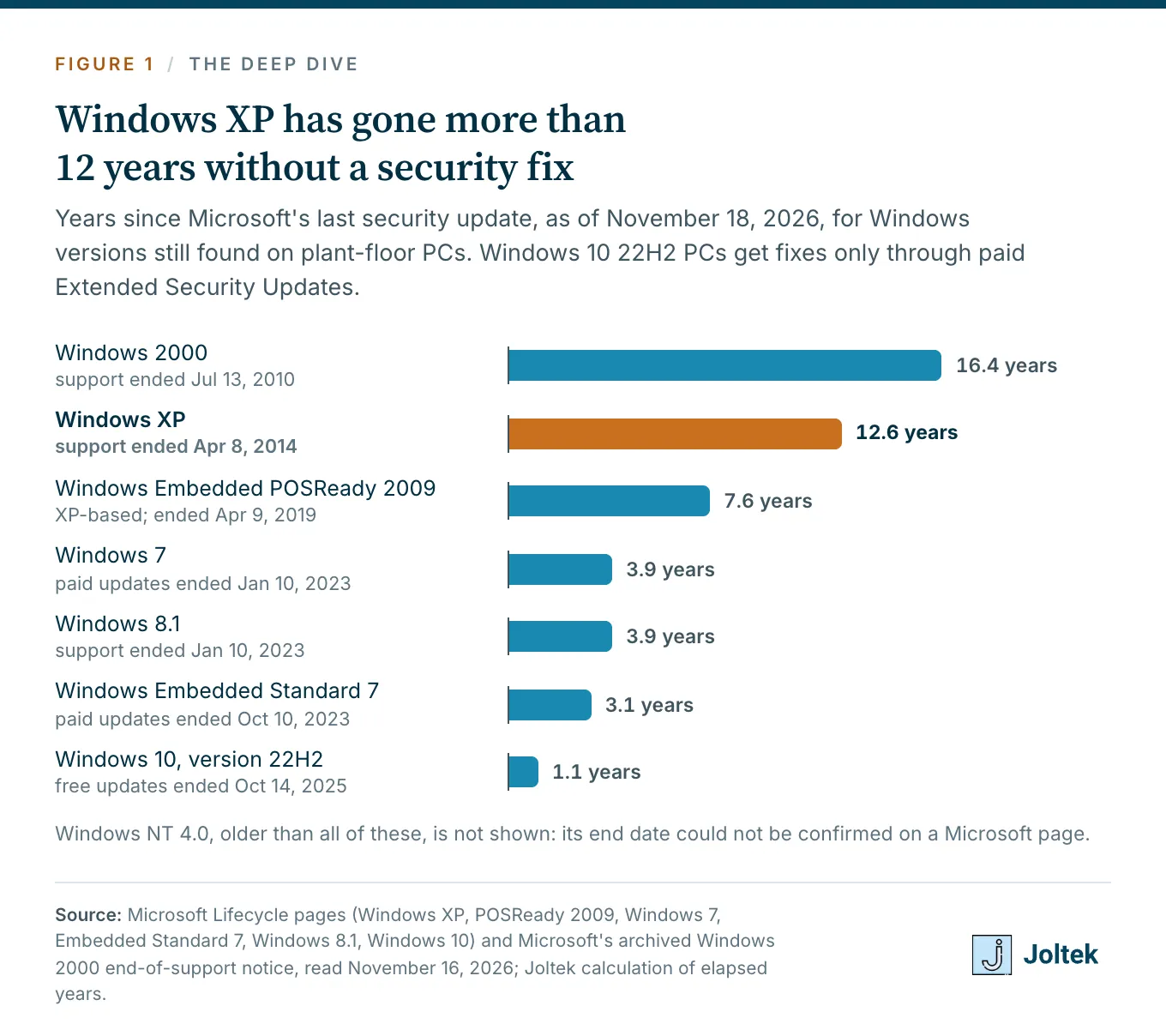
Windows 10 joined that list on October 14, 2025 (Microsoft). Windows 10 PCs keep running, but their security fixes now come only through Microsoft’s paid Extended Security Updates, which cost $61 per device for the first year, double in each following year, and end after three years. The program is cumulative, so a PC enrolled late pays for the years it missed (Microsoft Learn). By our arithmetic, that is $61, then $122, then $244, or $427 per PC for three years of security fixes and nothing else. There is also a trap for industrial PCs: Windows 10 IoT Enterprise version 22H2, the edition Microsoft licenses for fixed-purpose devices, has no paid extension at all (Microsoft IoT blog).
Why plants end up here
Engineers do not keep old Windows running because they are careless. The causes are structural, and naming them is the first step toward budgeting the fix.
- The equipment outlives the operating system. NIST puts the life of typical IT components at three to five years, while OT technology often lasts 10 to 15 years “and sometimes longer”, and a whole OT system can run for more than 20 years (NIST). Windows 7 received just over ten years of support, from October 2009 to January 2020, so a line commissioned with a new Windows PC will usually outlive its operating system.
- The PC is part of the control system, not a separate asset. The HMI or SCADA software, its drivers and the project files were tested together on one Windows version, so changing Windows means re-checking that whole chain, and sometimes upgrading the software and converting the project.
- Every change needs testing and a shutdown. NIST notes that updates must be “thoroughly tested by both the vendor and the end user”, that outages are planned “days or weeks in advance”, and that “the OT may also require revalidation”. FDA’s validation guidance for medical device software makes the same point: after any change “the validation status of the software needs to be re-established” (FDA).
- Nobody owns it. In many plants we work with, IT manages the office PCs, engineering owns the controllers, and the plant-floor PCs fall between the two, so their replacement never reaches anyone’s budget request.
TXOne’s respondents ranked the barriers the same way: compatibility with legacy equipment came first at 54%, ahead of cost at 38% and downtime risk at 35%.
Why it is more urgent this winter
Three things changed this year. The first is price: paid Windows 10 updates entered their more expensive second year on October 14, and two more platforms lose free fixes on January 12 (Lifecycle Watch, below).
The second is volume. Microsoft’s monthly security releases have grown from 63 new vulnerabilities in November 2025 to 1,415 in October and about 1,090 in November, according to the Zero Day Initiative’s monthly reviews (ZDI). A researcher at Fortra told CSO Online the rise reflects long-hidden flaws “being surfaced by AI”. Every one of those fixes tells the world a flaw exists, and an unsupported PC receives none of them.
The third is insurance. Beazley’s cyber insurance application for larger companies asks directly, “Do you have any end-of-life or end-of-support software on your network?”, and if the answer is yes, whether that software is segregated (Beazley). Whoever answers that question for your company needs the plant-floor inventory to answer it honestly.
What an unsupported PC exposes
When support ends, nothing breaks; every flaw discovered afterward simply stays open on that PC for good. The UK’s National Cyber Security Centre says such weaknesses “will remain unpatched and will be exploitable by relatively low skilled attackers”, and that “the only fully effective way to mitigate this risk is to stop using the obsolete product” (NCSC). CISA puts the “use of unsupported (or end-of-life) software” first on its list of bad practices for critical infrastructure (CISA).
The flaws are often shared with the versions that are still supported. More than once, Microsoft has judged a flaw dangerous enough to ship fixes for Windows versions it no longer supported, and two cases stand out. In May 2017, during the WannaCry outbreak, it took “the highly unusual step of providing a security update for all customers”, including Windows XP and Windows Server 2003 (Microsoft). In May 2019 it did so again for a remote desktop flaw it called “wormable”, one that “requires no user interaction” (Microsoft). Those were exceptions; for the hundreds of flaws fixed in an ordinary month, an unsupported PC stays exposed.
On a plant floor the way in is more often an engineering laptop, a vendor’s remote session or a USB drive than the internet itself, and once malicious code is on a flat network it can reach every PC that shares the same flaw. WannaCry stopped production at Renault’s plant in Douai, France, in May 2017 (Automotive News Europe).
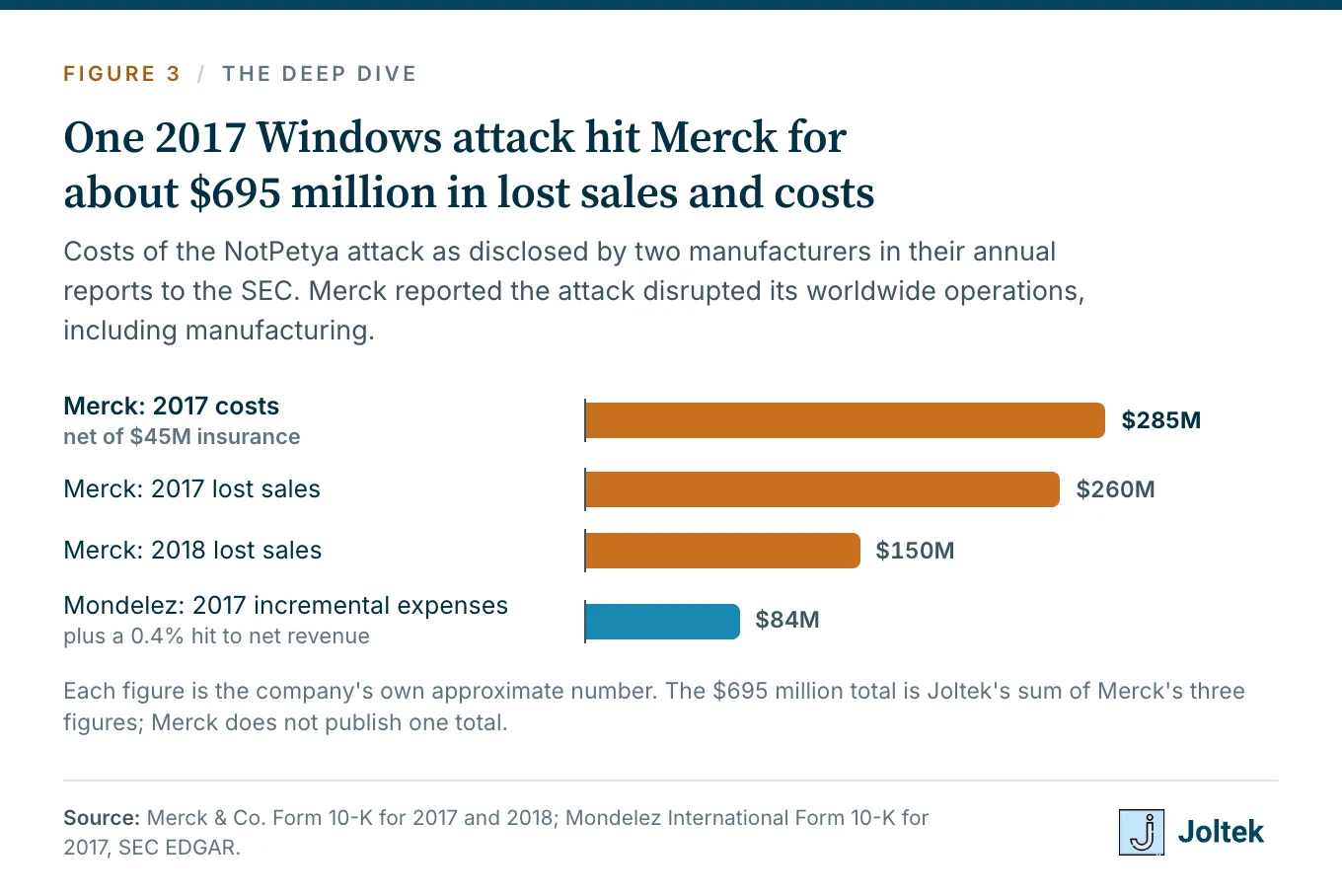
The best-documented costs come from the NotPetya attack of June 2017, because the public companies it hit had to disclose them. Merck reported that the attack disrupted “its worldwide operations, including manufacturing, research and sales operations”, and its annual reports put the effect at about $260,000,000 of lost sales in 2017, about $285,000,000 of costs in 2017 net of insurance, and about $150,000,000 of lost sales in 2018 (Merck 2017 10-K, 2018 10-K). Mondelez reported $84,000,000 of incremental expenses and a 0.4% reduction in net revenue (Mondelez 10-K). Neither attack depended on unsupported Windows alone, but both show what one Windows weakness can do to a plant network with nothing to stop it.
Three paths for every PC
Once the inventory exists, every PC goes down one of three paths, set by how critical its line is and how hard its software chain is to move.
Bridge. Pay for security updates where Microsoft still sells them, and isolate the PC either way: block its access to the internet and to untrusted networks, as the NCSC recommends, and restrict what software can run on it and what removable media it accepts, which are among the compensating controls in NIST’s draft guide. Then set its replacement date, because a bridge without an end date is a decision to stay.
Replace in a planned shutdown. The current releases of the major HMI and SCADA platforms already run on supported Windows. Rockwell Automation FactoryTalk View SE version 14 is tested on Windows 11 and on Windows 10 IoT Enterprise LTSC 2019 and 2021 (Rockwell Automation), Siemens WinCC V8.0 supports Windows 11 (Siemens), and Inductive Automation Ignition 8.3 supports Windows 10 and 11 and Windows Server 2016 to 2025 (Inductive Automation). The constraint is usually hardware: Windows 11 needs a TPM 2.0 chip, UEFI Secure Boot and a supported processor (Microsoft), so many older industrial PCs cannot be upgraded in place. Bundle the replacement with other work on the line so testing and downtime are paid for once.
Rethink. On some lines the right answer is not another PC in the panel but thin clients on a central, virtualized server, which is a roadmap decision rather than an IT refresh. Whichever path a PC takes, budget it as capital with the software upgrade, project conversion and test days included, because the PC itself is the cheapest part of the work.
The objection you will hear first
“It is not on the internet, so it does not need updates.” That is often true on the day a PC is installed and rarely true three years later, once engineering laptops have connected to it, a vendor’s remote tool has reached it and USB drives have carried project files in. Isolation is a control you verify, not an assumption, so if the bridge path depends on it, test it and write down what the PC can reach.
What we would do
- Inventory every Windows device on the plant floor, servers included: edition, version, control software and version, line, what it can reach, and whether it can run Windows 11.
- Check each software version against the vendor’s compatibility list before buying a single PC.
- Put every PC on a path with a date: bridge with an end date, replace in a named shutdown, or rethink in the roadmap.
- Isolate and restrict every PC on the bridge path now, because paid updates do not protect a PC that can reach the internet.
- Give the inventory to whoever answers your cyber insurance questionnaire, and budget the replacements as capital, with the software, conversion and testing included.
Field Kit
Five checks for every plant-floor PC
Give this to the engineers and technicians doing the inventory. Run it on each PC with a local administrator, and record the answers in one sheet per plant.
| Check | How | What to record |
|---|---|---|
| Windows edition and version | Run winver, then systeminfo and read “OS Name” | The full edition name, including “IoT” and “LTSC” if present |
| Can it run Windows 11? | tpm.msc for the TPM version; msinfo32 for Secure Boot and the processor | TPM 2.0 yes or no, Secure Boot yes or no, processor model |
| The control software | The application’s About screen | HMI, SCADA or engineering software, its exact version, and the project it runs |
| What it can reach | From the PC, test a connection to an internet address and to the office network | Yes or no for each, and who has remote access to it |
| Recovery | Ask, then check the backup location | Is there a current image of this PC, and when was it last restored as a test? |
The last two checks change priorities. A PC that can reach the internet, or one with no image and no restore test, moves to the top of the list whatever its Windows version.
Lifecycle Watch
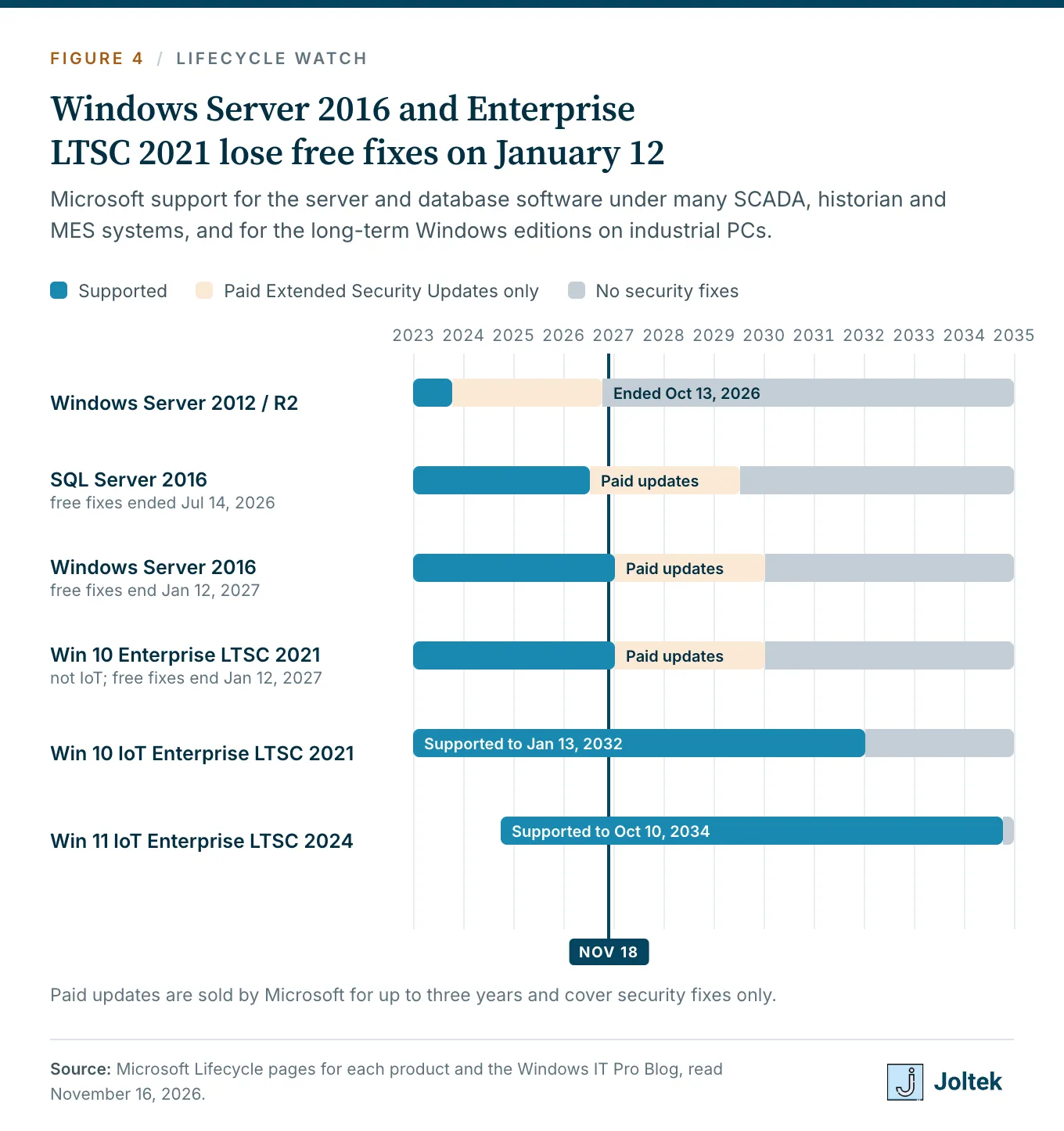
Windows Server 2016 and Windows 10 Enterprise LTSC 2021: free security fixes end January 12, 2027.
Both reach the end of support in eight weeks, with paid Extended Security Updates available afterward (Microsoft Lifecycle). Microsoft warns that the Enterprise edition of LTSC 2021 ends years before the IoT edition with the same name, which is supported until January 13, 2032 (Windows IT Pro Blog).
Our read: check the edition on every SCADA or historian server and every industrial PC labeled “LTSC 2021”, because the purchase order does not tell you which one you have.
SQL Server 2016 is already on paid updates, and Windows Server 2012 has none left.
SQL Server 2016 left extended support on July 14, 2026, and paid updates run to July 2029 (Microsoft Lifecycle). The last paid year for Windows Server 2012 and 2012 R2 ended on October 13, 2026 (Microsoft Lifecycle).
Our read: historians, batch systems and MES often run on SQL Server, so add the database version to the inventory, and treat any remaining Server 2012 machine as permanently unpatched.
Schneider Electric Modicon Quantum: Schneider’s own pages give two different end-of-service dates.
For the 140CPU65860 processor, Schneider Electric’s Canadian and UK product pages list end of service as December 31, 2026 (Schneider Electric Canada), while its US page lists December 31, 2027 (Schneider Electric US). The successor platform is Modicon M580.
Our read: get the date that applies to your contract in writing, and count the spares on the shelf in the meantime.
Financials
The watchlist, week to November 13
Honeywell’s process automation projects grew 14% in its first standalone quarter
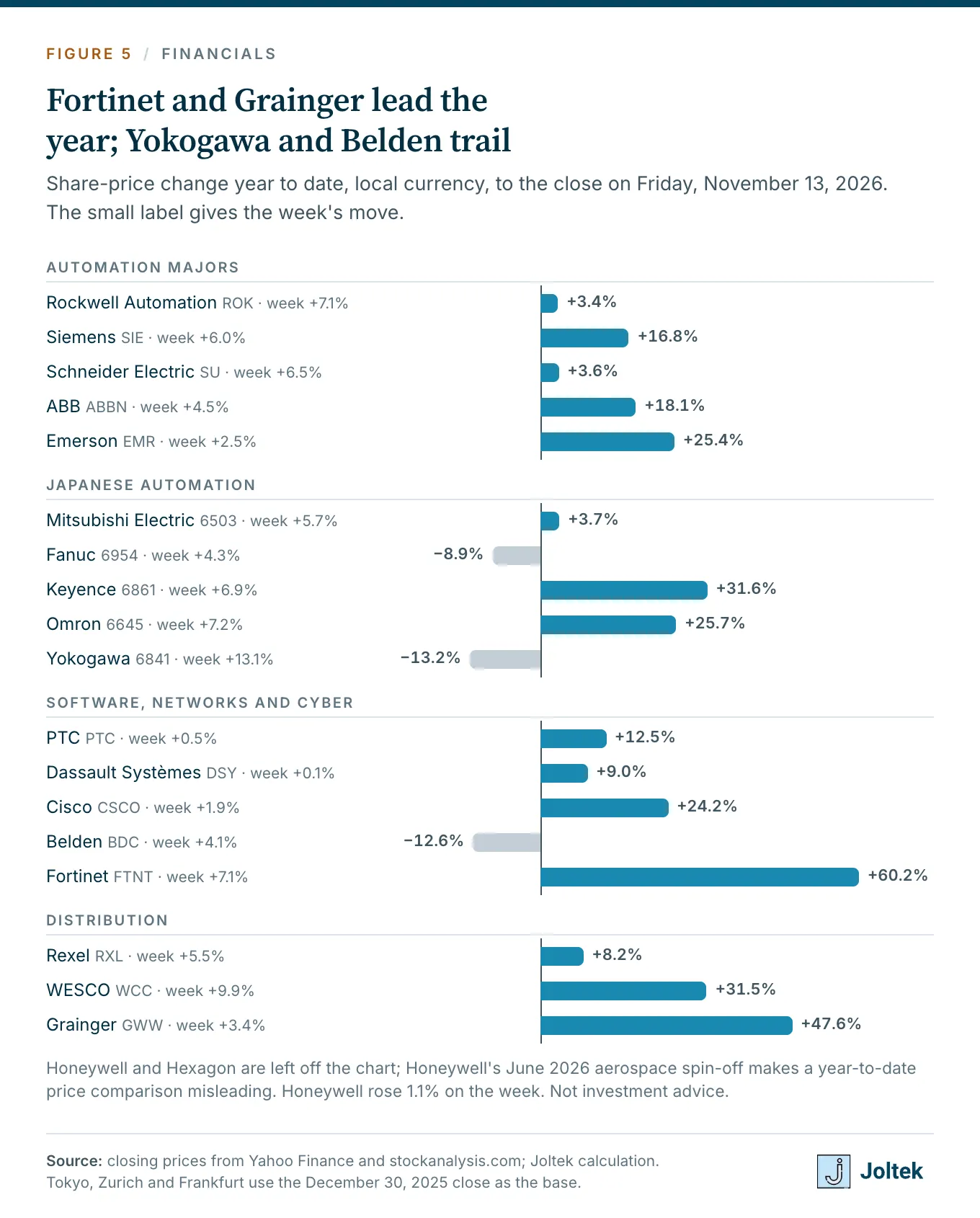
Every one of our 20 watchlist companies rose in the week to Friday, November 13, led by Yokogawa at 13.1% and WESCO at 9.9%. For the year, Fortinet is up 60.2% and Grainger 47.6%, while Yokogawa is down 13.2% and Belden 12.6%. Honeywell is left off the year-to-date chart because the June spin-off of its aerospace business distorts the comparison; it rose 1.1% on the week.
- 55.5 ISM Manufacturing PMI, October: a tenth month above 50, the line between growth and contraction.
- 75.2 ISM prices index, October: input costs still rising, a little more slowly than September’s 77.9.
- 76.9% US capacity utilization, September (Federal Reserve). October’s figure is due Tuesday, November 17.
Earnings read: Honeywell Technologies, third quarter
In its first quarter as Honeywell Technologies, the automation company left after the aerospace spin-off, sales were $4,994,000,000, up 7% organically. Process Automation and Technology grew 8% organically, with projects up 14% and aftermarket up 4%, Building Automation grew 8%, and Industrial Automation grew 4%. Backlog was nearly $19,000,000,000, up 7%, and Honeywell raised its full-year outlook to organic growth of 4% to 5% (Honeywell release, SEC). Chief executive Vimal Kapur said Honeywell Technologies “delivered strong results across the business in our first quarter as a standalone company.”
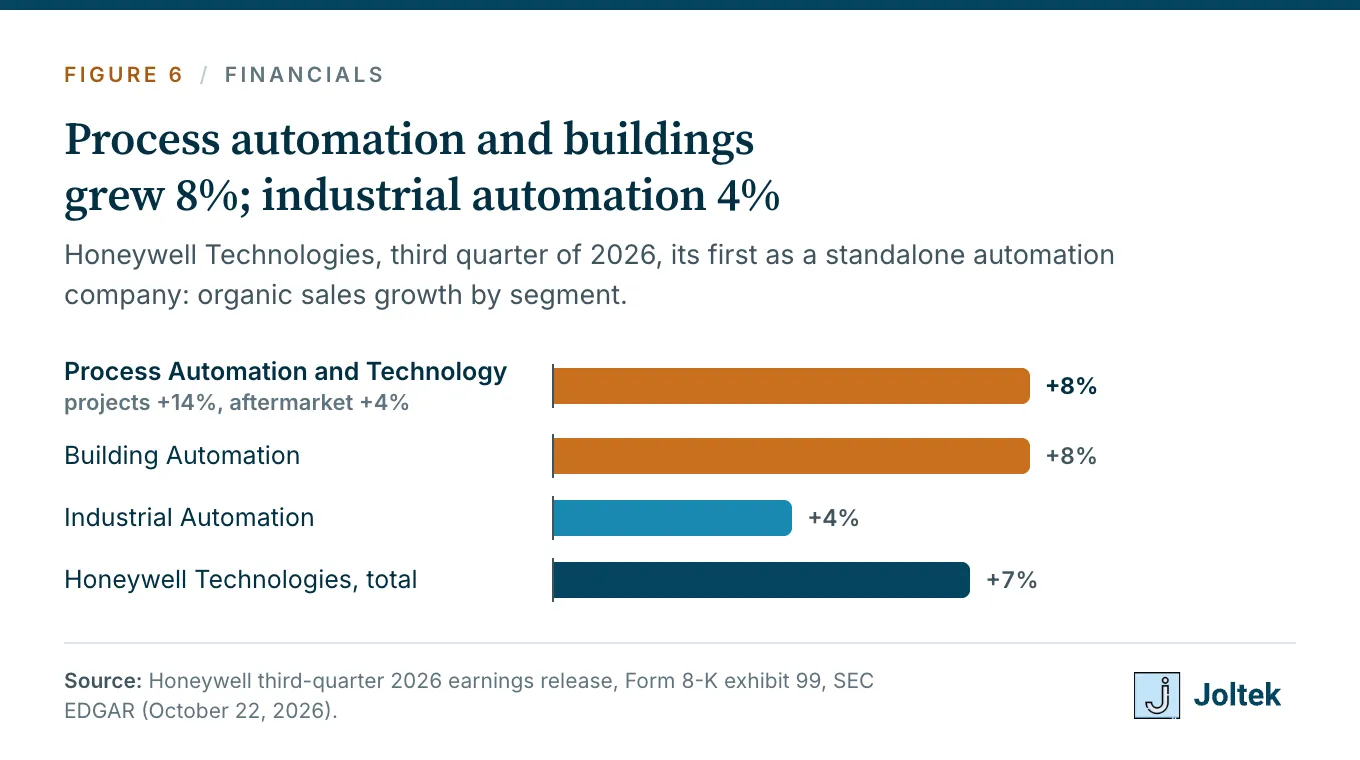
What it means for your plant: Project work is what is growing in process automation, and Honeywell is carrying a large backlog into 2027. If a control system or Experion upgrade is in your 2027 plan, ask for engineering and delivery dates before you commit the shutdown window, and after the spin-off, confirm which Honeywell entity now holds your support agreements.
Prices are closing prices from public market data, in local currency. This section is context on the market plants buy from, not investment advice.
Worth Your Time
- Obsolete products (UK National Cyber Security Centre). The clearest short guidance we know on what to do with systems you cannot replace yet: treat them as untrusted, constrain what they can reach, and plan their exit.
- NIST SP 800-82 Revision 4, initial public draft (NIST, September 2026). Read the patch management section and the discussion of unsupported components before the comment period closes on November 30.
- Plan for Windows 10 Enterprise LTSC 2021 end of support (Microsoft Windows IT Pro Blog). Microsoft’s own explanation of the Enterprise and IoT split. Send it to whoever buys your industrial PCs.
From Joltek
Control system modernization strategy. How we inventory an installed base, score each asset by risk and phase the upgrades into planned shutdowns, including the PCs and servers that are easy to forget until they fail.
One Question
How many Windows PCs run on your plant floors, and how many of them could you name the Windows edition of today?
Send your best guess for both numbers to vlad@joltek.com, or reply to the email edition. Vlad reads every reply, and the best answers shape a future issue.
Vlad Romanov, for the Joltek team
Founder, Joltek · Independent modernization advisory for manufacturers
The Plant-Side Brief
Get the next issue in your inbox.
Every Wednesday, 7:00 ET. Written for engineering and operations leaders responsible for controls, SCADA, MES and OT networks.
You’re on the list. The next issue arrives Wednesday at 7:00 ET.
One last step: check your inbox and click the confirmation button in the email from The Plant-Side Brief.
If it lands in a promotions or spam folder, move it to your main inbox so the next issues arrive where you’ll see them.
Sources
Every claim in this issue links to its source where it is made. The same sources, by section:
Industry News
- November 2026 Patch Tuesday: 63 critical Microsoft fixes, plus an Outlook zero-day · CSO Online
- Microsoft Patch Tuesday, November 2026 security update review · Qualys
- ICS advisory ICSA-26-316-03: Siemens Industrial Edge Management · CISA
- SP 800-82 Revision 4, Guide to Operational Technology Security (initial public draft) · NIST
- Mars investment in US manufacturing and operations in 2027 · Mars
- The Employment Situation, October 2026 · US Bureau of Labor Statistics
The Deep Dive
- Windows XP lifecycle · Microsoft Learn
- Windows 7 lifecycle · Microsoft Learn
- The legacy OT dilemma: 2026 update · TXOne Networks
- SP 800-82 Revision 3, Guide to Operational Technology Security · NIST
- Windows 10 Enterprise and Education lifecycle · Microsoft Learn
- Extended Security Updates for Windows 10 · Microsoft Learn
- Windows 10 end of support for Windows IoT Enterprise · Microsoft Tech Community
- General Principles of Software Validation · US Food and Drug Administration
- The November 2026 security update review · Trend Micro Zero Day Initiative
- Cyber insurance application, revenue above $250 million · Beazley
- Obsolete products · UK National Cyber Security Centre
- Bad practices · CISA
- Customer guidance for WannaCrypt attacks · Microsoft Security Response Center
- Prevent a worm by updating Remote Desktop Services (CVE-2019-0708) · Microsoft Security Response Center
- Renault-Nissan resume nearly all production after cyberattack · Automotive News Europe
- Merck & Co. Form 10-K for 2017 · SEC EDGAR
- Merck & Co. Form 10-K for 2018 · SEC EDGAR
- Mondelez International Form 10-K for 2017 · SEC EDGAR
- FactoryTalk View SE version 14 release notes · Rockwell Automation
- SIMATIC WinCC V8 · Siemens
- Ignition downloads and system requirements · Inductive Automation
- Windows 11 requirements · Microsoft Learn
Lifecycle Watch
- Windows Server 2016 lifecycle · Microsoft Learn
- Plan for Windows 10 Enterprise LTSC 2021 end of support · Windows IT Pro Blog
- SQL Server 2016 lifecycle · Microsoft Learn
- Windows Server 2012 R2 lifecycle · Microsoft Learn
- Modicon Quantum 140CPU65860 product page, Canada · Schneider Electric
- Modicon Quantum 140CPU65860 product page, United States · Schneider Electric