
The Plant-Side Brief · Issue 002
Who owns the code your line runs on
Integrators and machine builders lock control system code with tools the vendors supply, and the contract decides whether the plant ever gets the key. What actually happens, when each decision gets made, and how to recover a machine that is already locked.
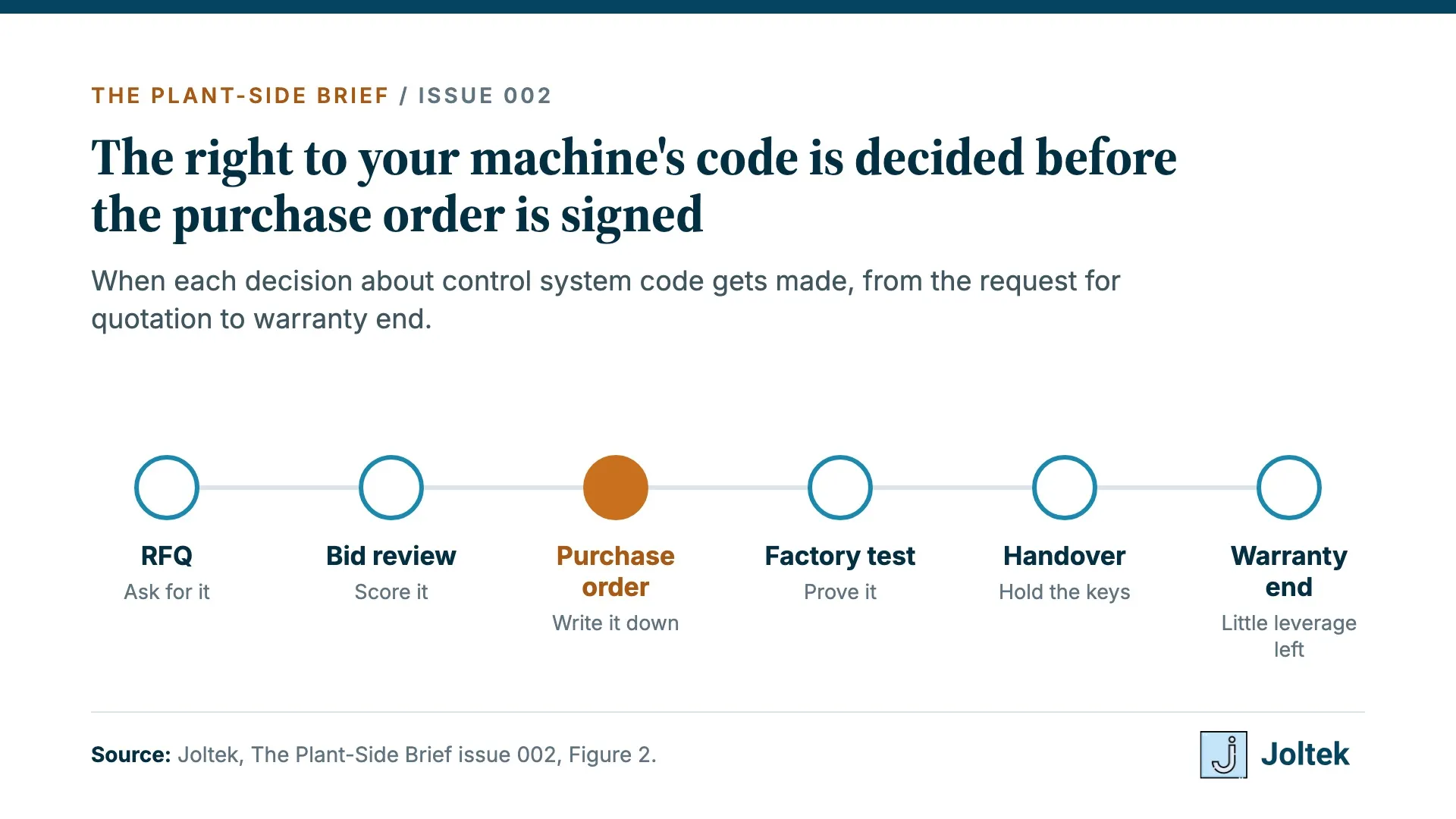
Table of contents
The Brief
Whether a plant can open, change and restore the program that runs its machine is usually decided in the purchase terms with the machine builder or system integrator, months before anyone asks for a password. This issue explains who locks control system code and why, when each decision about it gets made, and what to do for machines that are already locked.
This week in 60 seconds
- Industry News: during Automation Fair week, Rockwell Automation agreed to buy the mobile robot maker AGILOX and showed an AI orchestration layer that works inside its engineering software; Siemens plans no fix for an authentication flaw in some batch and historian products; robotics and machinery imports get talks instead of tariffs, for now; the food traceability deadline is July 2028.
- Deep Dive: the controller vendors supply the lock, but integrators and machine builders decide whether to use it, and the contract decides whether you get the key. Leverage is highest before the purchase order is signed.
- Field Kit: eight software clauses for every machine and integration purchase.
- Lifecycle Watch: Siemens changes how TIA Portal is licensed, the first S7-1200 enters phase-out, and the PowerFlex 7000 drive leaves sale March 31.
- Financials: Rockwell Automation’s Software and Control segment grew 15%, and the company is refunding tariff-related price increases.
Industry News
What moved, and what it means for your plants
Nov 18: Rockwell Automation agreed to acquire AGILOX, an Austrian maker of autonomous mobile robots.
AGILOX employs more than 250 people and has deployed more than 2,500 mobile robots. Rockwell says the deal will more than double its mobile robot business, which today is built on its OTTO platform, and expects it to close in the second quarter of its 2027 fiscal year, subject to regulatory approval. Terms were not disclosed (Rockwell Automation).
Why it matters: Material movement is becoming part of the control system vendor’s offer, not a separate purchase. If you are evaluating mobile robots for 2027, ask each supplier how its fleet software will be supported and integrated after an ownership change.
Nov 16 to 19: At Automation Fair in Boston, Rockwell gave a public debut to FactoryTalk Conductor, an AI layer that works inside its engineering tools.
Rockwell describes FactoryTalk Conductor as an AI-native orchestration platform that connects AI agents and workflows across the automation lifecycle. At launch it works with Studio 5000 Logix Designer, Logix Echo, Emulate3D and FactoryTalk Optix, and commercial availability is planned for the first quarter of 2027 (Rockwell Automation). The company expected about 15,000 attendees at the event (Rockwell Automation).
Why it matters: Tools like this work on the project files of your control systems. A plant that does not hold an open, current copy of its programs will not be able to use them, which is one more reason to settle code ownership now (Deep Dive).
Nov 17: Siemens plans no fix for an authentication flaw in some SIMATIC batch, historian and information server products.
The flaw, rated 7.5 out of 10, relies on the outdated NTLM authentication protocol and could let an attacker on the network take over a legitimate user’s session. It affects SIMATIC PCS 7 V9.1, BATCH V9.1, Process Historian 2020 and 2022, Information Server 2020 and 2022, and several WinCC versions. For some of these products Siemens says no fix is planned and recommends configuring SQL Server database encryption instead (CISA ICSA-26-321-08).
Why it matters: When the vendor’s answer is a configuration change, the work and its schedule belong to you. Ask your engineers which of these systems you run and who will make the change.
Oct 28: Robotics and industrial machinery imports get negotiations, not tariffs, with a 180-day clock.
A presidential proclamation under Section 232 found that imports of robotics, industrial machinery and their parts threaten national security, but directed the Commerce Secretary and the US Trade Representative to negotiate with trading partners instead of imposing tariffs now. Tariffs, quotas and fees remain available if no agreement is reached within 180 days (The White House). By our count, that period ends around April 26, 2027.
Why it matters: Imported machines and robots ordered this winter may arrive after that date, so put quote validity and tariff terms in the purchase order, not in a later change order.
Ongoing: The FDA will not enforce the food traceability rule before July 20, 2028.
Congress directed the FDA not to enforce the Food Traceability Rule, which requires additional records for foods on its traceability list, before July 20, 2028, and the agency held a public meeting on its draft enforcement policy on November 6 (FDA).
Why it matters: The original January 2026 date no longer applies. Use the extra time to sequence lot-level tracking with your MES and line upgrades, rather than to stop the work.
The Deep Dive
Delivery, integrators and vendors
Who owns the code your line runs on
The controller vendors supply the lock. System integrators and machine builders decide whether to use it, and the contract decides whether the plant ever gets the key. Here is what actually happens, when each decision gets made, and how to recover a machine that is already locked.
A line goes down, the engineer on call connects to the controller, and the software reports that the program is protected. The machine builder is slow to answer, wants a service visit at its own rate, or no longer exists. The plant cannot change the machine, cannot be sure it could restore it after a hardware failure, and cannot hand it to another integrator. For a corporate engineering leader, that is a problem of support, cost and risk on a production asset the company paid for.
It is easy to blame the controller vendor. In practice the vendor only supplies the protection features, and the people who switch them on are the system integrators and machine builders who write the program. Whether the plant ever receives the key is decided by the purchase terms.
What actually happens
Machine builders and integrators lock code for reasons they consider legitimate. The motives practitioners give are consistent. A builder who sells the same standard machine many times has invested in that program and wants to protect it. Some buyers have shared a supplier’s design with other fabricators to get a lower price, which makes suppliers guarded, as one long practitioner discussion on Control.com records (Control.com). And a builder does not want to be blamed under warranty for changes someone else made.
The plant usually discovers the lock late: when a backup will not upload, when a change is needed for a new product, or when the original builder cannot be reached. The same Control.com discussion makes the central point plainly: source code is not automatically included because you bought a machine, and modification support that was not asked for at the start often becomes a costly negotiation later.
How common is this? We could not find a published figure. The closest is a 2020 survey by PMMI, the packaging and processing machinery association, of 67 machine builders about how they handle passwords and program access; its findings are for members only (PMMI). We would rather say that no measurement exists than guess at one.
What the vendor features do
Every major controller platform gives the person writing the program ways to protect it. Siemens’s security guide for its SIMATIC controllers describes three that matter here. Know-how protection hides a block’s code behind a password, so only its interface can be read. Copy protection ties a block to one memory card or CPU serial number. CPU access levels restrict what can be read or loaded over the network, and Siemens notes that an access level “does not replace the know-how protection” (Siemens). Rockwell Automation’s Logix platform offers source protection by key or by licence, which can stop a routine from being viewed or edited without the right credential.
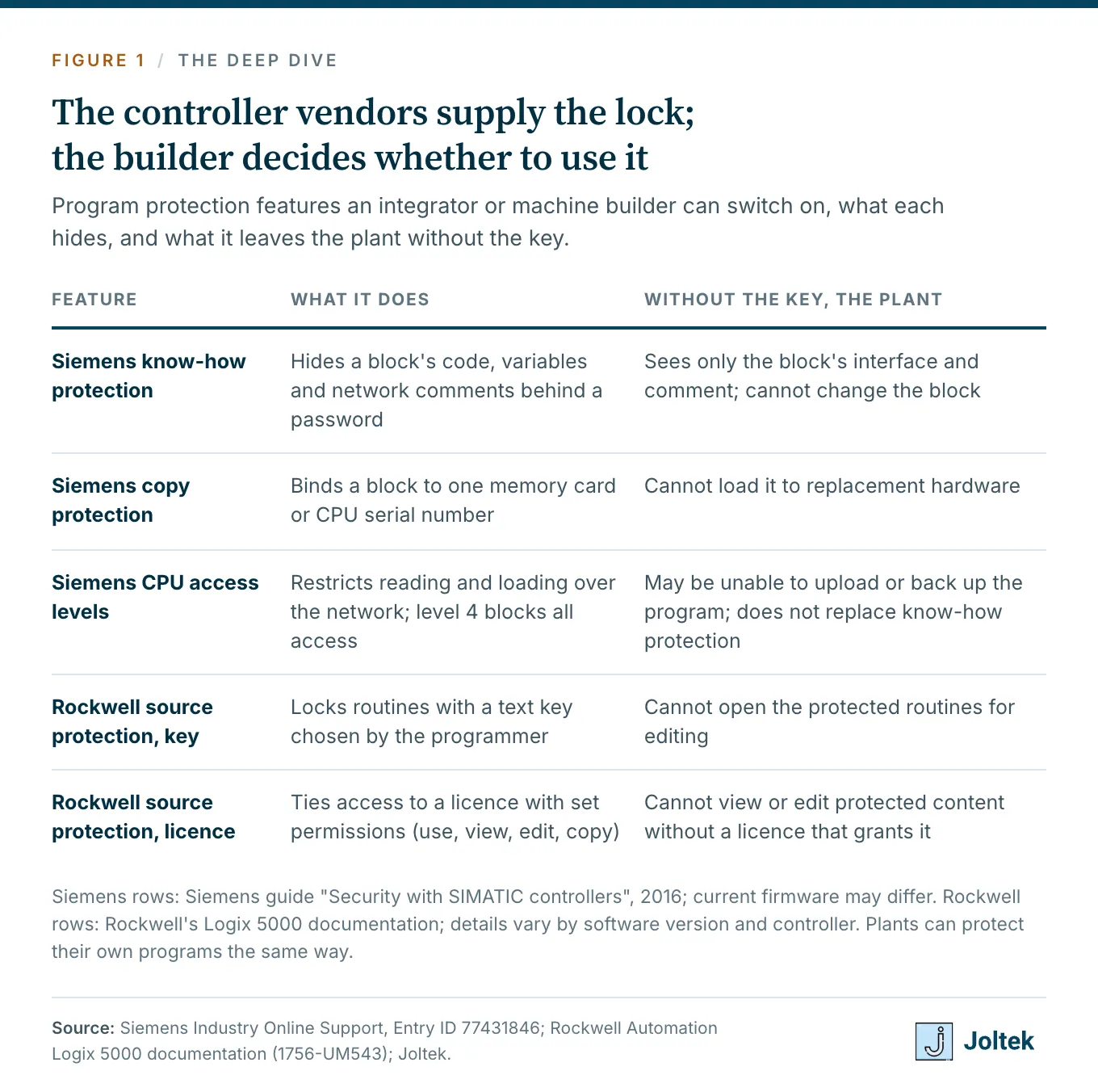
None of these features is a problem in itself. Protection against unauthorized change is good engineering, and a plant may protect its own programs the same way. The problem is a lock with no agreed arrangement for the key.
Who owns it unless the contract says otherwise
Copyright starts with the author. Under US law, a work made for hire belongs to the employer, and ownership can be transferred, but only in writing (17 U.S.C. §201). The programmers who write a machine’s code are usually employees of the builder or integrator, so their employer owns it, and the plant receives what the contract grants. The US Copyright Office’s guidance on works made for hire lists the nine categories of commissioned work that can be treated as made for hire, and control software is not one of them (US Copyright Office, Circular 30). Canada’s Copyright Act makes the author or employer the first owner too, and requires a signed, written assignment to change that (Copyright Act, section 13). This is not legal advice, and your counsel should read your own contracts, but the direction is clear: if the purchase order is silent, the plant has most likely bought the right to run the program, not to own or change it.
Bypassing a lock is not the way out either. In its 2024 rulemaking, the US Copyright Office added an exemption that allows a lock to be bypassed for repair of retail commercial food preparation equipment, and declined a broader one for commercial and industrial equipment, citing an insufficient record (Federal Register, 89 FR 85433). Production line controllers are not covered, and bypassing a lock may also breach the software licence.
When the decisions get made
Every question about the code has a moment when it is cheap to answer, and a later moment when it is expensive.
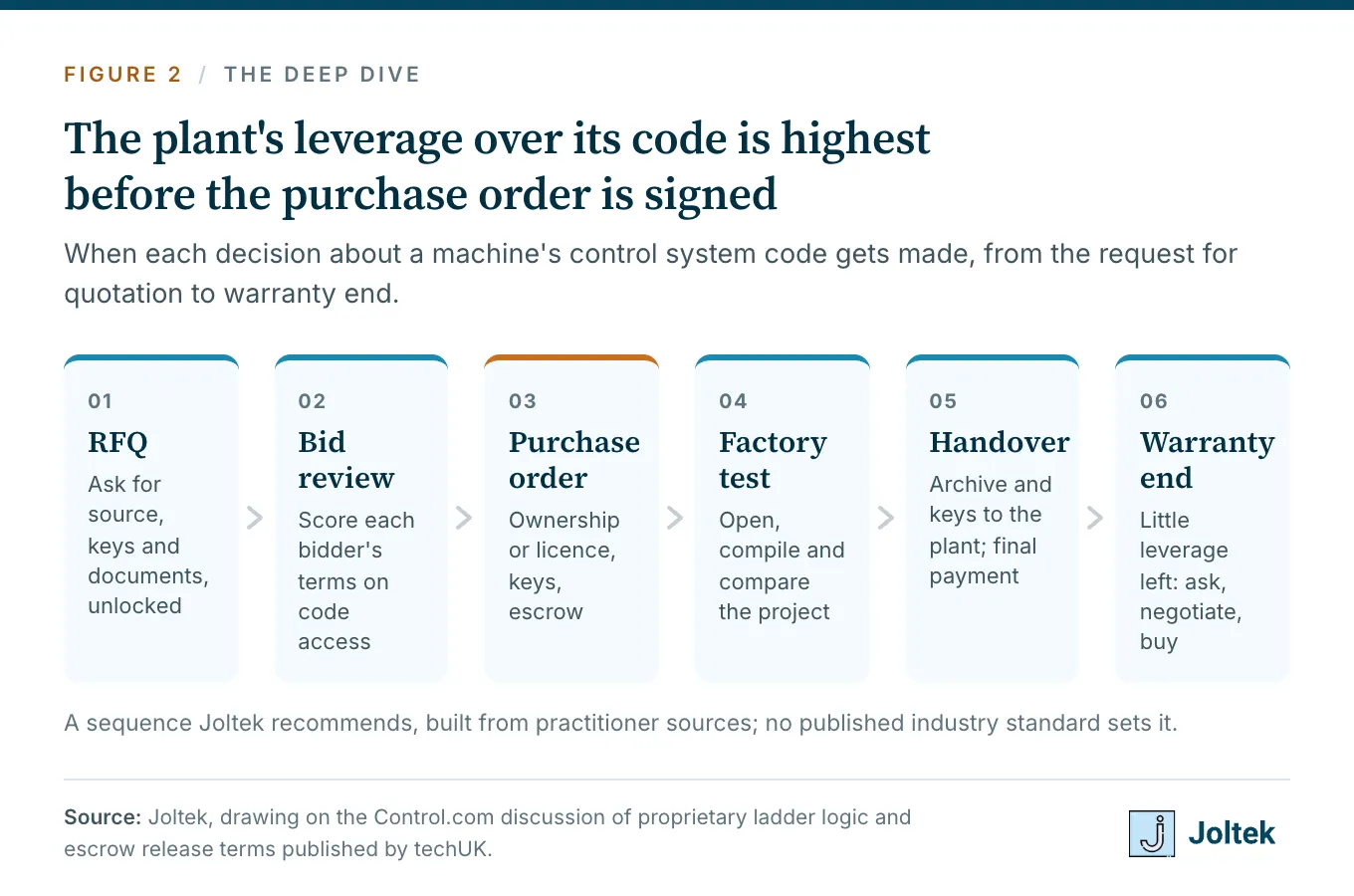
- Request for quotation. State that the plant receives the source code in its native format, every password and key, and the documentation, and that no delivered program is locked against the plant. Bidders price what they read.
- Bid evaluation. Treat a bidder’s conditions on code access as a scored item, not a footnote. A builder selling a standard machine may reasonably keep its core program; then the question becomes a licence, a copy held in escrow, or both.
- Purchase order. Write it down: an ownership assignment or a licence that lets the plant view, modify and restore the program; delivery of passwords and keys; and, if the builder keeps the code, escrow with defined release events. Escrow agreements commonly release the code if the supplier stops supporting the product, becomes insolvent or ceases trading (techUK).
- Factory acceptance test. Prove delivery: open the delivered project, compile it, compare it with the controller, and confirm every protected block opens with the credentials supplied.
- Handover. Tie a payment milestone to the as-built archive and the credentials, stored in the plant’s own system, not on an engineer’s laptop.
- Warranty end. By now the plant’s leverage is mostly gone. The warranty clause should never make delivery of the code conditional on the warranty ending.
For regulated plants there is one more reader. FDA rules for drug manufacturing require controls so that only authorized people change master records, a backup of data entered into computerized systems, and, in some cases, a written record of the program (21 CFR 211.68). They do not literally require the plant to hold source code, but ask your quality team how they would show change control on a program nobody in the plant can open.
When the machine is already locked
Most plants will not start with clean contracts. For machines already on the floor, work down a ladder from the cheapest step to the most disruptive.
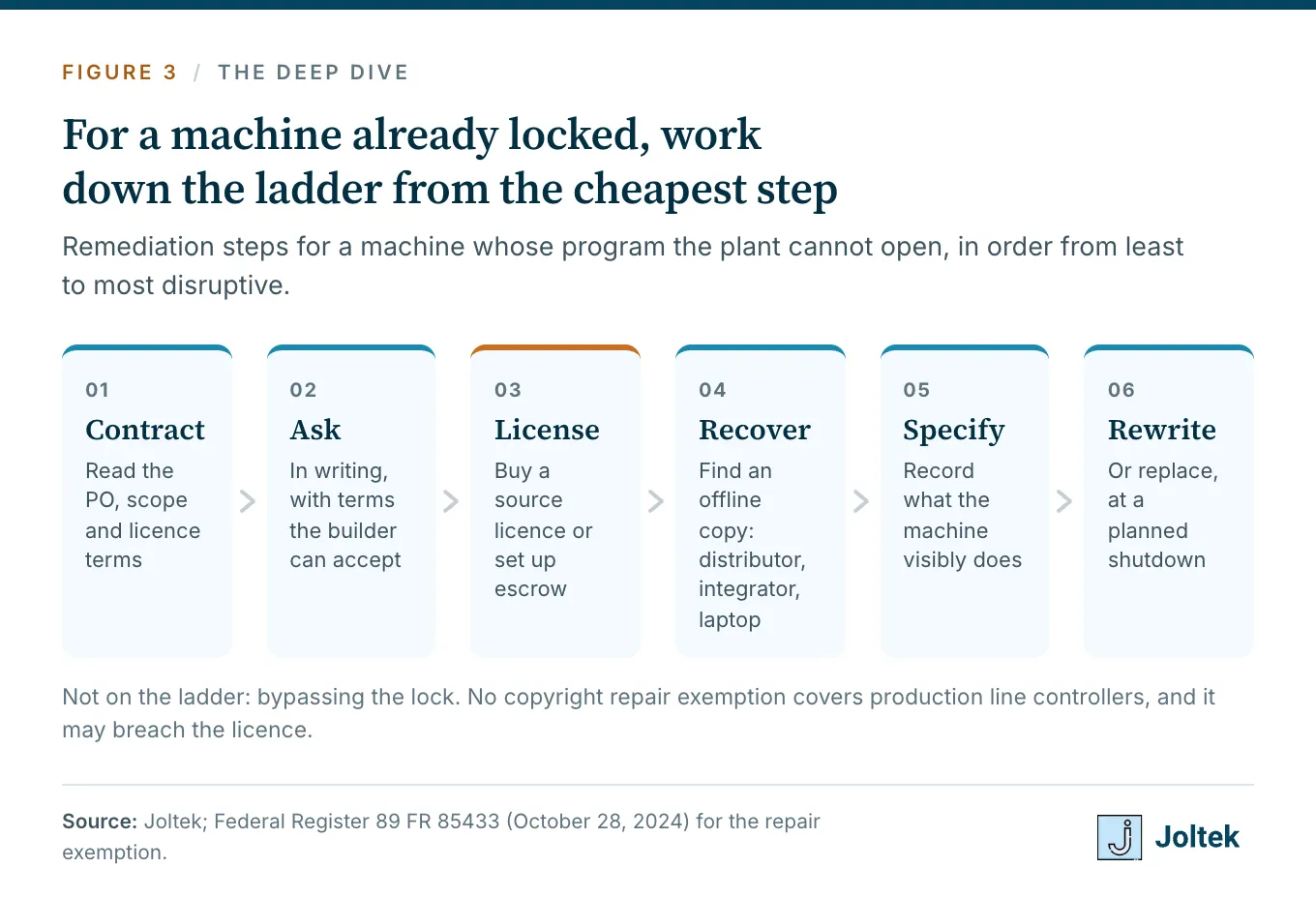
Start with the paperwork: the purchase order, scope of supply, licence terms and any service agreement often settle more than people expect. Then ask in writing, with a reason and terms the builder can accept: a nondisclosure agreement, use limited to that machine, or a fee. Builders who are still trading often agree to sell a source licence or set up escrow. If the builder is gone, look for an offline copy with its successor, the distributor, the previous integrator or the commissioning laptop. Controller vendors generally cannot remove another party’s protection. Where nothing else works, record what the machine visibly does, write a specification from it, and rewrite or replace the program at a planned shutdown, under a contract that gives the plant the result.
What we would do
- Add a software ownership and delivery section to the standard engineering specification and purchase order template, using the clauses in the Field Kit.
- Score bidders on it, and accept a licence or escrow only where the builder has a genuine standard product to protect.
- Verify delivery at the factory acceptance test, and tie a payment milestone to the as-built archive and credentials.
Field Kit
Eight software clauses for every machine and integration purchase
Give this to whoever writes your engineering specifications and purchase order templates, and have your counsel adapt the wording to your own terms.
| Clause | What it secures |
|---|---|
| Ownership or licence | An assignment of the program to the plant, or a licence to view, modify, copy and restore it for the life of the machine |
| Source in native format | The complete project files for the controller, HMI, drives and robots, in the format the engineering software opens |
| Passwords and keys | Every password, protection key and licence needed to open and change the delivered programs |
| No locks against the plant | No delivered program protected against the plant’s own engineers, unless the protection is listed and its key is delivered or held in escrow |
| Documentation | Commented code, I/O lists, network drawings and a functional description that matches the delivered version |
| Escrow | Where the builder keeps the code, a deposit with an escrow agent and release if it stops support, becomes insolvent or ceases trading |
| Proof at acceptance | At the factory and site tests: open, compile and compare the delivered project with the controller |
| Payment milestone | Final payment tied to the as-built archive and credentials, delivered to the plant’s own system |
The last two clauses are the ones that make the first six real. A clause nobody checks at acceptance is a promise, not a delivery.
Lifecycle Watch
Siemens TIA Portal V21.1 separates installed software from licensing.
Siemens says that within the V21 line it separates installed software from licensing across the TIA Portal engineering products and options, and ends project upgrades within that line. V21.1 is due for download at the end of November and as a package in December 2026 (Siemens).
Our read: fewer forced project upgrades is good news for plants. Siemens has not said what it means for existing licences, so ask your Siemens partner which entitlement covers each engineering PC before the next renewal.
The first-generation SIMATIC S7-1200 entered phase-out on November 1; the last order date is October 31, 2027.
Siemens plans spare-part availability until about 2036 and recommends the second-generation S7-1200 for new projects (Siemens).
Our read: update machine-builder specifications to the second generation now, so new machines do not arrive on a controller that is already in phase-out.
Rockwell Automation PowerFlex 7000 medium voltage drives leave sale after March 31, 2027.
Rockwell announced the discontinuation in June and recommends the PowerFlex 6000 family as the path forward (Rockwell Automation).
Our read: medium voltage drives are long-lead, high-impact assets. Confirm spares and service terms with your Rockwell contact before March 31.
.NET Framework 4.6.2 support ends January 12, 2027, and SQL Server 2014’s last paid update year ends in July 2027.
Both dates are on Microsoft’s lifecycle pages (Microsoft, Microsoft).
Our read: many older HMI, SCADA and historian clients depend on a specific .NET Framework version, so add it to the PC inventory from issue 001.
Financials
The watchlist, to November 23
Rockwell’s Software and Control segment grew 15% as it refunds tariff increases
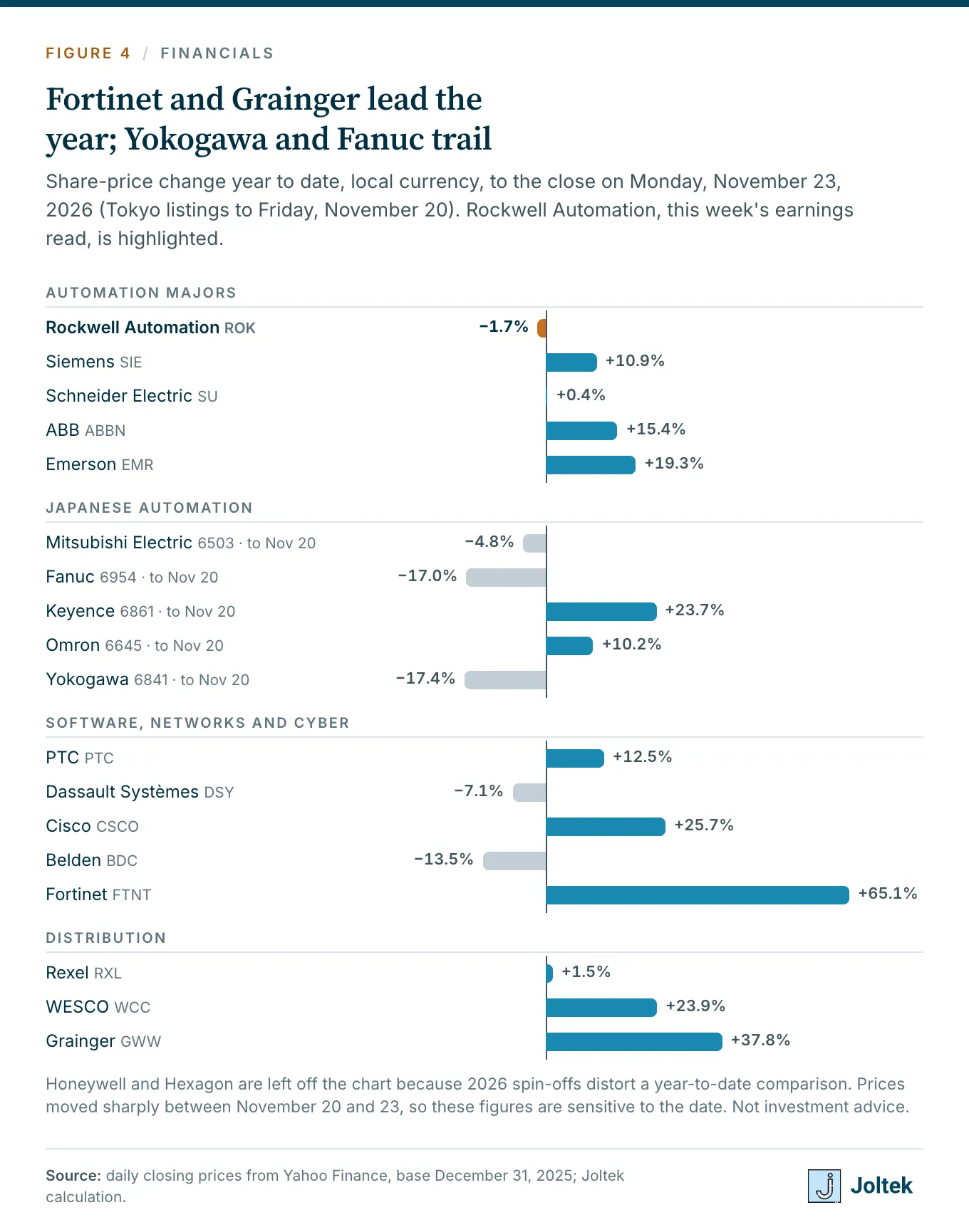
For the year to Monday, November 23, Fortinet leads the watchlist at 65.1% and Grainger follows at 37.8%, while Yokogawa is down 17.4% and Fanuc 17.0%. Rockwell Automation is down 1.7% for the year. Japanese prices are to Friday, November 20, because Tokyo was closed on November 23. Honeywell and Hexagon stay off the year-to-date chart because spin-offs distort the comparison.
- 55.5 ISM Manufacturing PMI, October. November’s reading is due Tuesday, December 1.
- −0.4% US industrial production, October, while manufacturing output rose 0.3% (Federal Reserve).
- 76.4% US capacity utilization, October (Federal Reserve).
Earnings read: Rockwell Automation, fourth fiscal quarter
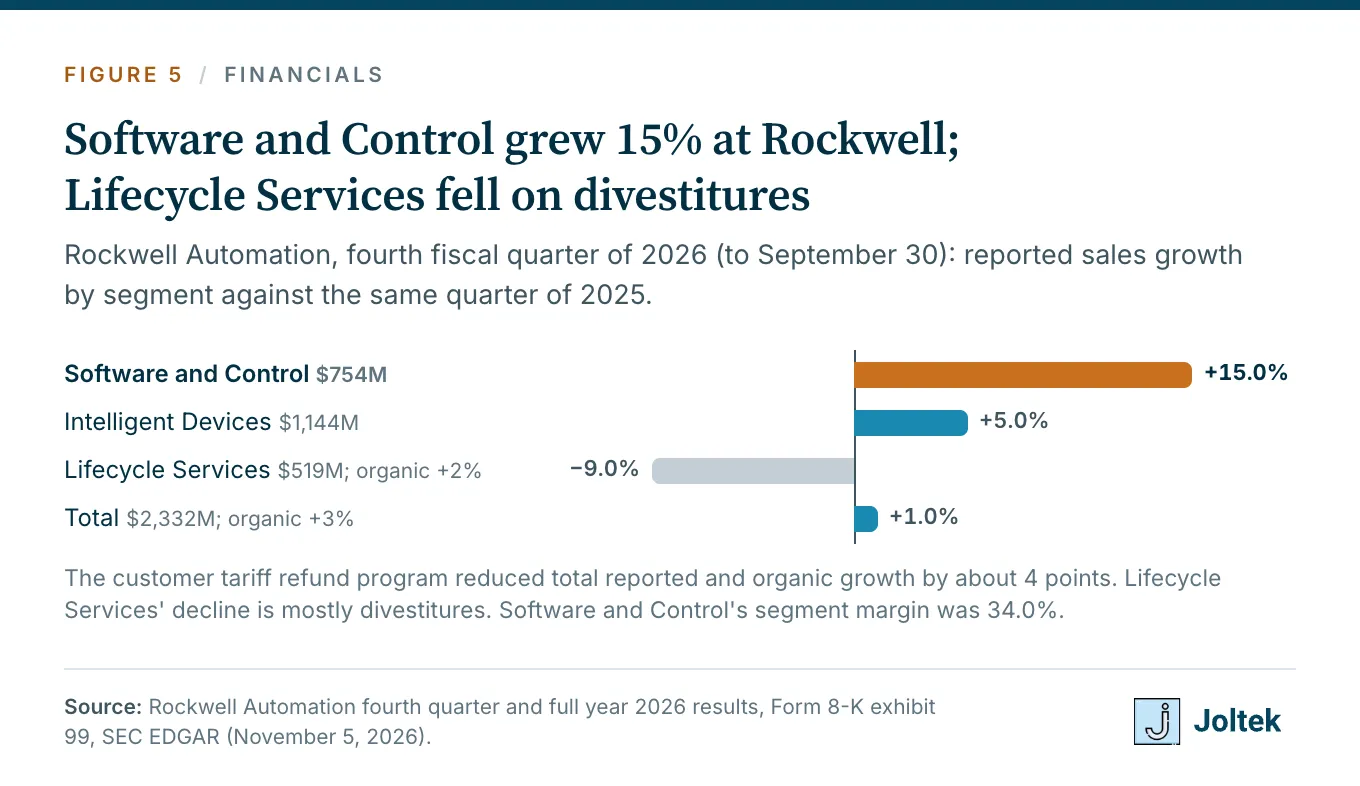
Rockwell’s sales for the quarter to September were $2,332,000,000, up 3% organically. Software and Control grew 15% to $754,000,000 with a 34.0% segment margin, Intelligent Devices grew 5%, and Lifecycle Services fell 9% as reported, or rose 2% organically. After receiving $103,000,000 of refunds of IEEPA tariffs, Rockwell approved a program to refund customers for price increases they paid on affected products and accrued $85,000,000 for it, which reduced the quarter’s sales growth by about 4 points. For fiscal 2027 it guides to organic sales growth of 6% to 9% (Rockwell release, SEC). Chief executive Blake Moret said the company enters fiscal 2027 “with healthy customer demand and significant new product releases.”
What it means for your plant: If your plants paid tariff-related price increases on Rockwell products, ask your distributor whether you qualify for the refund program, and get its terms in writing. Software is where Rockwell’s growth is, so expect more of your control system spending to arrive as licences and subscriptions, which makes the ownership terms in this week’s Deep Dive matter more, not less.
Prices are closing prices from public market data, in local currency. This section is context on the market plants buy from, not investment advice.
Worth Your Time
- Works Made for Hire, Circular 30 (US Copyright Office, 2024). Six pages on who owns commissioned work. Read it before your next machine purchase, then hand it to counsel.
- Exemptions to permit circumvention of access controls (Federal Register, October 2024). The section on repair of commercial and industrial equipment explains why production machinery got no exemption.
- Security with SIMATIC controllers (Siemens). A clear description of know-how protection, copy protection and access levels, useful for anyone writing a specification.
From Joltek
When the OEM won’t give you the PLC program: what you can legally do. The engineer’s side of this week’s Deep Dive: what is locked, where the legal line sits, how to ask in writing, and what to write into your next purchase order.
One Question
For the machine you depend on most, could your team open, change and restore its program tomorrow without calling the builder?
Send the machine and your honest answer to us at vlad@joltek.com, or reply to the email edition. We read every reply, and the best answers shape a future issue.
Vlad Romanov, for the Joltek team
Founder, Joltek · Independent modernization advisory for manufacturers
The Plant-Side Brief
Get the next issue in your inbox.
Every Wednesday, 7:00 ET. Written for engineering and operations leaders responsible for controls, SCADA, MES and OT networks.
You’re on the list. The next issue arrives Wednesday at 7:00 ET.
One last step: check your inbox and click the confirmation button in the email from The Plant-Side Brief.
If it lands in a promotions or spam folder, move it to your main inbox so the next issues arrive where you’ll see them.
Sources
Every claim in this issue links to its source where it is made. The same sources, by section:
Industry News
- Rockwell Automation signs definitive agreement to acquire AGILOX · Rockwell Automation
- Rockwell Automation introduces FactoryTalk Conductor, an AI-native orchestration platform for industrial automation · Rockwell Automation
- Rockwell Automation brings the future into focus at Automation Fair 2026 · Rockwell Automation
- ICS advisory ICSA-26-321-08: Siemens SIMATIC · CISA
- Adjusting imports of robotics, industrial machinery, and their parts and components into the United States · The White House
- FSMA Final Rule on Requirements for Additional Traceability Records for Certain Foods · US Food and Drug Administration
The Deep Dive
- Has anyone encountered proprietary ladder logic? · Control.com forum
- PLC Security Quickie Survey (2020) · PMMI Business Intelligence
- Security with SIMATIC controllers (Entry ID 77431846) · Siemens
- 17 U.S. Code §201: Ownership of copyright · Legal Information Institute, Cornell Law School
- Works Made for Hire (Circular 30) · US Copyright Office
- Copyright Act, section 13: ownership of copyright · Justice Laws Website, Government of Canada
- Exemption to Prohibition on Circumvention of Copyright Protection Systems for Access Control Technologies (89 FR 85433) · Federal Register
- What are the release events and clauses in software escrow agreements? · techUK (guest insight by Escrow London)
- 21 CFR 211.68: Automatic, mechanical, and electronic equipment · Legal Information Institute, Cornell Law School
Lifecycle Watch
- Continuous access to new software: Siemens ends project upgrades in TIA Portal within V21 · Siemens
- Automation systems migration · Siemens
- PowerFlex 7000 AC drive · Rockwell Automation
- Products reaching end of support in 2027 · Microsoft Learn
- SQL Server 2014 lifecycle · Microsoft Learn
Financials
- Rockwell Automation reports fourth quarter and full year 2026 results (Form 8-K, exhibit 99) · Rockwell Automation, SEC EDGAR