
Insights
CPG Automation: How Household, Personal Care and Paper Goods Plants Run at Speed
How non-food consumer goods plants are controlled: lines built from many machine builders, the rules and hazards that reach the line, and where to start.
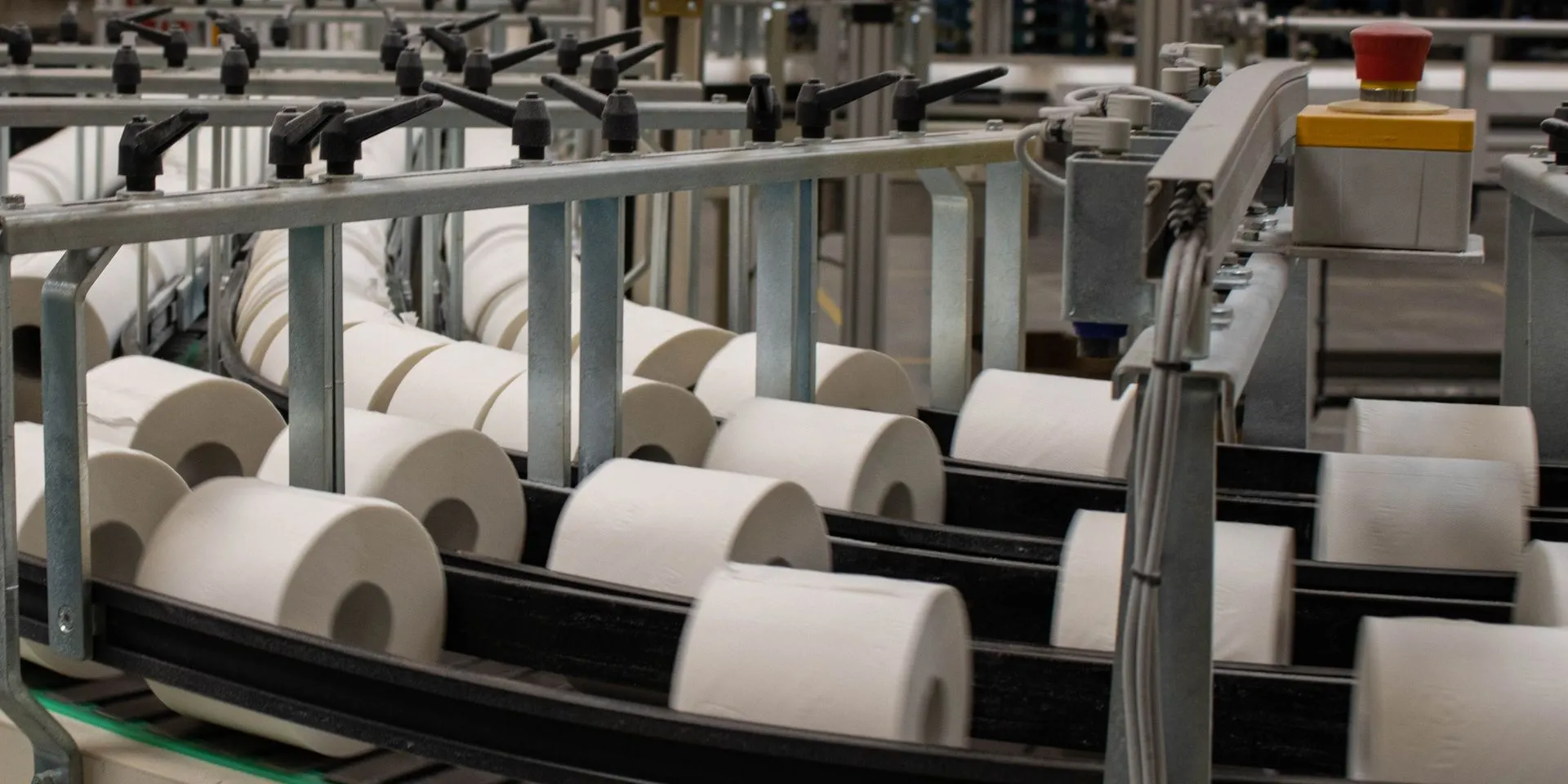
Table of contents
JOA lists its J8T-B baby diaper machine at up to 1,200 products a minute: one diaper every 50 milliseconds. On the consumer goods lines Vladimir Romanov has worked on, the machine that set a line’s pace was rarely its fastest one. It was usually older packaging equipment near the end of the line, a case packer or something like it, that kept failing.
That gap is the practical problem in CPG automation. This guide covers consumer goods manufacturing automation in that sense: the plant controls, machines and plant systems that make detergents, cleaners, personal care products, cosmetics, tissue, diapers, oral care products, aerosols and tobacco, and the rules and hazards that shape them.
Its position is that CPG automation uses the same controls as any other industry. What makes it hard is that one line takes many machine builders, and most problems live in the gaps between their machines. In the plants Vladimir has worked in:
- a line was assembled from many machines by many builders, and each builder brought its own control equipment;
- each builder focused on its own machine, not on the plant’s long-term viability or on how the plant actually ran;
- new lines were mostly upgrades of earlier equipment with new features, commissioned machine by machine, with a lot of engineering labor;
- PackML, the standard machine state model, was rare;
- batching ran mostly on hard-coded sequencers, not batch software.
Around the machines sit rules and hazards most CPG automation guides skip:
- a line that fills cosmetics is a facility registered with FDA;
- an antiperspirant or fluoride toothpaste line runs under drug manufacturing rules that reach the PLC;
- an aerosol line fills flammable propellant in a gas house, and every can, or a sample under an approved alternative, is tested before it ships;
- powder and pool chemical plants carry dust and oxidizer hazards, each with its own code.
Vladimir Romanov, Joltek’s founder, has delivered capital projects and new production lines for a global consumer goods manufacturer, and has worked at several co-packers, including more than two years at one co-packing plant. That work spanned R&D, line speed-ups, new product introductions, obsolescence, data extraction and continuous improvement, on FDA-regulated processes and through multiple audits. The first-hand observations in this guide come from those plants. Everything else is sourced.
It covers, as of October 2026:
- what counts as CPG automation, and how it differs from food;
- how detergents, tissue, diapers, personal care, aerosols and oral care products are made, and the speeds builders list;
- the control architecture of a CPG line, from batching to vision and PackML;
- every product rule that reaches a non-food line, and the hazards most guides ignore;
- changeovers, the machine builders and controls suppliers, the large producers and what changed in 2026;
- cyber incidents, co-packers and private label, packaging and PFAS laws, EU tobacco traceability, KPIs and where to start;
- a 40-term glossary.
This guide is part of Joltek’s series on how automation differs across 39 industries.
What counts as CPG automation, and how is it different from food?
CPG automation means the plant controls, machines and systems that make non-food consumer goods: detergents, cleaners, personal care, cosmetics, tissue, diapers and oral care. The PLCs and networks are the same as in food. What makes it hard is the line itself: many machine builders per line, many formats, and rules from cosmetics, drug and fire codes.
Which products count, by industry code
Statistics agencies sort these plants by product, not by process. In the North American Industry Classification System, soap, cleaning compound and toilet preparation manufacturing is industry group 3256, with four industries:
- 325611, soap and other detergent. The Census Bureau’s index also puts toothpaste, bar soap and hand sanitizer here.
- 325612, polish and other sanitation goods. Household bleach, disinfectants and air fresheners.
- 325613, surface active agents. Surfactants, the compounds in a detergent that remove dirt.
- 325620, toilet preparations. Shampoo, conditioner, sunscreen, deodorant, perfume, makeup and shaving preparations.
The rest of non-food consumer goods is scattered across other codes:
- Aerosols have no code of their own. The product decides, and aerosol filling on a contract basis sits in 325998, all other miscellaneous chemical products.
- Tissue, towel, diapers and feminine products are coded by whether the plant makes the paper: 322120 if it does, and 322291, sanitary paper products, if it converts purchased paper.
- Razors, toothbrushes, candles and tobacco sit elsewhere again: 332215, 339994, 339999 and 312230.
- Contract packaging of client-owned materials is 561910. A contract maker that blends and fills its own formulas is classed under the product code instead.
The codes also shift between surveys. The 2022 Economic Census uses 2022 codes, while the 2023 County Business Patterns and the 2024 Annual Integrated Economic Survey files still use 2017 codes. A company that blends, fills and also packs for others can appear in 325620, 325611 or 561910, depending on its main activity. Group 3256 sits inside chemical manufacturing, subsector 325; the rest of that subsector, from crackers to coatings plants, is covered in the chemical plant automation guide.
How big the industry is
The Census Bureau’s 2024 Annual Integrated Economic Survey, released in September 2026, puts US soap, cleaning compound and toilet preparation manufacturing at $79,267,852,000 in shipments and 101,343 employees in 2024. That is 1.14 percent of all US manufacturing shipments.
| Industry | Code | 2024 shipments | 2024 employees |
|---|---|---|---|
| Soap, cleaning compound and toilet preparation (group) | 3256 | $79,267,852,000 | 101,343 |
| Soap and other detergent | 325611 | $26,158,567,000 | 33,191 |
| Polish and other sanitation goods | 325612 | $8,741,183,000 | 16,530 |
| Surface active agents | 325613 | $8,953,935,000 | 6,504 |
| Toilet preparations | 325620 | $35,414,167,000 | 45,118 |
| Sanitary paper products | 322291 | $15,753,384,000 | 21,104 |
| Tobacco products | 312230 | $60,684,858,000 | 11,214 |
Source: US Census Bureau, 2024 Annual Integrated Economic Survey, released September 10, 2026. Codes as used in the survey file.
Most of these plants are small, but most of the jobs are in large ones. In the 2023 County Business Patterns, 69.5 percent of the 2,502 soap, cleaning compound and toilet preparation establishments had fewer than 20 employees. The 97 with 250 or more employees held 43.5 percent of the industry’s jobs. Sanitary paper plants run larger: 25 of 138, or 18.1 percent, had 250 or more employees, and they held 58.5 percent of the jobs.
For a controls team, that means two very different plants share one label. One is a small blender with a few mixing tanks and a filler. The other is a large site running many high-speed lines.
Canada’s industry is concentrated in two provinces. Statistics Canada puts 2024 revenue of soap, cleaning compound and toilet preparation manufacturing at C$6,695,041,000, of which Ontario was C$4,740,646,000 and Quebec C$1,521,306,000.
How CPG differs from food
In Vladimir’s experience, automating a consumer goods plant is much like automating any other plant. The caveats come mainly from the many machine builders it takes to build one full line. OEE and MES practice looked about the same as in food, and PackML was just as rare.
What does not carry over is the frame around the controls:
- The law. A food plant answers mainly to food safety law. A non-food plant answers to cosmetics, drug, pesticide, consumer product and transport rules, product by product.
- The hazards. Flammable propellants, combustible dust from powders, and oxidizers such as pool chemicals each bring their own code.
- The process. Large parts of the industry convert webs of paper and nonwoven at high speed, where food plants cook, chill and pasteurize.
For the food side of the same plants and suppliers, see the food and beverage guide.
How are detergents, tissue, diapers and personal care products made?
Each sub-segment pairs a process with high-speed packaging. Detergent is batched or spray-dried, tissue is made on a paper machine and then converted, diapers are built on one web converting machine, and lotions and toothpaste are batched and filled. Builders list diaper machines at 1,200 products a minute or more, but the weakest machine sets the line’s pace.
Plant tour
Walk a liquid household products line, from tank to pallet
Seven stages of a line filling a liquid detergent or cleaner. For each one: what happens, who owns the controller's code, the rule that applies, and what to watch for.
Batching
Plant-owned codeThe product is batched in mixing tanks to its recipe before it goes to the filler.
- Controller
- In the plants Vladimir has worked in, batching ran mostly on hard-coded sequencers in the plant's PLC, not batch software.
- Rule
- If the product claims to kill germs, it is a pesticide. The plant must register with EPA as a pesticide establishment before production and report what it made every year.
- Watch for
- A new scent or concentration that means a PLC program change instead of a new recipe record.
Bottle blow molding
Builder's PLCSome plants blow their own bottles on a stretch blow molder before filling.
- Controller
- The machine builder's own PLC and HMI. Serac says a mold change takes 10 minutes.
- Rule
- Washington requires at least 15 percent postconsumer recycled plastic in household cleaning and personal care containers through 2027, 25 percent from 2028 and 50 percent from 2031.
- Watch for
- Each step up in recycled content is a material change, and a line trial for the blow molder, filler and capper.
Filler-capper
Builder's PLCBottles are filled and capped on a rotary filler-capper. Serac lists one at up to 42,000 containers an hour.
- Controller
- The builder's PLC, with a servo-driven capping turret that monitors cap torque.
- Rule
- Household chemicals above set thresholds need child-resistant closures under 16 CFR 1700.14. On the line, that lives in the closure and in whether the capper applies it as designed.
- Watch for
- Rejects from bad seals and bad capping.
Labelling, coding and checkweighing
Device maker's controllerEach bottle is labelled and coded, and a checkweigher rejects bottles outside the weight limits.
- Controller
- The labeller's, coder's and checkweigher's own controllers, linked to the line.
- Rule
- A disinfectant's label carries "EPA Est." and the registration number of the plant that made it.
- Watch for
- Giveaway. NIST Handbook 133 sets the floor for net contents but no limit on overfilling. How far above the label to fill is the packer's choice.
Case packing
Builder's PLCBottles are packed into cases.
- Controller
- Usually a builder's machine with its own controls, often older than the machines around it.
- Rule
- Machine safety: ANSI/PMMI B155.1-2023 covers packaging machinery, and NFPA 79 (2024) adds a cybersecurity clause that applies when the purchase specification asks for it.
- Watch for
- On the lines Vladimir has worked on, older packaging equipment such as the case packer was usually the constraint, not the fastest machine. Bad glue is a common reject.
Palletizing
Builder's PLCCases are stacked onto pallets and wrapped for shipping.
- Controller
- The builder's PLC, tied to the case packer and the line by handshake signals.
- Rule
- For plants shipping to the EU, the packaging regulation requires at least 40 percent of transport packaging to be reusable from 2030.
- Watch for
- The handshakes between machines. That is where most of a line's problems sit.
Cleaning and changeover
Plant-owned procedureBetween products, the tanks and filler are cleaned, and the line changes size, scent or format.
- Controller
- Serac says its clean-in-place sequences for household and personal care fillers can be automated and run in sequence.
- Rule
- No regulator sets a changeover time. The useful benchmark is the plant's own: last good unit to first good unit, by product pair.
- Watch for
- In the plants Vladimir has worked in, a changeover took a crew of about five, mostly mechanical and process work.
Laundry and dish detergents
Powder detergent is still made the way EPA described it in its 1993 emission-factor text for soap and detergents: slurry preparation, spray drying and granule handling.
- Slurry. Liquid surfactant is blended with powdered and liquid builders and additives in a closed mixing tank called a crutcher. The slurry is held in a surge vessel and pumped continuously to the dryer.
- Spray drying. The slurry is sprayed at 4,100 to 6,900 kilopascals through single-fluid nozzles into a tower of hot air at 315 to 400 degrees C. Most towers are 4 to 7 meters across and 12 to 38 meters tall.
- Granule handling. The granules are conveyed to a mixer for dry and liquid additions, then to packaging and storage.
The same EPA document gives the dust figure: 45 kilograms of particulate per megagram of product from uncontrolled spray drying, cut to 0.54 kilograms with a fabric filter. Dust also comes from the scale hoppers, mixers and crutchers during batching. EPA itself flags its age. Its factors “are estimations and are not supported by current test data”, and the text notes that liquids had already reached 40 percent of US laundry detergent sold, while half of the granule spray drying plants had closed since 1970.
Liquids are batched and filled:
- Filling. Serac lists its RB rotary filler-capper at up to 42,000 containers an hour, or 700 a minute, for detergents, household products and personal care.
- Weight filling. Serac argues for weighing foaming and viscous liquids into each container. It says weight filling handles a container size ratio of 1 to 20 against 1 to 6 for volumetric filling. It adds that with an Automatic Weighing Instrument type approval, its fillers remove the need to overfill slightly.
Unit-dose packets have their own machine. Cloud Packaging Solutions lists its Hydroforma SP, which thermoforms, fills and seals water-soluble pouches, at up to 1,200 pouches a minute for powder and 700 for liquid. Liquid laundry packets also fall under a voluntary safety standard, ASTM F3159, covered with the rules below.
Tissue and towel
A tissue plant joins a continuous paper machine to discrete converting lines.
The paper machine. ANDRITZ supplies tissue lines “from stock preparation to the reel”, and lists its PrimeLine W 2200 at a design speed of 2,200 meters a minute, 5,600 millimeters wide at the reel and up to 280 tons a day. Valmet lists its Advantage DCT range from 2,000 meters a minute and 118 tons a day up to 2,200 meters a minute and 333 tons a day. The sheet dries on a Yankee dryer, a large steam-heated cylinder. Valmet builds it in 18 or 22 foot diameters, and ANDRITZ claims its steel design evaporates 15 to 20 percent more than a cast-iron one of the same size.
Converting. The paper machine winds a parent reel. Converting lines unwind it, rewind the sheet into logs, saw the logs into rolls, then wrap and bundle them.
- Valmet lists its Perini X10 Pro rewinder line at up to 550 meters a minute and 35 logs a minute, with servo controls monitoring log growth during rewinding.
- Its Perini Proxima S6 runs at up to 600 meters a minute and 30 logs a minute. Core diameter is changed from the HMI, and a vacuum system on the log saw cuts cleaning and fire risk.
- Perini has belonged to Valmet since November 2, 2023, when Valmet completed its purchase of Körber’s tissue business for about 380,000,000 euros.
Web breaks. In Vladimir’s experience, breaks on web lines are mostly process and raw-material related. Good sensors and feedback loops help diagnose and prevent the major ones. The controls rarely cause a break, but they are how a plant finds out why one happened.
Diapers and feminine care
A baby diaper machine builds the product from webs in one continuous machine:
- JOA lists its J8T-B at up to 1,200 products a minute and 600 meters a minute, for sizes newborn to 7. Its rolls feed accumulator-less turret unwinds, and raw material is delivered on a platform above the machine.
- Zuiko lists its premium baby diaper machines at 1,000 pieces a minute and its standard ones at 700, with a full servo drive system. Its premium feminine napkin line is listed at 1,400 pieces a minute.
- GDM says its lines can exceed 1,200 pieces a minute for diapers, adult briefs and underpads, with servo automation and vision-based quality control.
JOA’s platform list shows how far one builder’s range runs: baby diapers and pants, adult pants and briefs, feminine napkins, panty liners, light incontinence products and underpads.
Vision is part of the machine. JOA says the J8T-B’s vision system inspects products in-line at full machine speed and “automatically rejects single products and self-corrects the machine”. At one product every 50 milliseconds, inspection and rejection have to be automatic and product by product.
Personal care and cosmetics
Creams and lotions are emulsions. The oil and water phases are prepared separately and mixed into an emulsion, helped by heating to 45 to 85 degrees C depending on the formula and its viscosity. Mixing continues until the batch is homogeneous.
Silverson sizes its batch high-shear mixers for batches up to 400 US gallons, with sealed units for pressure or vacuum, and its in-line mixers for larger batches. Downstream, bottles go through the same kind of rotary filler-capper as household liquids, and tubes through the tube fillers described under oral care.
The process looks the same for a lotion and a sunscreen. The rules do not, as the rules section below shows.
Aerosols
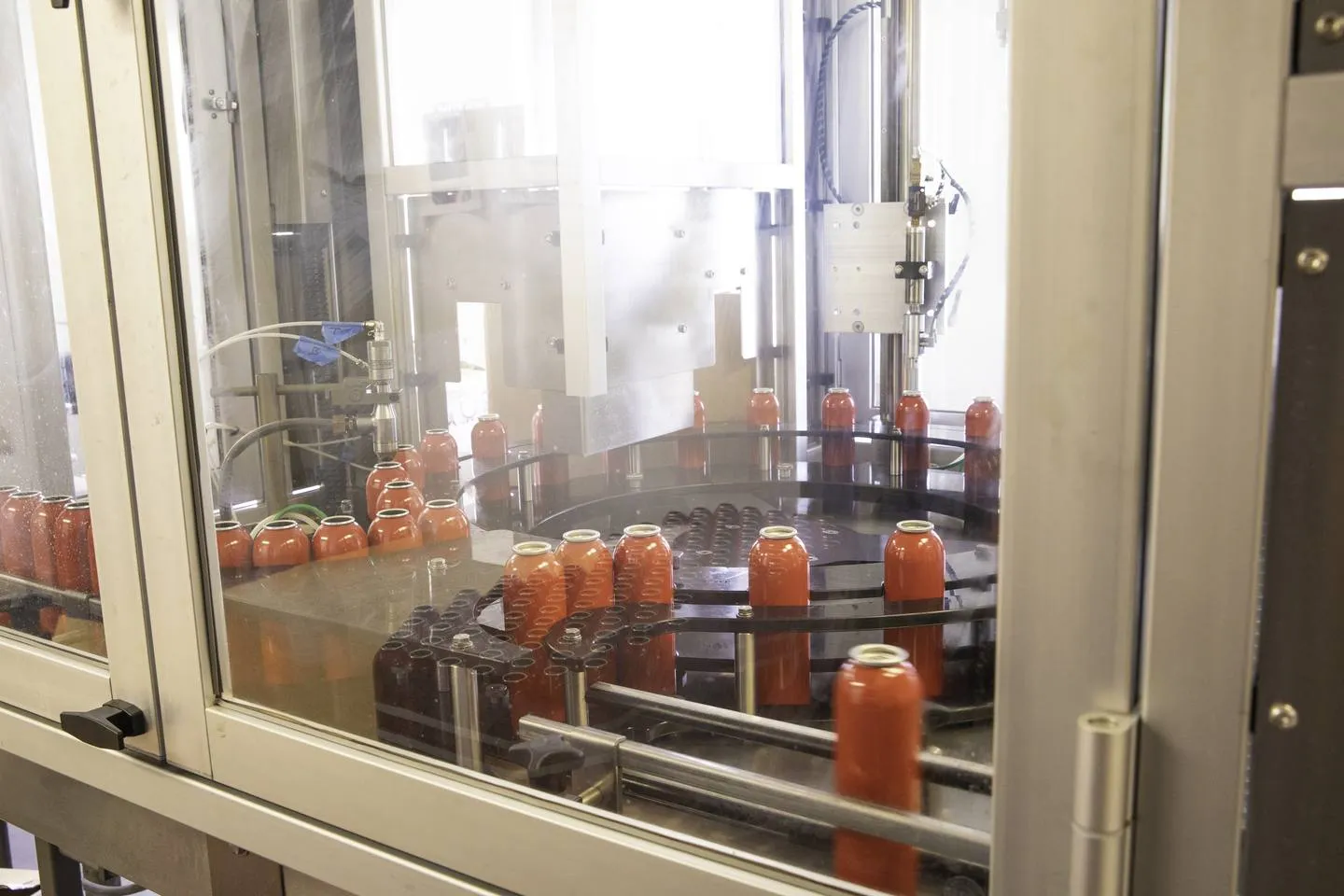
An aerosol line fills the product, places and crimps the valve, adds propellant, then tests every can. R.A Jones, a Coesia company, lists a chain of KP-Aerofill machines for this:
- a timed-orifice product filler at up to 600 cans a minute;
- a valve inserter and a pneumatic crimper at 500;
- a through-the-valve propellant filler at 600.
Its AM-600 monoblock does the work in one rotary machine at up to 600 cans a minute, rated NEC Class I, Division 1, Groups C and D. Its crimper is rated ATEX II 2G. Pamasol lists modular systems at up to 600 containers a minute, and also sells bag-on-valve lines.
Then comes the test bath. R.A Jones lists clip-style baths from 60 to 320 cans a minute and a magnetic bath at 395. The bath exists because of a transport rule: every filled can must be heated to prove it holds pressure before it ships as a limited quantity, unless the plant uses an approved alternative. The hazard ratings exist because of the propellant. Both are covered below.
Oral care
Toothpaste is a batch process with an air problem. Silverson describes the order of addition:
- the liquid base of water with sorbitol or glycerin;
- the rheology modifiers;
- the active ingredient, sweetener and preservative;
- the abrasive or filler;
- flavor and color;
- the detergent last, under slow agitation to limit foaming.
Because powders carry air and detergent makes it worse, mixing “is usually carried out under vacuum”. A typical white paste is 20 to 50 percent abrasive and 0.3 percent fluoride. A fluoride toothpaste is also an over-the-counter drug, which brings drug manufacturing rules into the mixing room.
Tubes are filled on dedicated machines. Coesia lists Norden tube fillers from 40 tubes a minute (NM 402) to 500 (NM 5002), and its NF series from 300 to 1,000. Toothbrushes are a different machine again: Zahoransky lists its Z.orca 216 double tufting machine at up to 2,400 tufts a minute.
Rated speed against the real constraint
The speeds above are maximums from builders’ own pages and brochures.
| Machine | Builder and model | Listed maximum |
|---|---|---|
| Baby diaper machine | JOA J8T-B | 1,200 products a minute |
| Baby diaper machine | Zuiko, premium | 1,000 pieces a minute |
| Feminine napkin line | Zuiko, premium | 1,400 pieces a minute |
| Water-soluble pouch machine | Cloud Packaging Hydroforma SP | 1,200 a minute (powder), 700 (liquid) |
| Rotary filler-capper | Serac RB | 700 containers a minute |
| Aerosol monoblock | R.A Jones KP-Aerofill AM-600 | 600 cans a minute |
| Aerosol test bath | R.A Jones AB-395 | 395 cans a minute |
| Tube filler | Coesia Norden NF 1000 | 1,000 tubes a minute |
| Toothbrush tufting machine | Zahoransky Z.orca 216 | 2,400 tufts a minute |
| Tissue rewinder line | Valmet Perini X10 Pro | 35 logs a minute |
| Tissue machine | ANDRITZ PrimeLine W 2200; Valmet DCT 300 | 2,200 meters a minute |
Sources: builders' product pages and brochures (JOA, Zuiko, Cloud Packaging Solutions via Food Engineering, Serac, R.A Jones, Coesia, Zahoransky, Valmet, ANDRITZ), read October 2026. Listed maximums, not running speeds.
At 1,200 products a minute, a diaper machine makes one product every 50 milliseconds. No public source reports how fast these machines actually run on real lines, or how much speed they lose against nameplate.
On the consumer goods lines Vladimir has worked on, the constraint was rarely the headline machine. It was usually older packaging equipment that kept failing: case packers and the like. Rejects came from many causes, among them bad seals, bad capping and bad glue. A line runs at the pace its weakest machine allows, so a faster primary machine does nothing for a line whose case packer is the constraint. One example of the work this takes: buying back throughput on a high-volume consumer goods line.
What does the control architecture of a CPG line look like?
A CPG line is a chain of machines, each from its own builder with its own controls, tied to each other and to plant systems above. In the plants Vladimir has worked in, liquids were batched by hard-coded sequencers more than batch software. Converting and packaging run on servo motion, registration and vision. PackML exists, but few lines use it.
The levels, from sensor to ERP
ISA-95 gives the vocabulary. Its Part 1, revised in 2025, describes five levels:
- level 0, the physical process;
- level 1, sensing and manipulating;
- level 2, monitoring and supervisory control by PLCs and DCSs;
- level 3, manufacturing operations management, such as MES and SCADA;
- level 4, business planning and logistics in ERP.
On a CPG line, levels 1 and 2 arrive inside each builder’s machine. For how the levels work in a real plant, see the ISA-95 levels in practice.
Batching: ISA-88 or a hard-coded sequencer
ISA-88 is the batch control standard. Part 1 sets models and terminology, Part 2 data structures, Part 3 general and site recipe models, and Part 4 batch production records. A technical report covers using ISA-88 and ISA-95 together. Rockwell Automation markets batch control to household and personal care plants and names “greater recipe diversity” among their challenges. Siemens promotes digital recipe management for consumer packaged goods.
In the plants Vladimir has worked in, batching ran mostly on hard-coded sequencers, not batch software. The consequence is practical:
- The recipe lives in the program. A new scent, color or concentration can mean a PLC program change, with the testing and change control that comes with it, rather than a new recipe record.
- The rules follow the program. In a plant that also makes cosmetic-drugs, changes to master production and control records may be made only by authorized people, so the sequencer’s code falls under the drug rules described below.
Web handling, registration and vision
Converting and hygiene machines are motion problems:
- Tension. A web line is split into tension zones. Unwind servos run in a master and slave relationship, with slave axes electronically geared to a master encoder and a dancer or servo current supplying tension feedback. As the roll shrinks, the controller keeps updating the gear ratio between the unwind spindle and the pull roll.
- Registration. A photo eye detects the print marks, and the axis position is latched in the motion controller, so cuts, prints and seals stay aligned.
- Format. Because cut length is a number in the controller, a converting line can run different products without hardware changeovers, by changing the electronic gear ratio.
That description comes from a 2006 Machine Design article. The builders build the same ideas into today’s machines. JOA’s diaper machine inspects in-line and rejects single products, Zuiko lists a full servo drive system on its diaper and napkin machines, and Serac’s capping turret is a brushless servo drive that monitors and registers cap torque.
PackML, and why it is rare
PackML is the attempt to make machines from different builders look alike to the line:
- Who made it. OMAC, the Organization for Machine Automation and Control, developed it, and ISA adopted it as ISA-TR88.00.02.
- What it defines. Standard machine states and modes, common OEE and root cause data, and flexible recipe handling, so a line controller, SCADA or MES can treat every machine the same way.
- Its OPC UA form. OPC 30050, version 1.01 of November 2020, sets the standard unit modes: Producing, Manual, Maintenance, Clean and Calibration.
Builders say they support it. Beckhoff, for example, lists pre-built packaging software blocks and PackML support in TwinCAT. How many plants actually require it is unknown: no survey of PackML requirements in non-food consumer goods plants was found. In the plants Vladimir has worked in, PackML was rare.
Networks and machine safety
Three industrial Ethernet networks meet on these lines:
- EtherNet/IP runs the Common Industrial Protocol over standard Ethernet, with conformance testing by ODVA.
- EtherCAT, developed by Beckhoff, is designed for cycle times of 100 microseconds or less.
- PROFINET offers performance features for cycle times down to 31.25 microseconds.
Each machine arrives on whichever network its builder chose. No public source states which network dominates non-food CPG plants.
Machine safety has its own set of standards:
- ANSI/PMMI B155.1-2023, released in July 2023, for packaging, converting and related conveying machinery;
- ISO 13849-1:2023, for the safety-related parts of control systems, which replaced the 2015 edition;
- NFPA 79, the electrical standard for industrial machinery. Its 2024 edition adds a clause on cybersecurity in network-connected machinery, written to apply when a customer specification, policy or regulation triggers it. A plant that wants it has to ask for it in the purchase specification.
Who owns the machine code
This is where the position of this guide comes from. When a plant brings in many machines from many builders, it brings in different control equipment. Each builder focuses on its own machine, rather than on the plant’s long-term viability or how the plant actually runs. The result is a line of islands: each machine with its own PLC brand, its own HMI, its own code and often its own owner of that code.
The gaps between the islands are where the line’s problems sit:
- the handshake signals between machines;
- the accumulation and speed-following logic;
- who is allowed to change any of it.
A plant that cannot open a machine’s program cannot fix the handshake from its own side. One example is a converting line mixing Omron and Rockwell controls. Knowing who changed which machine’s code, and when, is the job of version control for machine code.
Which rules reach a non-food consumer goods plant?
In the United States, five sets of product rules reach a non-food consumer goods line: FDA’s cosmetics law (MoCRA), drug CGMP for products such as antiperspirant, sunscreen and fluoride toothpaste, EPA rules for disinfectants, CPSC packaging rules and DOT rules for aerosols. The drug and aerosol rules reach into the control system. MoCRA’s GMP rule has still not been proposed.
A food plant answers mainly to food safety law. A non-food consumer goods plant answers to whatever law covers each product it makes, and one plant can make products under several:
- a personal care plant can run a shampoo line under the cosmetics law beside an antiperspirant line under drug law;
- a household products plant can fill a cleaner under consumer product rules and a disinfectant under pesticide law;
- an aerosol line adds a transport rule that tests the cans on the line.
The table maps each rule to the part of the line it lands on. Fire and hazard codes reach the same plants and are covered in the next section.
| Rule | What it covers | What it asks of the line | Where it lands |
|---|---|---|---|
| MoCRA, the cosmetics chapter of the Federal Food, Drug, and Cosmetic Act | Facilities that make or fill cosmetics for the US market | Facility registration, product listing, adverse event reports; the GMP rule is not yet proposed | Product data, records, change control |
| Drug CGMP, 21 CFR Parts 210 and 211 | Cosmetic-drugs: antiperspirant, sunscreen, fluoride toothpaste, anti-dandruff shampoo | A quality unit; automated equipment on a written check program; changes to master records by authorized people only; batch records naming who checked automated steps | Recipe and PLC access, calibration, batch records, data backup |
| 21 CFR Part 11 | Electronic records kept to meet drug CGMP | Validation, limited access, audit trails | Historians, batch reports, HMI logins |
| EPA, FIFRA establishment rules (40 CFR 167) | Plants that make disinfectants and other pesticides | Registration before production; an annual production report; the “EPA Est.” number on each label | Label data, production reporting |
| CPSC, 16 CFR 1700.14 | Mouthwash, fluoride products and household chemicals above set thresholds | Child-resistant packaging | Closures and cappers |
| ASTM F3159 (voluntary) | Liquid laundry packets | Packet safety requirements | Film, packaging, warnings |
| DOT, 49 CFR 173.306 | Aerosols shipped as limited quantities | A hot water bath for every filled can, or one of four alternatives | Test baths, checkweighers, pressure and leak testers, reject logic |
| Canada: Cosmetic Regulations, Natural Health Products Regulations, Consumer Chemicals and Containers Regulations, 2001 | Products sold in Canada | Cosmetic notification; site licenses and GMP for natural health products; hazard labels and child-resistant containers | Records, labels, closures |
Sources: the Federal Food, Drug, and Cosmetic Act; eCFR titles 16, 21, 40 and 49; ASTM International; Justice Laws Canada. Current as of October 2026.
MoCRA: registration, listing and a GMP rule that does not exist yet
The Modernization of Cosmetics Regulation Act, signed on December 29, 2022, added a cosmetics chapter to the Federal Food, Drug, and Cosmetic Act. It reaches the plant in three ways:
- Registration. Every facility that makes or processes cosmetics for distribution in the United States must register with FDA, within 60 days of starting, renew every two years, and report changes within 60 days. The law excludes a site that only labels, packages or holds product, but says that packaging does not include “filling a product container with a cosmetic product”. A filling line is a facility. A contract plant that makes cosmetics for several brands needs only one registration.
- Listing. The brand owner, which the law calls the responsible person, must list each product within 120 days of first sale and update the listing every year. Each listing carries the registration number of every facility that makes the product, and its full ingredient list, including fragrances, flavors and colors. A formula change or a move to another plant has to show up in the listing.
- Scale and thresholds. FDA counted 16,398 active facility registrations and 1,298,361 active product listings on June 30, 2026, and began enforcing registration and listing on July 1, 2024. A business with average US cosmetics sales under $1,000,000 a year is exempt from the registration, listing and GMP sections, unless its products contact the eye, are injected or taken internally, or change appearance for more than 24 hours.
What MoCRA does not yet do is set manufacturing practice. It told FDA to write cosmetic GMP rules “consistent, to the extent practicable, and appropriate, with national and international standards”, with a proposed rule due by December 29, 2024 and a final rule by December 29, 2025. Both dates have passed:
- As of October 23, 2026, no proposed or final rule had appeared in the Federal Register.
- A law firm’s review of FDA’s spring 2025 regulatory agenda found the rule moved to the long-term list, with no proposed rule date.
- FDA’s only cosmetic GMP text is a 2013 draft guidance, written after reviewing ISO 22716, which FDA says it intends to withdraw or revise once the rule is done.
Until the rule exists, three things set a cosmetic line’s manufacturing practice:
- the Act’s existing ban on cosmetics “prepared, packed, or held under insanitary conditions”;
- ISO 22716:2007, the international cosmetics GMP guideline, which ISO confirmed as current in 2022;
- for products sold in Europe, the EU Cosmetics Regulation, which requires GMP and presumes it where manufacture follows the published harmonised standards.
For a controls team, the practical reading is that no US cosmetics rule today specifies access control, audit trails or electronic records for a cosmetic line. That changes when FDA’s rule is final, and the law points that rule at existing national and international standards.
When a cosmetic is also a drug
An antiperspirant, a fluoride toothpaste, an anti-dandruff shampoo, or a moisturizer or makeup with a sun-protection claim can be both a cosmetic and a drug. FDA says such products “must comply with the requirements for both cosmetics and drugs”. MoCRA steps aside for them: a product or facility subject to the drug rules is exempt from MoCRA’s GMP, registration and listing sections. The drug rules reach much further into the control system.
These products are made under FDA’s over-the-counter monographs, among them M019 for antiperspirants, M020 for sunscreens and M021 for anticaries products, the category that covers fluoride toothpaste. Each monograph drug facility pays an annual user fee: $47,891 for fiscal 2027, or $31,927 for a contract manufacturing facility. The manufacturing rules are FDA’s drug current good manufacturing practice regulations, 21 CFR Parts 210 and 211, “the minimum current good manufacturing practice” for making a drug. A drug made outside them is adulterated.
Part 211 is where the plant’s controls enter the rule:
- A quality unit with authority. A quality control unit must be able to approve or reject components, containers, closures, in-process materials, packaging, labeling and finished product, and must review production records. Production and process control procedures must be written, and deviations “recorded and justified”.
- Automated equipment on a written program. Section 211.68 allows computers and automatic equipment if they are “routinely calibrated, inspected, or checked according to a written program”, with records. Changes to master production and control records may be made “only by authorized personnel”. Inputs and outputs must be checked for accuracy, and data must be backed up.
- Who checked the machine. A batch production record must identify who performed or checked each significant step. If automated equipment performed the step, the record must identify “the person checking the significant step performed by the automated equipment”.
- Electronic records. Records kept electronically to meet those rules fall under 21 CFR Part 11, which for a closed system requires validation, access limited to authorized people, and “secure, computer-generated, time-stamped audit trails”. FDA has said since 2003 that it reads Part 11’s scope narrowly, but the underlying record rules still apply. Its 2018 data integrity guidance asks for data that is attributable, legible, contemporaneously recorded, original and accurate, known as ALCOA, with validation “commensurate with the risk posed by the automated system”.
In control system terms, the difference between a lotion line and a sunscreen line comes down to four questions:
- who can change a recipe or a setpoint;
- whether each step the PLC performs is checked, and by whom, in the batch record;
- whether the instruments are on a written calibration program;
- whether the electronic batch record has an audit trail.
Vladimir has worked on many FDA-regulated processes and been through multiple audits. In Vladimir’s experience, no two were the same: each process brought its own requirements, on the process side and on the controls side.
Disinfectants are pesticides
A cleaner that claims to kill germs is regulated differently from one that only cleans. EPA treats any product sold with a claim that it can prevent, destroy, repel or mitigate a pest as a pesticide, and its own disinfectant page says plainly: “Disinfectants are pesticides and can be harmful.” Under FIFRA, the federal pesticide law, every establishment where a pesticidal product is produced must be registered with EPA, and its number must be assigned “before any production may occur”:
- the producer files an annual report of what it made, sold and plans to make by March 1, “even if the producer has produced no pesticidal product for that reporting year”;
- the label carries “EPA Est.” and the registration number of the final establishment where the product was produced.
For the line, the label data becomes part of the regulated record. The establishment number printed on each package names the plant that made it, and production quantities by product feed a federal report.
Child-resistant packaging and laundry packets
The Poison Prevention Packaging Act rules in 16 CFR 1700.14 require child-resistant “special packaging” for household products above set thresholds, among them:
- mouthwash with 3 grams or more of ethanol in one package;
- household substances with more than 50 milligrams and 0.5 percent of elemental fluoride;
- liquid household chemicals with 10 percent or more hydrocarbons and low viscosity, including drugs and cosmetics;
- liquids with 10 percent or more ethylene glycol or turpentine.
The package must pass panel tests. Child-resistant effectiveness must be at least 85 percent without a demonstration and 80 percent after one, and senior-adult use effectiveness at least 90 percent. On the line, that requirement lives in the closure, and in whether the capper applies it as designed.
Liquid laundry packets are different. There is no mandatory federal standard. CPSC’s page names the voluntary standard ASTM F3159, whose active edition is F3159-15, reapproved in 2022, and lists no rulemaking. CPSC staff reported in 2020 that:
- industry had adopted the standard’s measures by December 2016, and nearly all products for sale complied;
- estimated emergency department visits for children under five were 4,200 from July 2012 to June 2013, and 3,600 in 2019.
Aerosols: the hot water bath and its alternatives
A consumer aerosol can ship as a limited quantity under 49 CFR 173.306 if:
- the container holds no more than 1 liter;
- its pressure stays at or below 180 psig at 54.4 degrees C (130 degrees F);
- it can withstand 1.5 times that equilibrium pressure without bursting.
To prove it, the rule puts a test on the line. Each filled container, “after it is filled”, goes through a hot water bath that brings its internal pressure to what it would reach at 55 degrees C (131 degrees F), with no leakage or permanent deformation allowed. R.A Jones, for example, lists a magnetic test bath at 395 cans a minute.
The rule allows four alternatives to bathing every can:
- An alternative water bath. One filled container in each lot of 2,000 is bath-tested, a second is weight-checked, and the rest are inspected visually.
- An automated pressure test. This needs:
- a written pressure specification for each container design or content;
- automatic rejection of any container outside it;
- instruments “properly calibrated before a production run”;
- periodic inspection of a random container. If it fails, five more are checked, and if any of those fail, everything made since the last inspection is rejected.
- A weight test. This needs a target weight for each container, scales “sufficiently sensitive to measure within 0.10 g of the true weight”, a heat test of one container from each lot of no more than 2,000, and a visual inspection of every container before packing.
- A leakage test. Each empty container is pressure- and leak-tested before filling. Each filled container is then weighed and leak-tested with equipment that detects a leak rate of 2.0 x 10^-3 mbar L/s at 20 degrees C.
This is the one rule in this section that writes test-and-reject logic for the line. Replacing the bath with a pressure or weight test moves the safety case into the controls:
- the specification for each container;
- the calibration before each run;
- the reject decision;
- a fallback rule that can scrap everything made since the last good check.
Plastic aerosol containers have narrower options. They can use the limited-quantity exception only for nonflammable Division 2.2 gases, up to 160 psig, and only with the bath or the leakage test.
The definition is also moving. PHMSA’s final rule of August 4, 2026, effective September 3, 2026, changed the definition of an aerosol so that a container holding only a gas can qualify, matching international definitions. FDA adds its own warning for cosmetics in pressurized containers, beginning “Avoid spraying in eyes. Contents under pressure.”
Canada
Canada splits the same products across different laws:
- Cosmetics. A manufacturer or importer must notify Health Canada within 10 days after first selling a cosmetic, listing the ingredients by INCI name with their concentrations. The Cosmetic Regulations contain no good manufacturing practice provisions. New fragrance allergen labeling rules were adopted in 2024 but, as of October 15, 2026, were still listed as not in force.
- Natural health products. No one may manufacture, package, label or import one for sale without a site license. The work must follow the regulations’ good manufacturing practices, and the license application needs a quality assurance report showing that it does.
- Consumer chemicals. The Consumer Chemicals and Containers Regulations, 2001 set hazard statements and child-resistant containers for toxic, corrosive and flammable consumer chemicals. They also set fixed warnings for pressurized containers, including “CONTENTS UNDER PRESSURE” and “CONTAINER MAY EXPLODE IF HEATED”.
- Other consumer products. The Canada Consumer Product Safety Act excludes cosmetics but covers most other consumer products. It requires incident information within two days and a written report within 10 days.
Which hazards do most CPG automation guides ignore?
Flammable propellants, combustible dust and oxidizers. An aerosol gas house falls under NFPA 30B, whose draft next edition classifies checkweighers and test baths. Spray drying and powder handling make dust, and where it is combustible, NFPA 660 requires a dust hazard analysis. Oxidizers such as pool chemicals have their own code, and a 2024 warehouse fire showed the stakes.
Aerosol propellants and the gas house
Almost all domestic aerosols use flammable LPG propellants, blends of propane and butane. That comes from a 2018 IChemE conference paper by engineers at MMI Engineering and Unilever, which describes the setup:
- Speed and quantity. Cans are filled at up to 500 a minute, with up to 200 milliliters of LPG each.
- The gas house. Filling is done in dedicated, unmanned buildings outside the main factory.
- The layers of protection. Hazardous area classification, gas detection, forced ventilation, unmanned operation and automatic shutdown, with explosion relief through vent panels or a lifting roof.
The same paper found the NFPA 68 venting correlations “somewhat simplistic”, and full-scale testing the only way to validate one gas house design.
The governing code in the United States is NFPA 30B, the Code for the Manufacture and Storage of Aerosol Products. The second draft of its next edition, in development as the 2027 edition, reaches further into the line’s equipment than most controls teams expect:
- The charging room. Electrical equipment and wiring in propellant charging and pump rooms must suit Class I, Division 1, or Zone 1 or Zone 0 locations.
- Checkweighers. One inside the charging room carries the same rating. One outside it, handling product with flammable gas or Class I liquid before leak verification, is Class I, Division 2 or Zone 2, along with the area within 1.5 meters of it. Leak detection equipment follows the same pattern.
- Button tippers and test baths. The enclosure of one handling such product is Division 1, or Zone 1 or 0, with Division 2 for 1.5 meters around it.
- Larger containers. Rooms that fill pressurized cylinders larger than 1,000 milliliters, such as industrial spray adhesives and expanding foam, come under the same chapter.
For the code’s purposes, a Class I liquid has a flash point below 37.8 degrees C. Confirm the edition in force with NFPA before design work starts.
OSHA’s rules sit underneath the code:
- Storage. A flammable aerosol is treated as a Category 1 flammable liquid for container storage.
- Classified locations. Under 29 CFR 1910.307, equipment and wiring must suit the vapors, dusts or fibers present and how likely they are to be present, and each room is considered individually. Classified areas set up after August 13, 2007 must be documented, and the documents must be available to the people who design, install, inspect, maintain or operate the equipment.
- Divisions and zones. In Division 1, ignitable concentrations may exist in normal operation. In Division 2, they escape only in an accident or abnormal operation, or are normally kept away by ventilation that could fail.
In Joltek’s reading, that makes the area classification drawing a controls document. It decides which sensors, drives, checkweighers and HMIs can sit in and around the gas house, and a change of product or propellant can change it.
What Accra Pac taught about interlocks
On June 24, 1997, the gas house for filling line 61 at Accra Pac Group’s North Plant in Elkhart, Indiana exploded. One employee died, 59 people sought medical treatment, and the area within a one-mile radius was evacuated. The plant made pressurized containers, mostly consumer aerosols such as hair sprays and deodorants.
EPA’s investigation report reads like a controls case study:
- A breathing air pump stopped.
- The operator shut the filling operation down in a hurry, without closing any valve in the ethylene oxide supply system.
- On returning, the operator found a hydrocarbon alarm tripped at 40 percent of the lower explosive limit.
- As the operator left the gas house, it exploded.
EPA noted that the plant did not know what ethylene oxide level would trip that alarm, because the alarm was set for hydrocarbons.
EPA named six root causes and contributing factors. Four of them bear on equipment and controls:
- an inadequate shutdown procedure;
- a reclamation tank inside the gas house holding up to 20 pounds of ethylene oxide, with no level monitoring;
- explosion vents sized for propane, when ethylene oxide burns more than twice as fast;
- electrical equipment that did not meet the National Electrical Code for a Class I, Division 1, Group B material.
Its first recommendation was an interlock: “valves in ethylene oxide feed lines that close automatically when the conveyor line is stopped”, with remote manual shutdown so no one has to enter the hazardous area.
The lessons travel to any gas house:
- A shutdown that depends on a person closing valves in a hurry is not a shutdown. Put the safe state in the interlock.
- A detector calibrated for one gas says little about another. The alarm point has to match the material actually in the room.
- A material change can change the hazard without changing the room. Here, ethylene oxide sat in a room vented for propane.
Combustible dust
Detergent spray drying is a dust process. EPA says blending, mixing, drying and packaging may all involve dust emissions. It calls spray drying “the single largest source of dust in the manufacture of synthetic detergents”, at 45 kilograms of particulate per megagram of product uncontrolled.
NFPA 660, the Standard for Combustible Dusts and Particulate Solids, replaced six earlier dust standards (NFPA 61, 484, 652, 654, 655 and 664) in December 2024, according to trade press:
- Layout. General requirements come first and commodity chapters after. Chapter 25, for all other combustible materials, carries the former NFPA 654 content.
- The dust hazard analysis. New and existing facilities in its scope must complete one, with no deadline given. NFPA began requiring a dust hazard analysis “as recently as 2015”, and the CSB likens it to the process hazard analysis in OSHA’s process safety standard.
- Force. The standards bind through the authority having jurisdiction, which can apply new or revised requirements.
OSHA has no combustible dust standard. In its 2006 study the CSB counted at least 281 combustible dust fires and explosions in general industry from 1980 to 2005, with at least 119 deaths, and found that no OSHA standard comprehensively addresses the hazard. As of October 2026, OSHA had published no proposed rule.
The investigated cases come from other industries, but the lessons transfer:
- Didion Milling, 2017. A dust explosion killed five of 19 workers. The CSB called for third-party dust hazard analyses, minimum transport velocity in dust collection ducts, deflagration venting and suppression, and management of change for dust.
- A spray tower dryer, Marseille, 2010. At a fungicide plant, a dryer exploded 47 minutes after a restart following maintenance. Its temperature and pressure detection, suppressant injection and vents kept the explosion from spreading. The French accident database records the lesson for the restart: check vent stroke limiters, automatic vent closure, pressure recordings and dust nests before bringing a dryer back.
Oxidizers and the Conyers fire
Pool and cleaning chemicals bring a third hazard. At about 5:00 a.m. on September 29, 2024, at the Bio-Lab warehouse in Conyers, Georgia:
- The failure. A corroded sprinkler component failed and let water reach chlorinated isocyanurates, starting a decomposition reaction. The heat set off more sprinklers, which wet more chemicals.
- The inventory. The building held nearly 14 million pounds of reactive chemicals, more than twice the roughly 6.2 million pounds reported to local officials in 2019.
- The consequence. About 17,000 residents were evacuated, and about 90,000 people were advised to shelter in place.
The operation belonged to KIK Consumer Products, a maker of consumer pool and cleaning products.
The CSB’s final report, released on July 21, 2026, lists five key safety issues, with “run to failure” first. Its lead investigator said the chemicals are not covered by OSHA’s process safety management standard. The CSB made seven recommendations, all open:
- four to KIK, including a corporate standard for storing and handling bulk pool chemicals and a way to assess third-party facilities;
- three to NFPA, to revise NFPA 400, which assigns oxidizers to Classes 1 to 4 using reaction-to-fire tests.
For a maintenance and controls team, “run to failure” is the line to take away. The part that failed was a corroded component of the fire protection system itself.
Why do changeovers decide so much in a CPG plant?
Because one line makes many sizes, scents and formats, and every switch stops production. In plants Vladimir has worked in, a changeover took a crew of about five, mostly mechanical and process work with some automation and setpoint validation. Builders now sell recipe-driven servo changeovers, but no independent benchmark for changeover time exists in non-food consumer goods.
What a changeover actually takes
In the plants Vladimir has worked in, a changeover took a crew of about five. Most of the work was mechanical and process change, with some automation work and setpoint validation. That split matters: a changeover program that starts with the PLC starts with the smallest part of the job.
The method most plants reach for is SMED, single-minute exchange of die, developed by Shigeo Shingo:
- separate the internal setup tasks, which need the machine stopped, from the external ones, which can be done while it runs;
- convert internal tasks into external ones wherever possible;
- aim for a changeover in single-digit minutes, “less than 10 minutes”.
In OEE terms, changeovers are setup and adjustment time, an availability loss, and typically the largest source of it. Measure it the same way every time: from the last good unit of one product to the first good unit of the next, including cleaning, adjustment and startup.
What builders promise
Builders sell changeover as a feature. These are their own claims, not independent measurements:
- Serac says a stretch blow molder mold change takes 10 minutes, that weight filling covers a 1 to 20 size range “with a minimum number of tooling changeovers”, and that its clean-in-place sequences can be automated to cut downtime.
- Zahoransky claims “up to 50% faster changeover” on its toothbrush machine.
- Valmet says its Advantage NTT tissue machine can swing between conventional and textured tissue “in a few hours”, and lists core diameter changes from the HMI on its Perini rewinder.
- CRG Automation’s cartoner, built on Rockwell controls and ArmorKinetix distributed servo drives, changes over from preloaded recipes at about 60 cartons a minute. Its CEO is quoted: “Now with the push of a button the machine will change itself over.”
- Beckhoff says its XTS linear transport “enables software-based format changes without downtimes”.
- JOA lists “Rapid Changeover” and “Electronic Size Change” but publishes no changeover time, and Zuiko lists how many product sizes a machine can make but no time.
Recipe-driven servo changeovers attack the adjustment work. In the changeovers Vladimir has seen, much of the time went to mechanical and process work, so the gain depends on how much of that a servo can absorb.
Why there is no benchmark
No independent figure was found for the share of production time non-food consumer goods lines lose to changeovers, or for a typical changeover duration in household, personal care, tissue or hygiene plants. Searches return consultants’ and vendors’ posts. No public source gives a SKU count for any named plant or company either. FDA’s 1,298,361 active cosmetic product listings, as of June 30, 2026, count product listings, not SKUs.
The useful benchmark is the plant’s own: time from last good unit to first good unit, by line and by product pair, tracked long enough to show which pairs cost the most.
Who builds the machines and controls in CPG plants?
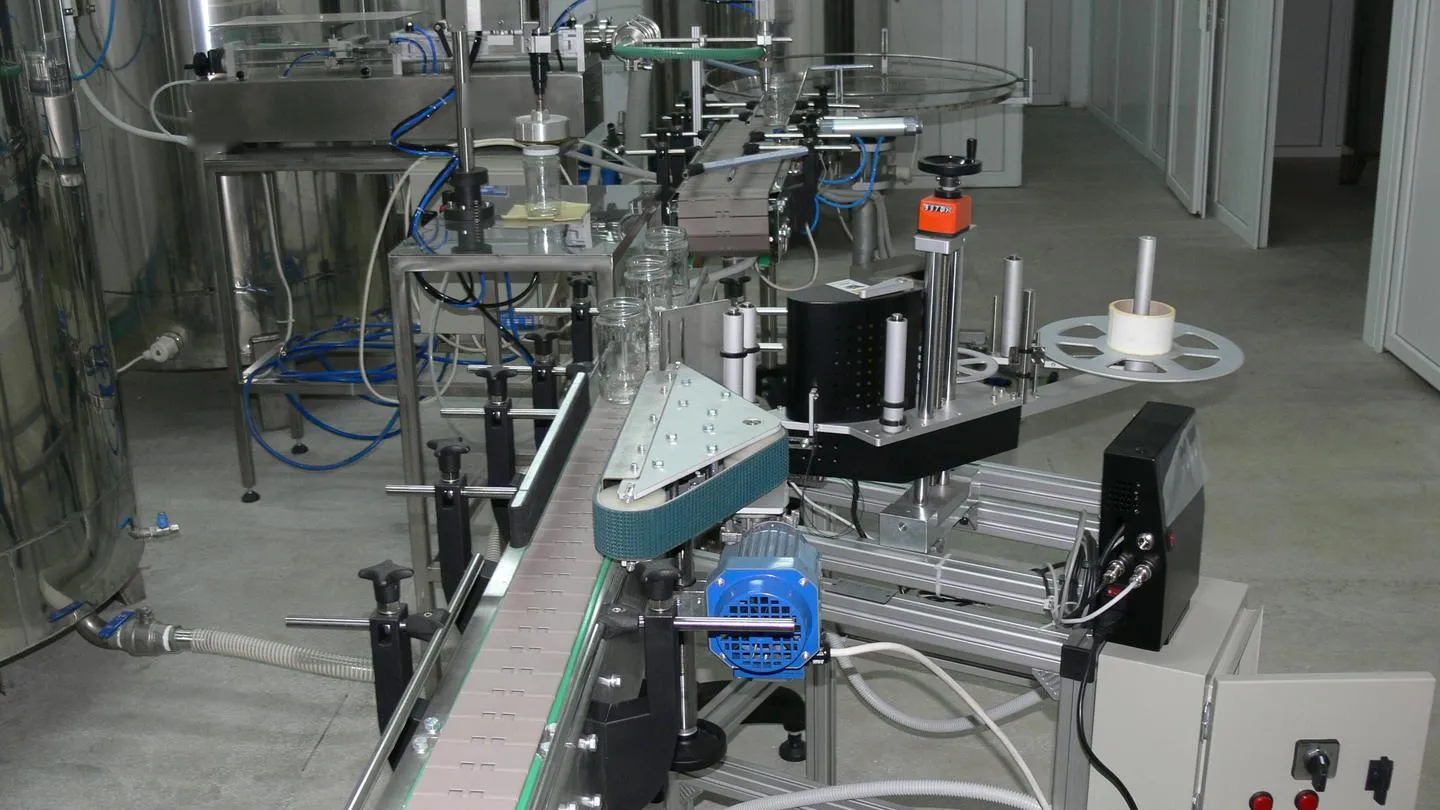
Specialist builders make the core machines: GDM, Fameccanica, JOA and Zuiko for hygiene products, Valmet and ANDRITZ for tissue, Serac for liquids, and Coesia’s Norden and R.A Jones for tubes and aerosols. Rockwell Automation, Siemens and Beckhoff are among the controls suppliers that market to these plants. No public source measures any of their market shares here.
Machine builders by sub-segment
Hygiene. A handful of specialists build the diaper, adult care and feminine care machines:
- Fameccanica reports turnover of 390,600,000 euros in 2025, 93 percent of it from export, with more than 1,300 installations. It is part of the Angelini group.
- GDM, formed when Coesia acquired and merged two Italian builders, says it has installed more than 700 machines and upgrade kits.
- JOA, headquartered in Sheboygan Falls, Wisconsin, with offices in Germany and Italy, says it acquired the Italian hygiene machine maker Cellulose Converting Solutions.
- Zuiko lists baby diaper, adult incontinence and feminine care machines.
- PCMC, part of Barry-Wehmiller since 2005 and of BW Converting since 2023, builds hygiene lines and tissue wrappers from Green Bay, Wisconsin.
Tissue. Valmet reports 2025 net sales of about 5,200,000,000 euros, and its tissue business has covered converting since the 2023 Perini purchase. It describes itself as the only builder integrating automation with both tissue making and converting. ANDRITZ reports 2025 revenue of 7,900,000,000 euros.
Liquids, tubes and aerosols:
- Serac, with more than 600 people, fills and caps household and personal care products.
- Coesia, with 2025 revenues of 2,122,000,000 euros, owns Norden for tubes and R.A Jones for aerosols.
- IMA lists personal care and tissue among its industries, and Marchesini builds packaging lines for pharmaceutical and cosmetic customers.
Revenue is not market share. Each of these firms sells well beyond non-food consumer goods, and no source gives any firm’s share of a machine category. Several, including JOA, Zuiko and Serac, publish no revenue at all.
Controls and plant software
The controls suppliers that market to these plants include:
- Rockwell Automation, with fiscal 2025 sales of $8,342,000,000. It markets batch control and packaging solutions to household and personal products plants, and its 10-K says a large percentage of its North American sales go through distributors.
- Siemens, with fiscal 2025 revenue of 78,900,000,000 euros.
- ABB, through B&R, which it calls its global center for machine and factory automation.
- Beckhoff, with 2025 sales of 1,240,000,000 euros.
Above the machines, Siemens offers its Opcenter manufacturing operations management portfolio. Rockwell cites one unnamed cosmetics maker’s OEE project, with no numbers. No primary source gives market share for PLC, DCS, SCADA, MES or OEE products in non-food CPG.
Why builders optimize their own machine
In the plants Vladimir has worked in:
- Who built the machines. The builders were the usual large packaging machine builders.
- What they focused on. Each focused on its own equipment. Few considered the long-term viability of the plant or tried to understand how it operated.
- How new lines arrived. Most were upgrades of earlier equipment with new features, commissioned machine by machine, with a lot of engineering labor.
None of that is a failing of any one builder. A builder is paid to deliver a machine that passes its acceptance test. Nobody on that purchase order is paid to make the line work as a line, unless the plant gives that job to someone. That someone is the plant’s own engineering team, or whoever it brings in. For the pieces of that job, see:
- how builders and integrators split the work;
- bringing a new machine into the plant;
- factory acceptance testing.
Who are the big CPG producers, and what is changing for them in 2026?
Large non-food producers include Unilever, Colgate-Palmolive, Henkel, Kimberly-Clark, Kenvue, Reckitt, Estée Lauder and Clorox. In 2026 Kimberly-Clark expects to close its purchase of Kenvue in the fourth quarter, Clorox completed its purchase of GOJO, and Section 232 duties of 50 percent on aluminum and steel took effect in April.
Selected producers
| Company | Fiscal year | Net sales or revenue | Capital spending | What the filing says about plants |
|---|---|---|---|---|
| Unilever | 2025 | 50,503,000,000 euros | 1,417,000,000 euros | Restructuring “concentrated in supply chain, productivity initiatives and functional transformation” |
| Colgate-Palmolive | 2025 | $20,382,000,000 | $564,000,000 | A three-year program that includes initiatives to “optimize our global supply chain” |
| Henkel | 2025 | 20,495,000,000 euros, of which Consumer Brands 9,677,000,000 | Not read | Not read |
| Kimberly-Clark | 2025 | $16,447,000,000 | $1,138,000,000 | 74 production facilities in 30 countries; “scalable automation” in its supply chain strategy |
| Kenvue | 2025 | $15,124,000,000 | $475,000,000 | About 60 percent of sales volume made in its own plants |
| Estée Lauder | 2026 | $15,049,000,000 | $457,000,000 | “Our manufacturing processes are substantially automated” |
| Reckitt | 2025 | 14,205,000,000 pounds | 592,000,000 pounds | Capital spending 4.2 percent of net revenue, guided to about 4 percent in 2026 |
| Clorox | 2026 | $6,720,000,000 | Not read | ERP and digital transformation completed at about $580,000,000 |
| Church & Dwight | 2025 | $6,203,200,000 | $122,400,000 | Plants and warehouses in 16 US states and 10 other countries, plus contract manufacturers |
Sources: each company's annual report, Form 10-K or full-year results for the fiscal year shown, read October 2026. A selection, not a ranking.
No filing read gives an automation spend, a share of lines automated or a robot count for any of these producers. Capital spending runs from about 2.0 percent of sales at Church & Dwight to about 6.9 percent at Kimberly-Clark.
Kimberly-Clark and Kenvue
The terms. Kimberly-Clark and Kenvue signed a merger agreement on November 2, 2025:
- each Kenvue share converts into 0.14625 Kimberly-Clark shares plus $3.50 in cash, valuing Kenvue at an enterprise value of about $48,700,000,000;
- the companies named $2,100,000,000 of run-rate synergies, about $1,900,000,000 of them cost synergies;
- the termination fee is $1,136,000,000.
The approvals. Shareholders of both companies approved the deal on January 29, 2026, and the US Hart-Scott-Rodino waiting period expired on February 4. On October 13 the European Commission cleared it in its first phase, on condition that Kimberly-Clark sell its tampon and other feminine hygiene brands in the European Economic Area.
The timing. As of October 28, 2026 the deal had not closed. Kimberly-Clark expects it to close in the fourth quarter of 2026. The agreement’s outside date is November 2, 2026, with an automatic extension to May 3, 2027 in certain circumstances.
The plants. The filings say little yet. Kimberly-Clark sold 51 percent of its International Family Care and Professional business to Suzano, closing on July 1, 2026. It extended its Transformation Initiative through 2028, with workforce reductions of 4 to 5 percent, and its supply chain strategy names “scalable automation” alongside value stream simplification and network optimization. No filing read says which plants will be combined, closed or sold.
Clorox, GOJO and the ERP finish
On January 22, 2026, Clorox agreed to buy GOJO, the maker of PURELL, for $2,250,000,000 in cash, including anticipated tax benefits valued at about $330,000,000. It completed the purchase in April 2026. After fiscal 2026 net sales fell 5 percent to $6,720,000,000, Clorox guides fiscal 2027 net sales up 13 to 14 percent, about 9.5 points of it from GOJO.
Clorox also says it completed its enterprise resource planning and digital transformation in the third quarter of fiscal 2026, at a total incremental investment of about $580,000,000.
Tariffs, labor and robots
Tariffs. The 2026 tariff picture changed twice:
- February 20. The Supreme Court held that the International Emergency Economic Powers Act does not authorize tariffs, ending the IEEPA tariffs but leaving Section 232 duties in place.
- February 24 to July 24. A temporary 10 percent import surcharge under Section 122 ran for 150 days.
- April 6. Section 232 duties of 50 percent applied to aluminum, steel and most copper articles.
- July 24. Section 301 duties of 10 to 12.5 percent took effect for goods from many trading partners, the moment the Section 122 surcharge ended.
Packaging costs moved in the same period. Berlin Packaging, citing the Producer Price Index, reports that from July 2025 to July 2026:
- plastic resins rose 10.7 percent;
- aluminum mill shapes rose 40.5 percent;
- steel mill products rose 22.5 percent;
- paper rose 10.4 percent.
No tariff line specific to wood pulp or plastic resin was found, so any tariff effect on tissue and plastic packaging costs rests on company statements. Kimberly-Clark, for one, reported about $100,000,000 of incremental tariff-related costs in 2025.
Labor. The Bureau of Labor Statistics shows:
- Employment. 115.4 thousand employees in soap, cleaning compound and toilet preparation manufacturing in August 2026, up from 113.8 thousand a year earlier, and 275.3 thousand in converted paper products.
- Operators. In 2025, 57,400 packaging and filling machine operators in chemical manufacturing and 87,050 paper goods machine operators in paper manufacturing.
- Productivity. Output per hour fell 3.5 percent in paper manufacturing in 2025 and 1.9 percent in chemical manufacturing.
Robots. The International Federation of Robotics counted 38,400 industrial robot installations in the United States in 2025, up 12 percent. The Association for Advancing Automation reported that North American robot orders from its food and consumer goods sector rose 17 percent in units in the first half of 2026.
What happens when a consumer goods company’s systems go down?
The disruption reaches orders and production. When Clorox found unauthorized activity in its IT systems in August 2023, it took systems offline and switched to manual ordering at a reduced rate. It began returning to automated ordering about six weeks later, had resumed production at most plants by mid-September, and saw first-quarter net sales fall 20 percent.
Clorox, 2023
The filings give the timeline:
- August 14, 2023. Clorox reported “unauthorized activity on some of its Information Technology (IT) systems”. It said it was taking systems offline and had put workarounds in place for some offline operations.
- September 18. In its second filing, it said it had moved to manual ordering and processing “at a reduced rate of operations” and had resumed production at “the vast majority” of its manufacturing sites. It expected to start returning to automated order processing the week of September 25, and warned that the impact on the quarter would be material.
- The quarter. First-quarter net sales fell 20 percent, from $1,740,000,000 to $1,386,000,000, “driven largely by lower volume resulting from the cyberattack”, with about $24,000,000 of attack costs.
- The year. Costs net of insurance recoveries came to about $29,000,000. Clorox said it had fully restored supply and distribution and regained most of its lost market share by June 30, 2024.
Read as a plant event, the shape is clear. About six weeks passed from first notice to the start of the return to automated ordering, and most plants were producing again by the second filing. Clorox’s filings name its IT systems, and the disruption they describe ran through ordering and order processing.
Estée Lauder and others
Estée Lauder reported a cybersecurity incident on July 18, 2023. An unauthorized third party had gained access to some systems and obtained some data, and the company took some systems down. It began bringing systems back online within days, and later said the incident cut its first-quarter earnings by 8 cents a share.
Smaller cases show the range:
- Mativ, which had merged with Neenah, reported that a 2022 incident temporarily disrupted operations and reduced sales, with $6,100,000 of costs in the quarter.
- Oil-Dri reported that a cyberattack on a key customer disrupted that customer’s ordering and hurt sales of Oil-Dri’s co-packaged litter.
- Stepan took a $3,500,000 charge in 2024 for a payment fraud that did not involve access to its systems.
Since the SEC’s cybersecurity disclosure rule took effect, a material incident has to be reported on Form 8-K, Item 1.05, within four business days of the materiality determination. From January 2021 to October 26, 2026, none of 32 US-listed consumer products issuers checked filed one. That shows only that none of them reported an incident under that item.
What the advisories say
The plant-floor exposure shows up in the government advisories, not the filings:
- HMIs on the internet. CISA’s advisory AA25-343A, revised in December 2025, describes pro-Russia hacktivists reaching OT devices through minimally secured, internet-facing VNC connections, logging into HMIs with default or weak passwords, and changing setpoints. The targeted sectors include food and agriculture.
- Default passwords on PLCs. An earlier advisory on Unitronics PLCs found at least 75 devices compromised, each with a default password or none, and named food and beverage manufacturing among the sectors using them.
- Ransomware. The FBI knew of about 900 entities affected by Play by May 2025, and Akira had claimed about $244,170,000 in proceeds, with a noted preference for sectors including food and agriculture.
Each of those entry points can exist on a CPG line built from many builders’ machines: a builder’s remote access box, an HMI reachable from outside, a default password on a machine’s controller. For the program that closes them, see ISA/IEC 62443 for plant leaders and locking down OEM remote access.
How do co-packers and private label change the automation?
A co-packer runs many brands’ products on shared lines, so changeovers, line clearance and records multiply. US store brands reached a record 21.3 percent dollar share in 2025, and contract fillers run whole aerosol and liquid plants. Vladimir has worked at several co-packers, including more than two years at one.
Store brands
Store brands are one source of the work. The Private Label Manufacturers Association, using Circana data, reports a record $282,800,000,000 in US store-brand sales in 2025: a 21.3 percent dollar share and a 23.5 percent unit share. Store-brand revenue in beauty rose 2.8 percent. No source gives the private label share of tissue, laundry detergent, diapers or personal care.
Contract makers
Brand owners lean on contract makers too:
- Kenvue says some of its products are made at a single location or a limited number of locations, and that it partners with third parties to make certain key products. About 60 percent of its 2025 sales volume came from its own plants.
- Church & Dwight and Estée Lauder both say they use third-party manufacturers.
The contract makers range from cosmetics specialists to whole aerosol plants:
- Accupac makes cosmetic, over-the-counter and medical device products in Pennsylvania, and describes its facilities as “cGMP, FDA Registered and ISO Certified”.
- Voyant Beauty lists 11 locations, with liquid, fragrance, aerosol and bar soap plants.
- Aerofil Technology, part of KDC/ONE, lists nine aerosol filling lines, two liquid lines and a 180,000-gallon propellant tank farm in one 400,000 square foot facility.
- PLZ Corp lists 14 manufacturing locations across North America, on one company-wide SAP system.
- Intercos and COSMAX develop and make cosmetics that other companies sell under their own brands.
Portfolios keep moving. Clearwater Paper sold its private-label tissue business to Sofidel for $1,060,000,000, and Essity bought Edgewell’s North American feminine care brands. Industry codes undercount all of this, because a contract maker that blends and fills its own formulas is classed under the product code, not under contract packaging.
What changes for the automation
Vladimir has worked at several co-packers, including more than two years at one co-packing plant. On a shared line, each added brand adds changeovers, line clearances and records.
The rules multiply the same way. A cosmetics contract plant that makes products for several brands needs only one FDA registration. But every brand’s product listing has to name that facility, so a formula or site change by any customer touches the plant’s regulatory record.
In Joltek’s reading, that argues for two things on a co-packing line:
- Recipe and label data held outside individual machine programs, so a new customer or product is a data change, not a code change.
- A changeover and line clearance checklist the plant owns, applied the same way for every customer.
What do EPR, recycled content and PFAS laws change on the line?
They change materials, weights and data. California, Colorado, Maine, Maryland, Minnesota, Oregon and Washington have packaging EPR laws. Washington requires 25 percent recycled plastic in household cleaning and personal care containers from 2028, the EU packaging regulation applies from August 12, 2026, and PFAS bans already cover cleaning products and cosmetics in several states.
Packaging EPR
Packaging extended producer responsibility laws are now running on separate clocks in these states:
- California. SB 54, signed in 2022. The permanent regulations were approved on May 1, 2026, Circular Action Alliance is the first producer responsibility organization, and CalRecycle received its plan on October 13, 2026. By 2032, plastic covered material must be source-reduced by 25 percent and reach a 65 percent recycling rate.
- Oregon. The program plan was approved on February 21, 2025. A federal court issued a narrow preliminary injunction in a distributors’ lawsuit in February 2026.
- Colorado. The final plan was approved on December 9, 2025, with producer dues due by January 1, 2026.
- Minnesota. The first annual registration was due July 1, 2026. The program starts in early 2029, with producers funding at least 50 percent of covered costs, rising to 90 percent by 2031.
- Maryland. Producers registered by May 31, 2026, and reimbursement of collection and processing costs starts July 1, 2028.
- Washington. Producers registered by July 1, 2026, and implementation is expected by 2030.
- Maine. The first such law, passed in July 2021. Circular Action Alliance declined to bid for its stewardship contract in 2026.
Recycled content
Washington’s recycled content law reaches household and personal care lines directly. Plastic containers for household cleaning and personal care products, from 8 fluid ounces to 5 gallons, must contain at least:
- 15 percent postconsumer recycled plastic from 2025 through 2027;
- 25 percent from 2028 through 2030;
- 50 percent from 2031.
The definition covers laundry detergents, softeners and stain removers, household cleaners, liquid soap, shampoo, conditioner, styling sprays and gels, and skin care. A producer that misses the requirement pays a penalty under the statute’s formula from June 1 of the year after the requirement first applies. Producers also report each year the recycled content percentage and the resin type of the virgin plastic they used.
A container with more recycled resin is a material change. In Joltek’s reading, each step up in content is a line trial on the blow molder, filler, capper and labeler, and worth scheduling like one.
Other states’ recycled content laws mainly target beverage containers and bags. New Jersey’s law exempts rigid plastic containers that hold cosmetics or drugs.
The EU packaging regulation
For plants that ship to Europe, Regulation (EU) 2025/40, the Packaging and Packaging Waste Regulation, has applied since August 12, 2026. Its main dates for a consumer goods line:
- Recycled content. By 2030 at the earliest, minimum recycled content in plastic packaging, 35 percent for most packaging that is not contact-sensitive, calculated as an average per manufacturing plant and year.
- Recyclability. All packaging recyclable by design from 2030, and recycled at scale from 2035, each at the earliest.
- Minimization. Weight and volume cut to the minimum by 2030, with double walls, false bottoms and unnecessary layers banned.
- Labels. A harmonised material composition label from August 12, 2028 at the earliest.
- Banned formats. From 2030, single-use hotel toiletry packaging such as small shampoo and lotion bottles, and single-use plastic grouping film at the point of sale.
- Reuse. At least 40 percent of transport packaging reusable from 2030.
- Registers. A national register of producers in each member state.
The per-plant calculation is the detail that reaches the plant: recycled content is averaged per manufacturing plant per year, so the plant’s own material records carry the compliance.
PFAS
State bans on intentionally added PFAS now cover cleaning products and cosmetics:
- Maine banned it in cleaning products, cosmetics, dental floss and menstruation products from January 1, 2026, with most other products following in 2032, under 38 M.R.S. 1614.
- Minnesota’s ban on the same kinds of products has applied since January 1, 2025. Any product with intentionally added PFAS is banned from 2032 unless the use is ruled currently unavoidable. A law firm reports that Minnesota moved its manufacturer reporting deadline to September 15, 2026.
- Vermont banned it in cosmetics and menstrual products from January 1, 2026, with cleaning products following on July 1, 2027.
- Colorado’s ban in most cleaning products took effect on January 1, 2026, according to a law firm.
Federally, FDA’s December 2025 report on PFAS in cosmetics found 51 PFAS used in 1,744 formulations and reached no definitive safety determination. EPA moved the start of its TSCA PFAS reporting period to January 31, 2027 at the latest.
How does EU tobacco traceability reach the packing line?
In the EU, every unit packet of tobacco must carry a unique identifier, applied and verified on the line, and every machine has its own identifier code. This has applied to cigarettes since May 20, 2019 and to other tobacco products since May 20, 2024. From May 20, 2028, application, arrival and some other events must be reported in three hours.
What the EU requires at the line
Directive 2014/40/EU requires every unit packet of tobacco to carry a unique identifier, “irremovably printed or affixed, indelible and not hidden or interrupted”. From it, the date and place of manufacture, the facility, “the machine used to manufacture the tobacco products”, the shift or time, the product, the intended market and the shipment route can all be determined. Each packet also carries a tamper-proof security feature. The rules have applied to cigarettes and roll-your-own tobacco since May 20, 2019, and to other tobacco products since May 20, 2024.
Implementing Regulation (EU) 2018/574 puts the detail on the line:
- Verify after applying. Each unit-level identifier must be verified directly after it is applied, for correct application and readability. The process must be protected by an anti-tampering device supplied and installed by an independent third party. A failed code is re-applied, and the device’s record is kept for nine months. Since a 2023 amendment, the record must prove the correct application of each code, and any omission in marking must be recorded.
- The code. Up to 50 characters: an issuer code, a serial number with less than a one in ten thousand chance of being guessed, a product code and a time stamp to the hour.
- Machines have identities. Each facility, machine and machine part has a code from the ID issuer for its territory. Since 2023 a machine is an assembly of machinery integral to the manufacturing process, and a machine part is any identifiable module. The Commission changed the definition after finding “considerable problems with the quality of traceability data”, including data on production machines.
- Print quality. A Data Matrix, QR Code or DotCode on each packet, rated at least 3.5 under ISO/IEC 15415 and readable for at least five years, with a human-readable code beside it.
- Events and timing. The plant records the application of unit and aggregated codes, dispatch, arrival and trans-loading, and sends them to a primary repository run by an independent provider. From May 20, 2028, application, arrival and some other events must be sent within three hours. Until then, 24 hours applies, and smaller operators keep 24 hours after that.
The Commission published its evaluation of the tobacco directives on April 2, 2026, with an analysis of the track and trace system in its evidence base.
The US: a proposed rule
In the United States, FDA proposed tobacco product manufacturing practice rules, proposed 21 CFR Part 1120, on March 10, 2023. The proposal reaches automation directly:
- Validation. Process validation where results cannot be fully verified, “including any automated processes”, with automated cigarette making and the filter rod maker as examples.
- Records. Records that are attributable, legible, contemporaneously recorded, original and accurate, with all electronic records subject to Part 11.
- Timing. Larger manufacturers would comply two years after a final rule takes effect, and small ones after four.
The rule is not final. The August 2026 HHS regulatory agenda lists it as a long-term action, with a final rule date of July 2027. FDA separately proposed tobacco registration and listing rules on June 29, 2026. Every US tobacco manufacturer already needs a permit from the Alcohol and Tobacco Tax and Trade Bureau and keeps production records for three years.
The US industry is small in plants and large in shipments: 125 establishments in 2023, and 11,214 employees shipping $60,684,858,000 in 2024.
Which KPIs matter in a CPG plant, and what benchmarks exist?
OEE, changeover time, rejects and giveaway are the numbers CPG lines run on, much as in food. Public benchmarks are thin: vendor data puts CPG packaging OEE at 58 to 62 percent, TAPPI says tissue converting runs at 40 to 70 percent efficiency, and no independent changeover or reject benchmark exists.
OEE
OEE is availability times performance times quality. The 85 percent OEE benchmark traces to Seiichi Nakajima’s 1984 book on TPM. OEE.com, which repeats it, notes that it applies to discrete manufacturing, and that most manufacturers score closer to 60 percent.
The public benchmarks for consumer goods come from vendors:
- TeepTrak, an OEE monitoring vendor, puts consumer packaged goods packaging at 58 to 62 percent on average, against 82 to 85 percent at the top end. It says most plants find their real number 10 to 18 points below the reported one after a 48-hour sensor check.
- Evocon, another vendor, found roughly 6 percent of organizations at 85 percent or above across its connected machines.
- Valmet tells tissue converters that about 60 percent is an achievable average.
The one association figure is old. A 2017 TAPPI newsletter said tissue converting efficiency runs at 40 to 70 percent, far below tissue machines. It blamed operations practices, setup times, maintenance and equipment failures.
In Vladimir’s experience, OEE and MES practice in consumer goods plants is about the same as in food. For the measurement itself, see how plants measure OEE.
Rejects and giveaway
Reject rates cannot be generalized. Plants want as few as possible, but some bad product is inevitable. The figures in circulation are builders’ claims: Zahoransky claims “only 10% rework, only 5% waste” for one toothbrush machine, and Serac an efficiency above 98 percent for its blow molders. JOA’s diaper vision rejects single products, but it publishes no rate.
Giveaway has a legal floor and no ceiling. NIST Handbook 133 sets the net contents rules: the average of a lot may not fall below the labeled quantity, and the handbook “does not specify limits of overfilling”, which is left to the packer. That is why filler accuracy is money. Serac argues that type-approved weight fillers remove the need to overfill slightly.
Rejects and giveaway are only part of the ledger. For the other part, see what drives downtime.
Where should a CPG plant start?
With the line it already has. In plants Vladimir has worked in, most new lines were upgrades of older equipment, commissioned machine by machine, and older packaging machines were usually the constraint. Inventory every machine, its builder, its controls and who owns the code; find the constraint with line data; then plan upgrades around changeovers and shutdown windows.
Five first moves, in order:
- Build the machine register. List every machine on every line with its builder, its controller and HMI, its firmware and software versions, and who owns and can change its code.
- Map the rules by product. Sort the products into cosmetics, cosmetic-drugs, products with a kill claim and aerosols, and note which lines each runs on. The map decides where recipe access, calibration, audit trails and test-and-reject logic must hold up to an audit.
- Find the constraint with line data. On the lines Vladimir has worked on, it was usually older packaging equipment, such as a case packer, not the fastest machine. Measure stops and speed losses machine by machine before buying anything.
- Name the hazard owners. For each gas house, dust area and oxidizer store, record the area classification drawing, the shutdown interlocks and the person who owns them.
- Sequence the upgrades. Most new lines are upgrades of earlier equipment, commissioned machine by machine. Plan each upgrade against changeovers and shutdown windows, and specify the handshakes between machines before the purchase order, not after the factory acceptance test.
Two examples of this work in practice: three new lines integrated into one site, and, where the controls platform itself is reaching end of life, planning a PLC platform migration.
Joltek’s plant systems assessment covers the first move in one fixed-scope engagement: an installed-base register with lifecycle status, scored by production risk and sequenced against the plant’s shutdown windows. For how Joltek works with consumer goods plants more broadly, see support for food, beverage and consumer goods plants.
CPG automation glossary
Forty terms a newcomer meets in a non-food consumer goods plant, with the rule or standard behind them where one exists.
Show all 40 terms
- Aerosol
- A non-refillable receptacle holding a gas compressed, liquefied or dissolved under pressure, with a self-closing device that releases the contents. Since September 2026, a container holding only a gas can also qualify.
- Cartoner
- A machine that forms retail cartons, inserts products such as toothpaste tubes, and closes the flaps by folding, tucking or gluing.
- Changeover
- The time from the last good unit of one product to the first good unit of the next, including cleaning, adjustment and startup.
- Co-packer
- A contract firm that packs and labels a client's materials into finished packages. NAICS 561910 describes this as packaging client-owned materials.
- Converting
- Turning purchased paper or nonwoven stock into finished consumer products such as tissue, towels, napkins and disposable diapers.
- Cosmetic-drug
- A product that is both a cosmetic and an over-the-counter drug, such as antiperspirant, sunscreen or fluoride toothpaste. It follows drug CGMP and is exempt from MoCRA's GMP, registration and listing sections.
- Crutcher
- A closed mixing tank where liquid surfactant is blended with powdered and liquid builders and additives to make the slurry that feeds a spray dryer.
- Drug CGMP (Part 211)
- Current good manufacturing practice for finished drugs under 21 CFR Part 211, which reaches over-the-counter products such as sunscreen and fluoride toothpaste.
- Dust hazard analysis
- A systematic review of where combustible dust can ignite or explode in a facility and what safeguards control it. NFPA 660 requires one for new and existing facilities in its scope.
- Electronic gearing
- Software that locks one servo axis to a master axis at a set ratio, so changing a product can mean changing a number.
- EPR
- Extended producer responsibility: laws that make producers pay for collecting and recycling their packaging, such as California's SB 54.
- Filler-capper
- A rotary machine that doses product into containers and applies closures in one block. Serac lists its RB at up to 42,000 containers an hour.
- Gas house
- The dedicated, usually unmanned building or room where flammable propellant is charged into aerosol cans. NFPA 30B calls it the propellant charging room.
- Giveaway
- Product delivered above the labeled net quantity. Net contents rules set the legal floor, and the packer chooses how far above it to run.
- Hard-coded sequencer
- Batch logic written directly into the PLC program as fixed steps, so a recipe change can mean a program change. The common alternative to ISA-88 batch software in the plants Vladimir has worked in.
- ISA-88
- ISA's batch control standard series, with parts for models and terminology, data structures, recipes and batch production records.
- ISA-95
- The standard for linking plant control systems to business systems, defining levels 0 to 4 and the interface between level 3 and level 4.
- ISO 22716
- The international guideline for cosmetics good manufacturing practice, published in 2007 and confirmed in 2022, which buyers often audit against.
- MoCRA
- The Modernization of Cosmetics Regulation Act of 2022, signed December 29, 2022, requiring facility registration, product listing, adverse event reports and FDA cosmetic GMP rules.
- OEE
- Overall equipment effectiveness: availability times performance times quality, showing how much planned production time made good product at full speed.
- OMAC
- The Organization for Machine Automation and Control, a user group of manufacturers, machine builders, integrators and technology providers that developed PackML.
- PackML
- A standard set of machine states and modes, developed by OMAC and adopted by ISA as ISA-TR88.00.02, so packaging machines report status alike.
- Parent reel
- The large roll of tissue wound at the end of the paper machine. Converting lines unwind it and turn it into finished products.
- Private label
- A store brand sold under a retailer's name and made for it by a manufacturer. US store brands held a 21.3 percent dollar share in 2025.
- Recipe
- A stored set of materials, steps and parameters for making a product. ISA-88 Part 3 defines general and site recipe models.
- Registration
- Keeping a cut, print or seal aligned to marks on the web, using a photo eye that latches the axis position when a mark passes.
- Responsible person
- Under MoCRA, the manufacturer, packer or distributor named on a cosmetic product's label, who must list the product with FDA, including its ingredients.
- Rewinder
- A converting machine that unwinds the parent reel and rewinds the sheet into logs. Valmet rates its Perini Proxima S6 at 30 logs a minute.
- Servo drive
- A motor, amplifier and position feedback that follow a commanded position and speed closely. Zuiko lists a full servo drive system on its diaper machines.
- SMED
- Single-minute exchange of die: a method for shortening changeovers by doing setup work while the machine runs, with a goal of under 10 minutes.
- Spray tower
- A tall cylindrical tower where detergent slurry is sprayed through nozzles into hot air, leaving dry granules that move on to mixing and packaging.
- Surfactant
- The surface-active compound in a detergent that removes dirt. It is blended with builders and additives to make the finished product.
- Tension zone
- A section of a web line built to hold one constant web tension, using electronically geared drives, dancers or current monitoring.
- Tube filler
- A machine that fills and seals plastic, laminate or aluminum tubes. Coesia lists Norden models from 40 to 1,000 tubes a minute.
- Unique identifier
- The code of up to 50 characters printed on every EU tobacco unit packet, from which the facility, machine, time and market of manufacture can be determined.
- Vision inspection
- Cameras and software that check each product at line speed and trigger a reject. JOA's diaper machine inspects in-line at full speed.
- Web
- A continuous strip of paper, film or nonwoven that runs through a converting machine under controlled tension.
- Web break
- A tear in the running web that stops a converting line. In Vladimir's experience, most are process or raw-material related, and good sensors and feedback loops help diagnose and prevent the major ones.
- Weight filling
- Filling by weighing product into each container. Serac says it suits foaming and viscous liquids and, with type approval, avoids slight overfilling.
- Yankee dryer
- A large steam-heated cylinder on a tissue machine that dries the paper sheet. Valmet lists 18 and 22 foot sizes, and ANDRITZ builds steel ones.
Frequently asked questions
What is CPG automation?
CPG automation is the set of PLCs, drives, sensors, vision systems and plant systems that run non-food consumer goods plants: detergents, cleaners, personal care, cosmetics, tissue, diapers and oral care. The controls are the same as in other industries. What sets CPG apart is the line: many machines from many builders, frequent format changes, and rules from cosmetics, drug, transport and fire codes.
Does the FDA regulate cosmetics manufacturing plants?
Yes. Since MoCRA, a facility that makes or fills cosmetics for the US market must register with FDA, and every product must be listed. FDA has not yet proposed the cosmetic GMP rule MoCRA requires, though both statutory deadlines have passed. Products that are also drugs, such as antiperspirant, sunscreen and fluoride toothpaste, are exempt from those MoCRA sections and follow drug CGMP in 21 CFR Parts 210 and 211.
Which NFPA code applies to aerosol filling?
NFPA 30B, the Code for the Manufacture and Storage of Aerosol Products. It covers the propellant charging room, or gas house, where flammable propellant is added. The second draft of its next edition rates electrical equipment in that room for Class I, Division 1 or Zone 1 or 0, and extends classification to checkweighers, test baths and button tippers that handle flammable product.
How fast do diaper machines run?
Builders list their fastest baby diaper machines at 1,000 to 1,200 products a minute or more. At 1,200, that is one diaper every 50 milliseconds. JOA lists its J8T-B at up to 1,200, Zuiko its premium machines at 1,000, and GDM says its lines can exceed 1,200. These are listed maximums: no public source reports typical running speeds on real lines.
What is the EU tobacco traceability system?
It is the system under Directive 2014/40/EU that tracks every unit packet of tobacco from the factory to the first retail outlet. Each packet carries a unique identifier, printed and verified on the line, and each machine has its own identifier code. Events go to independent data repositories. It has applied to cigarettes since May 20, 2019 and to other tobacco products since May 20, 2024.
Is there a benchmark for changeover time in consumer goods plants?
Not an independent one. No association or regulator publishes changeover times, or the share of production time lost to changeovers, for household, personal care, tissue or hygiene plants. The figures in circulation come from consultants and equipment vendors. The useful benchmark is the plant’s own: time from the last good unit of one product to the first good unit of the next, by line and by product pair.
Many builders, one line
CPG automation is less about the controls than about the line they sit on:
- The machines come from many builders, each with its own controls and its own idea of how the line should run, and the oldest of them often sets the pace.
- The products decide the rules. A cosmetic, a cosmetic-drug, a disinfectant and an aerosol can share one plant and answer to four different rulebooks, and the drug and aerosol rules reach into the control system.
- The hazards are specific. Propellants, dust and oxidizers each have a code, and the draft of the next aerosol code reaches the checkweigher.
A plant that knows every machine on its lines, who built it, what controls it and what production it puts at risk can plan upgrades around changeovers and shutdown windows instead of around failures. Joltek’s plant systems assessment builds the installed-base half of that picture: every controller, HMI, drive, network and server, its lifecycle status and the production it puts at risk. A free modernization consultation is the simplest place to start.
Photos: filling and labelling line photo by Hesuruio, via Wikimedia Commons, licensed CC BY-SA 3.0; cropped, resized and with two equipment badges removed, and this adapted version is shared under the same license. Aerosol filling photo by Glacier National Park (US National Park Service), public domain. Header photo by Dávid Lehoczki (Pexels).

References and further reading
- Modernization of Cosmetics Regulation Act of 2022 (MoCRA) · US Food and Drug AdministrationFacility registration, product listing and the cosmetic GMP rule FDA has not yet proposed.
- 21 CFR Part 211, Current Good Manufacturing Practice for Finished Pharmaceuticals · Electronic Code of Federal RegulationsApplies to cosmetic-drugs such as antiperspirant, sunscreen and fluoride toothpaste.
- 21 CFR Part 11, Electronic Records; Electronic Signatures · Electronic Code of Federal Regulations
- NFPA 30B, Code for the Manufacture and Storage of Aerosol Products · National Fire Protection Association
- AP-42 Section 6.8, Soap and Detergents · US Environmental Protection Agency, 1993 (reformatted 1995)
- The Clorox Company, Annual Report on Form 10-K, fiscal 2024 · US Securities and Exchange CommissionThe company's account of the August 2023 cyberattack and its recovery.
- Kimberly-Clark and Kenvue merger announcement (Exhibit 99.1) · US Securities and Exchange Commission, November 2025
- Directive 2014/40/EU on tobacco and related products · Publications Office of the European Union