
Insights
Food and Beverage Automation: How Plants Are Controlled, from Receiving to the Pallet
How food and beverage plants are controlled: OEM machines, the food safety rules that reach the PLC, hygienic design, FSMA 204 and where to start.
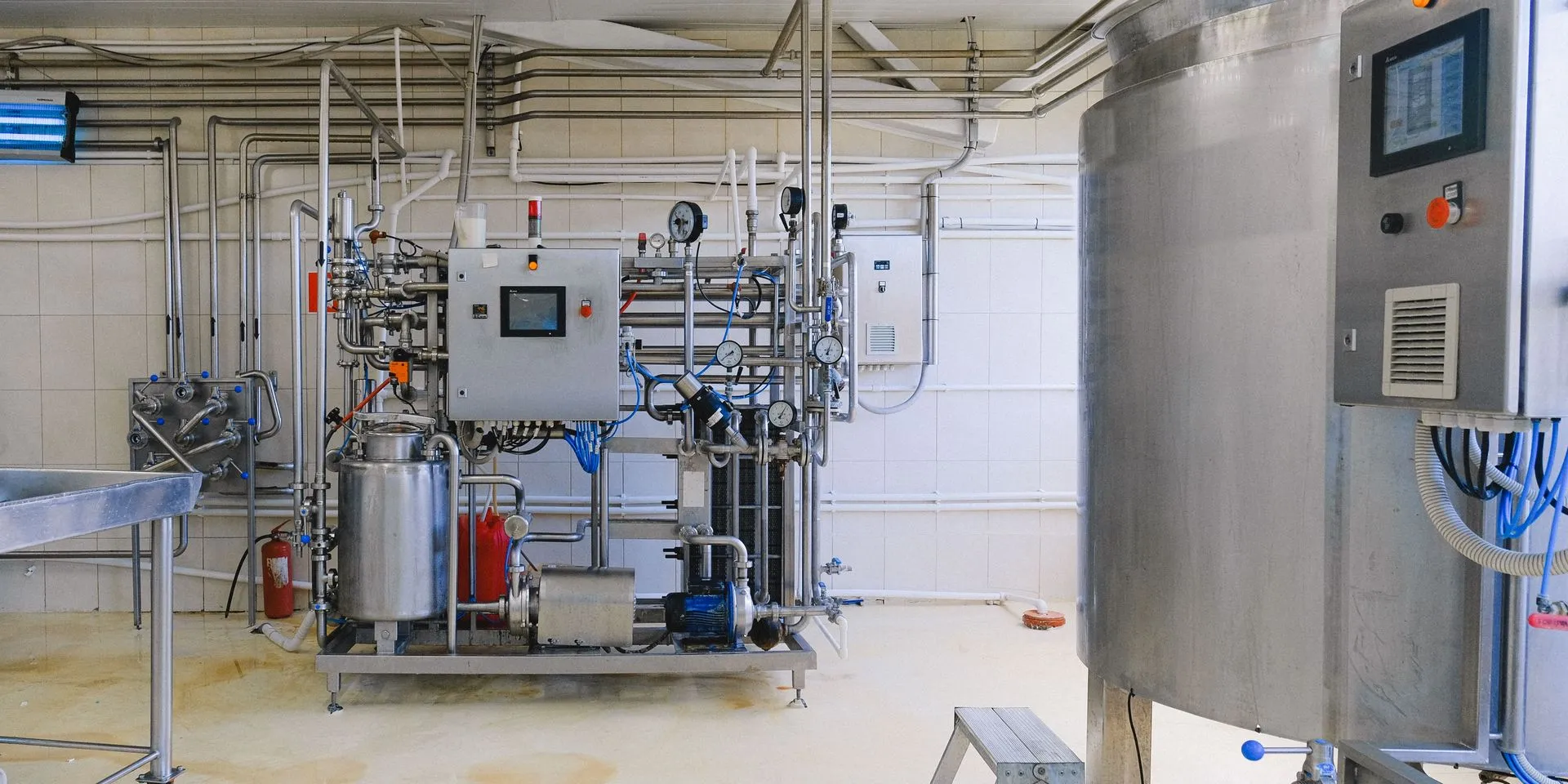
Table of contents
A food plant’s hardest automation problems rarely start inside the PLC. They arrive from outside the panel:
- a sanitation crew washing the line down every other day;
- a food safety rule that decides what must be measured and recorded;
- a machine from an outside builder whose code the plant cannot open.
This guide covers food and beverage automation in that sense. It is about the plant controls, PLCs, machines and plant systems that run food and drink plants from receiving to the pallet, and the rules that shape them.
There is one place where the law writes PLC requirements directly. Under the Grade A Pasteurized Milk Ordinance, the PLC that runs a milk pasteurizer’s public health controls must meet five requirements:
- it is dedicated to that one pasteurizer;
- no other computer or HMI can command it;
- it scans every input and output at least once a second;
- its program sits in read-only memory;
- the state regulator seals its program access.
Everywhere else, food safety rules reach the control system indirectly, through what must be measured, recorded and kept clean.
That points to this guide’s position:
In food and beverage, the machine is the unit of automation, and the rules sit on the machine.
In the plants Vladimir has worked in:
- equipment comes from many builders, each machine with its own PLC;
- the machines are tied together over Ethernet by message instructions and produced and consumed tags;
- PackML, the standard machine state model, is rare;
- traceability mostly lives at the end-of-line coder;
- when ERP or MES goes down, production usually keeps running, with batches on paper and setpoints checked by hand.
What decides how a food plant’s controls are built is food safety law, sanitation and the washdown, more than any platform choice.
Vladimir Romanov, Joltek’s founder, has worked in maintenance and operations in high-volume food manufacturing, on a greenfield food plant expansion, and on capital projects and new production lines for a global consumer goods manufacturer. The first-hand observations in this guide come from those plants. Everything else is sourced.
It covers, as of October 2026:
- what counts as food and beverage automation, and why the industry is hybrid;
- how dairy, meat and poultry, bakery and snack, beverage, brewing, pet food and confectionery plants actually run;
- the control architecture of a food plant;
- every food safety rule that reaches the control system, led by the pasteurizer PLC;
- what FSMA 204 traceability means for plant systems;
- hygienic design and washdown, allergen changeovers and clean-in-place;
- who supplies the controls and machines, validation compared with pharma, what investigations found, cyber incidents, what changes from 2026 to 2028, brownfield modernization, KPIs and where to start;
- a 40-term glossary.
This guide is part of Joltek’s series on how automation differs across 39 industries.
What counts as food and beverage automation, and why is the industry hybrid?
Food and beverage automation means the PLCs, drives, sensors, HMIs and plant systems that run food and drink plants, from receiving to the pallet. The industry is hybrid: a process area cooks, pasteurizes, ferments or mixes, then high-speed packaging fills and packs. Each half is controlled, regulated and staffed differently.
Federal statistics split the industry in two. In the North American Industry Classification System, food manufacturing is subsector 311 and beverage manufacturing is industry group 3121, which covers soft drinks, bottled water, ice, breweries, wineries and distilleries. Pet food sits inside food as dog and cat food (311111), and so do dairy drinks, coffee and flavoring syrups. Food itself has nine industry groups:
- animal food;
- grain and oilseed milling;
- sugar and confectionery;
- fruit and vegetable preserving and specialty food;
- dairy;
- animal slaughtering and processing;
- seafood;
- bakeries and tortillas;
- other food.
The Census Bureau’s 2024 Annual Integrated Economic Survey, published in September 2026, puts US food manufacturing at $1,054,261,701,000 in shipments and 1,702,155 employees in 2024. That is about 15 percent of everything US manufacturers shipped. Beverage manufacturing added $119,849,873,000 and 275,299 employees. Meat and poultry is the largest food sub-segment by both measures.
| Sub-segment (NAICS) | 2024 shipments | 2024 employees |
|---|---|---|
| Animal slaughtering and processing (3116) | $296,209,624,000 | 559,040 |
| Dairy (3115) | $154,525,608,000 | 164,455 |
| Beverages (3121) | $119,849,873,000 | 275,299 |
| Bakeries and tortillas (3118) | $90,329,698,000 | 318,282 |
| Animal food, including pet food (3111) | $79,501,181,000 | 71,989 |
| Sugar and confectionery (3113) | $47,079,525,000 | 82,812 |
Selected sub-segments. Source: US Census Bureau, 2024 Annual Integrated Economic Survey.
In Canada, Statistics Canada puts 2024 food manufacturing revenue at C$167,803,428,000, about 18 percent of all Canadian manufacturing, with C$35,939,272,000 of it in Quebec. Canadian food plants employed 261,233 people in 2025, 64,150 of them in Quebec, and beverage plants employed 50,496.
The typical food plant is small, but the typical food worker works in a large plant. In the Census Bureau’s 2023 County Business Patterns:
- 68.0 percent of the 31,130 US food manufacturing establishments had fewer than 20 employees;
- only 5.2 percent had 250 or more, yet those plants held 58.2 percent of food manufacturing jobs;
- 94.3 percent of breweries had fewer than 50 employees, and none had 1,000;
- 88 of 520 poultry processing plants had 1,000 or more, and 95.5 percent of poultry processing jobs were in plants of 250 or more.
A guide that describes only the large plant misses most sites. One that describes only the small plant misses most of the workforce. Household, personal care and paper goods plants are covered in the sibling CPG automation guide.
Rockwell Automation’s annual report groups food and beverage with life sciences and tire as “hybrid end markets”. The label fits. A food plant has two halves with different control traditions:
| Process half | Packaging half | |
|---|---|---|
| What it does | Mixes, cooks, pasteurizes, ferments, extrudes | Fills, seals, labels, packs, palletizes |
| Production style | Batch or continuous | Discrete, high speed |
| Typical control | A plant PLC or DCS running recipes | Each machine’s own PLC from its builder |
| Rules that land hardest | Kill steps, critical limits, food safety records | Net contents, date coding, foreign-object detection, machine safety |
| Typical failure | A deviation that puts product on hold | A stop that starves or blocks the rest of the line |
Joltek’s comparison, drawn from the rules and machines described in this guide.
The split runs through the rest of this guide. The food safety rules land mostly on the process half. Speed, changeovers and machine ownership dominate the packaging half.
The closest public figure for what plants spend on equipment comes from the 2022 Economic Census. That year US food manufacturers spent $15,710,084,000 on machinery and equipment, and beverage manufacturers $2,871,485,000. It covers every machine type, so it is not an automation figure.
How does a food plant run, from receiving to the pallet?
Every food plant follows the same arc: receive and store ingredients, process them under a food safety control such as a cook or pasteurization step, package at speed, then palletize and ship. What differs by sub-segment is the kill step, the hygiene regime, the regulator and the speed at which the packaging half runs.
Somewhere between receiving and the filler sits the step the food safety plan depends on: a pasteurizer, an oven, a fryer, a retort, a chiller or a roaster. Its time and temperature setpoints usually live in a PLC, and its records are what an inspector reads. Downstream, the packaging half is mostly OEM machines from several builders, each paced by the one in front of it.
The figures below come from regulations, census data and machine builders’ own pages. Every speed is the maximum a builder lists for one named machine, not what plants run. No public source gives typical line speeds.
Plant tour
Walk a fluid milk plant, from tanker to truck
Seven stages. For each one: what happens, who owns the controller's code, the rule that applies, and what to watch for.
Receiving and raw milk silos
Plant-owned codeTankers unload into raw milk silos, where the milk waits for processing.
- Controller
- The plant's process PLC runs the unloading valves, the pumps and the silo levels.
- Rule
- Under the Pasteurized Milk Ordinance, storage tanks must be emptied and cleaned at least every 72 hours, with cleaning records kept for two years.
- Watch for
- A silo running past its 72-hour cleaning interval.
HTST pasteurizer
Sealed by the regulatorMilk is heated, held in the holding tube for the legal time, and sent back automatically if it falls below the legal temperature.
- Controller
- A dedicated public-health PLC that no other computer or HMI can command, with its program access sealed by the regulator.
- Rule
- PMO Appendix H: a one-second scan, no JUMP or GOTO instructions, the program in ROM, and pasteurization data stored at least every five seconds.
- Watch for
- Any change to the logic, the network or the controller brings the regulator back for a retest and a reseal.
Filler
Builder's PLCCartons or bottles are filled and sealed. Tetra Pak lists one dual carton filler at 9,000 packages an hour.
- Controller
- The machine builder's own PLC, tied to the line by tags or message instructions.
- Rule
- Net contents: under NIST Handbook 133 a lot's average may not fall below the label. How far above it to fill is the packer's choice.
- Watch for
- Speed drift. In Vladimir's experience, machines arrive at their rated speed and slow down over the years.
Coding and checkweighing
Device maker's controllerEach package gets a date and lot code, and a checkweigher rejects packages outside the weight limits.
- Controller
- The coder's and the checkweigher's own controllers, linked to the line.
- Rule
- FSMA 204 lot-level records apply only to foods on FDA's Food Traceability List. Soft cheeses are on it; fluid milk is not.
- Watch for
- A date code identifies the run, but not which input lots went into it.
Case packing and palletizing
Builder's PLCPackages are packed into cases or crates and stacked onto pallets.
- Controller
- Each machine runs its builder's PLC, and a line PLC paces them.
- Rule
- Machine safety: ANSI/PMMI B155.1-2023 for packaging machinery, and ISO 13849-1:2023 for safety-related controls.
- Watch for
- A short stop here backs up into the filler unless the conveyors have room to accumulate.
Cold storage and shipping
Utility maker's controlsFinished product is held cold until it ships. Many plants cool with an ammonia refrigeration system.
- Controller
- In the plants Vladimir has worked in, usually the refrigeration maker's own self-contained controls.
- Rule
- OSHA PSM and EPA RMP apply at 10,000 pounds of anhydrous ammonia, including the integrity of controls, alarms and interlocks.
- Watch for
- Alarms that reach an empty control room, and no historian to explain an upset, as the CSB found at Cuisine Solutions in 2024.
Clean-in-place, across the plant
Plant or CIP supplierTimed rinses, caustic, acid and sanitizer circulate through the tanks, lines and pasteurizer between runs.
- Controller
- A CIP station PLC, holding the time, temperature, flow and chemical strength of each step.
- Rule
- The PMO requires a recorder on each circuit's return line, and electronic CIP records must meet 21 CFR Part 11.
- Watch for
- A cleaning record that cannot show time, temperature and chemical strength for every cycle.
Dairy
A fluid milk plant is continuous from the balance tank to the buffer tank. Tetra Pak’s example line for pasteurized milk runs in this order:
- Raw milk enters through a balance tank.
- It is preheated in a plate heat exchanger.
- It is separated into skim milk and cream, then standardized.
- It is partly homogenized.
- It is pasteurized in a heat exchanger with a separate holding tube.
- It is cooled and sent to buffer tanks for filling.
The example plant runs 20,000 liters an hour, seven hours a day. The homogenizer typically works at 100 to 250 bar.
Pasteurization has two legal definitions:
- Federal rules: 21 CFR 131.3 gives five time and temperature pairs, from 145 degrees F for 30 minutes in a batch vat to 161 degrees F for 15 seconds and 212 degrees F for 0.01 second. The temperature rises 5 degrees F when the product has 10 percent or more fat or added sweeteners.
- The PMO: the Pasteurized Milk Ordinance lists six continuous-flow pairs, adding 194 degrees F for 0.5 second and 201 degrees F for 0.1 second. It also raises the temperature at 18 percent or more total solids.
A recipe table built from one list will not match the other.
The PLC on a dairy pasteurizer holds interlocks the ordinance spells out:
- Flow diversion: the flow diversion device sends milk back automatically whenever the pasteurization condition is below the legal limit.
- The booster pump: it may run only when the timing pump is running, the flow diversion device is in forward flow, and the pasteurized product pressure exceeds the booster pump pressure by at least 1 psi.
- Pressure: a differential pressure controller diverts flow whenever pasteurized milk fails to stay at least 1 psi above the heating medium. Forward flow then stays blocked until the surfaces between the holding tube and the diversion device have been at pasteurization temperature for the full pasteurization time.
Instrument makers sell recorder-controllers built for these rules. Anderson-Negele says its AV-9900 “meets all Pasteurized Milk Ordinance (PMO) requirements for HTST, HHST, and UHT applications”. Whether a given installation complies is still the state regulator’s decision.
Long-life milk runs hotter and is more automated:
- The process: Tetra Pak gives 137 to 142 degrees C for four to six seconds for UHT milk.
- The interlocks: aseptic systems are interlocked so production cannot start until pre-sterilization is complete, and product goes to a reject tank if the sterilization temperature drops.
- Cleaning: a full CIP cycle on such a line takes 70 to 90 minutes.
On the packaging side, Tetra Pak lists its Tetra Top TT/3 XH IC dual filler at 9,000 packages an hour. The US had 437 fluid milk plants and 564 cheese plants in 2022. Fluid milk plants run larger than most food plants: 15.0 percent had 250 or more employees in 2023, against 5.2 percent across food manufacturing.
The rules section below draws the full loop, with its sealed public-health PLC.
Meat and poultry
Meat and poultry plants answer to USDA’s Food Safety and Inspection Service, with inspectors on the line, and the rules reach line speed itself:
- Poultry: under the New Poultry Inspection System, 9 CFR 381.69 caps a young chicken line at 140 birds a minute and a turkey line at 55.
- The poultry proposal: on February 19, 2026, FSIS proposed raising those caps to 175 and 60. The proposal notes that 20 plants have run at up to 175 under waivers. No final rule had appeared by late October 2026.
- Hogs: hog lines were capped at 1,106 head an hour until a 2019 rule. FSIS proposed in February 2026 to let swine plants set their own speeds, as long as they maintain process control.
Machine builders design past the cap. JBT Marel says its LineSplit handles up to 250 birds a minute of evisceration capacity, then splits the line into two inspection lines of 125 a minute each. At 140 birds a minute, a bird passes every 0.43 second.
Three food safety steps carry most of the control logic:
- Lethality. Cooked beef must reach a 6.5-log reduction of Salmonella and fully cooked poultry a 7-log reduction, with limits on Clostridium growth. The oven or cook tank’s time, temperature and humidity setpoints are the kill step.
- Chilling. Poultry chilling is a performance standard, not a timetable. Each plant writes its own chilling procedures and folds them into its HACCP plan. Frozen poultry must reach 0 degrees F at the package center within 72 hours.
- Listeria control. Ready-to-eat products exposed after cooking follow one of the three Listeria alternatives described in the rules section below.
The plant mixes production styles, in Joltek’s reading of the rules and machines:
- slaughter is discrete and line-paced, with each carcass on a shackle;
- grinding, mixing and cooking are batch;
- chilling, freezing and tunnel cooking are continuous;
- packaging is discrete.
Meat and poultry is the most concentrated food segment. In 2022, animal slaughtering and processing had 3,870 establishments, $303,646,203,000 in shipments and 535,134 employees. In 2023, 83.9 percent of its jobs were in plants with 250 or more employees.
Bakery and snacks
Bakery make-up lines are where servo motion replaced mechanical dividers:
- High volume: AMF Bakery Systems says its BreadFlex system delivers up to 13,500 loaves an hour, with recipe-driven servo dividing and automated changeovers. It also claims 40 to 60 percent fewer moving parts than volumetric dividers, and no divider oil.
- Mid-size: Sveba Dahlen lists a bread line at up to 4,500 pieces an hour and a rounder at 6,000.
Snack lines run on fryer control:
- Chip systems: Heat and Control says its continuous potato chip systems are built for 400 to over 6,500 finished pounds an hour. A fryer it shipped in 2015 makes 5,000 pounds an hour, with oil flow and temperature adjusting automatically to the product load.
- Fabricated chips: its fabricated chip fryer lists a clean-in-place spray system and electro-pneumatic oil level control as standard.
- Bagging: Ishida launched its Inspira bagmaker in 2017 at 120 bags a minute in intermittent motion and above 200 in rotary motion.
Not every bakery has a process control in the food safety sense. Under 21 CFR 117.135, the plant’s hazard analysis decides. Where heat processing must control a hazard, the oven or fryer exit temperature becomes a parameter with a stated maximum or minimum value.
Allergen controls apply almost everywhere. FDA says bakery products, snack foods and candy are among the foods most often recalled for undeclared allergens.
The US had 2,918 commercial bakeries and 483 snack food plants in 2022. In 2023, 78.8 percent of bakery and tortilla establishments had fewer than 20 employees.
Beverages and bottling
A beverage plant’s process side is short, and its packaging side is long and fast. The rules set sanitizing and coding requirements:
- Bottled water: 21 CFR 129.80 requires product-contact surfaces to be sanitized at 170 degrees F for 15 minutes, 200 degrees F for five minutes, or with ozone at 0.1 part per million for five minutes. Every package needs a production code. Filler and capper performance must be monitored, with filled containers inspected visually or electronically.
- Juice: processors need control measures that deliver a 5-log pathogen reduction.
Packaged beer and many juice drinks go through a tunnel pasteurizer, which works in pasteurization units (PU). KHS says its Innopas tunnel pasteurizer controls PU from the measured temperature and time of the containers themselves, at 5,000 to 180,000 containers an hour.
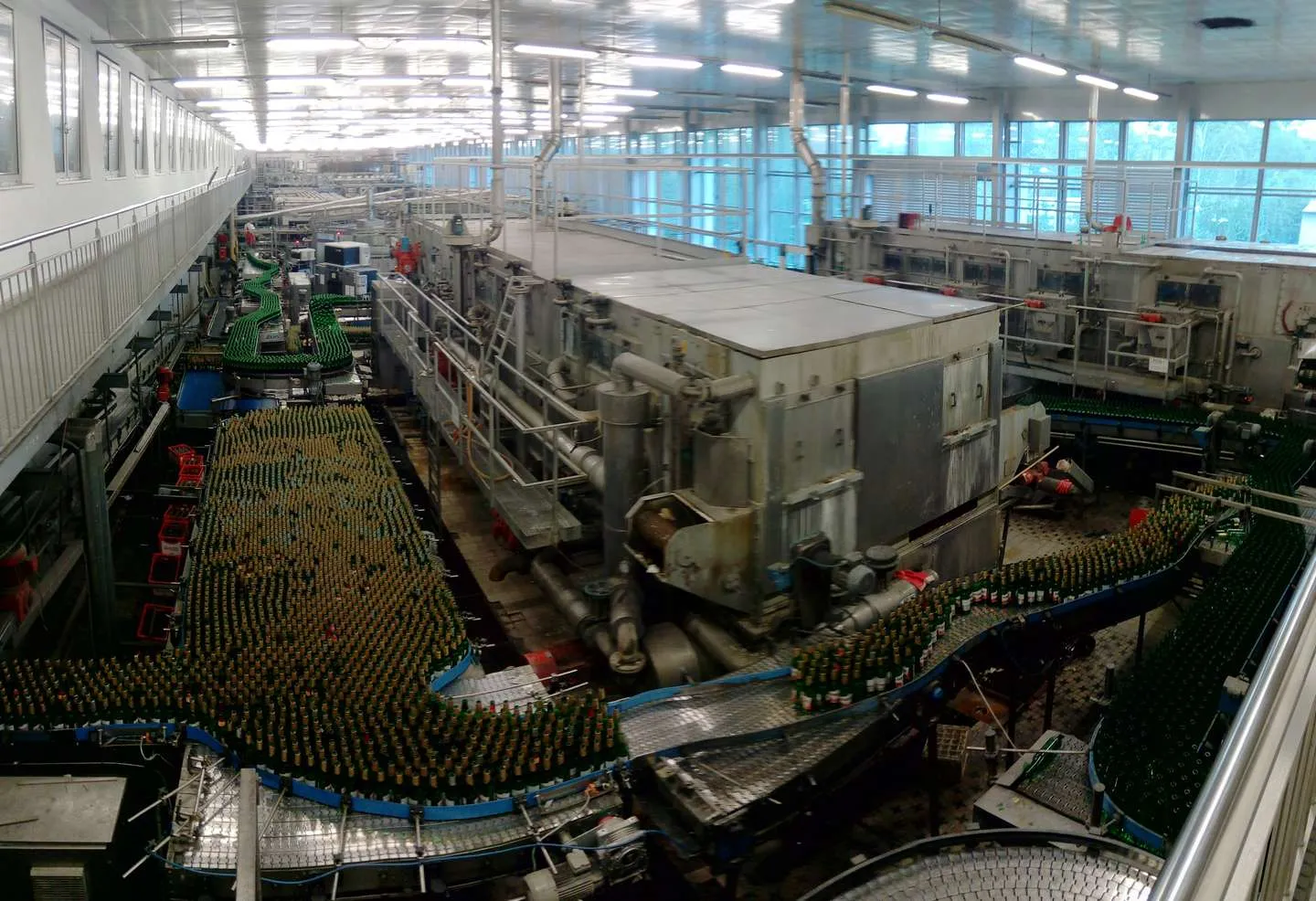
The packaging half is a chain of separate machines, each with its builder’s own controls.
| Machine | Listed maximum |
|---|---|
| Stretch blow molder, KHS InnoPET Blomax Series IV | 81,000 PET bottles an hour |
| Glass bottle filler, KHS Innofill Glass DRS | 80,000 bottles an hour |
| Can filler and seamer block, KHS SmartCan with Ferrum | 136,000 cans an hour |
| Can filler, Sidel EvoFILL Can | Over 130,000 cans an hour |
| Labeler, KHS Innoket Neo Flex | 74,000 bottles an hour |
| Palletizer, KHS Innopal PLR | 700 layers an hour |
Builders’ listed maximums for named machines, not typical plant speeds.
The fast machines share a design pattern:
- servo axes in place of cams and gearboxes;
- cameras for alignment;
- reject stations built into the machine.
KHS’s labeler offers servo-driven bottle plates and camera alignment at up to 60,000 containers an hour, and Sidel moved its filler-to-seamer drive to servomotors. That shared pattern is Joltek’s reading of the builders’ pages, not a builder’s claim.
The US had 612 soft drink plants and 291 bottled water plants in 2022.
Brewing
Breweries sit partly outside FDA’s food safety plan rules. Two subparts of Part 117 do not apply to alcoholic beverages at a facility that holds a Treasury permit and is registered with FDA:
- subpart C, hazard analysis and preventive controls;
- subpart G, the supply-chain program.
Good manufacturing practices still apply. So a brewery’s control points come mainly from quality and from the Treasury’s alcohol rules, rather than from a written FDA food safety plan.
Most breweries are small. The Brewers Association counts 9,724 US breweries in 2025, 9,578 of them craft. Brewery batch control shows up in three published projects:
- ProLeiT’s brewmaxx (now ProLeiT by Schneider Electric) covers silos, the brewhouse, fermenting and storage cellars, yeast, filtration, bottling and CIP. It is described as “independent of the PLC manufacturer” and built on “parameterisation instead of programming”.
- A California craft brewer’s upgrade: integrator Wunderlich-Malec tied 100,000 existing field tags from two brewhouses, making over 300,000 barrels a year, into two Rockwell ControlLogix 5580 controllers. It used Ignition SCADA and batch software with ISA-88 recipes, in three phases while production continued.
- A 50-barrel brewery near Boise: a Rockwell article describes a PlantPAx sequencer running brew and clean-in-place sequences across about seven varieties a week, with about 50 equipment parameters and 50 recipe parameters.
Pet food
Pet food is regulated much like human food. FDA says the Federal Food, Drug, and Cosmetic Act requires all animal foods to be safe to eat, and canned pet food must meet the low-acid canned food rules in Part 113. A plant that complies with Part 113 is exempt from the animal food preventive controls for the microbiological hazards Part 113 covers. So a wet pet food retort keeps the same records as a human food canner.
Dry pet food runs on the extruder:
- Throughput: Wenger lists its PetFLEX twin-screw extruder at up to 12,000 kg an hour.
- Density control: Wenger says its Auto Density Control can sample product density as often as every 45 seconds and reach a new setting in as little as two minutes, recording the data for validation.
The US had 456 dog and cat food plants, with $27,453,629,000 in shipments, in 2022.
Confectionery
Chocolate’s kill step is the roast. A 2021 study in Frontiers in Microbiology calls cocoa roasting “a critical control point for inactivation of foodborne pathogens in chocolate production”:
- roasting runs at 110 to 160 degrees C for 5 to 120 minutes;
- 10 minutes at 150 degrees C gave more than a 5-log reduction of Salmonella.
Chocolate’s low water activity stops Salmonella from growing but not from surviving. So the roaster’s time and temperature setpoints carry the safety case.
Foreign objects and allergens drive the inspection and cleaning load:
- Foreign objects: FDA treats a ready-to-eat food containing a hard or sharp object 7 to 25 mm long as adulterated. That is the size band metal detector and X-ray sensitivity targets are usually argued against.
- Allergens: chocolate lines run milk, soy, tree nuts and peanuts, and candy is among the foods most often recalled for undeclared allergens.
Wrapping is fast and servo-driven. Syntegon says its Pack 403 flow wrapper runs up to 600 packages a minute on a full-servo design, and ships with “a Rockwell control system with Syntegon HMI 4.0”. Its integrated wrapping and cartoning systems reach 1,500 a minute.
Most confectionery plants are small: in 2023, 70.7 percent of sugar and confectionery establishments had fewer than 20 employees.
Rated speed against real speed
Speed changes what the controls must do:
- at 130,000 cans an hour, a filler handles one can every 27.7 milliseconds;
- at 80,000 bottles an hour, it handles one every 45 milliseconds;
- a two-minute stop upstream of a 130,000-an-hour filler leaves about 4,333 cans with nowhere to go.
That arithmetic is why accumulation, line control and reject handling take so much engineering on packaging lines.
The listed speeds are maximums, and real speeds drift away from them. In Vladimir’s experience, machines arrive from the builder running at their rated speed and then degrade over the years, and packaging equipment in particular slows down. Real speeds vary too much from line to line to quote a typical figure, and no public source gives one. The number worth having is the measured speed of the plant’s own constraint machine, which is where the KPI section below starts.
What does the control architecture look like in a food plant?
A food plant is usually a collection of machines rather than one system. OEM machines arrive with their own PLCs, exchange signals with a line PLC over Ethernet tags, and report up to SCADA, a historian and sometimes an MES. Utilities such as refrigeration often run their own OEM controls. PackML exists but is rarely used.
The levels, from sensor to ERP
ISA describes the ISA-95 model in five levels:
- level 0 is the physical process;
- level 1 is sensing and manipulating;
- level 2 is monitoring and supervisory control by PLCs and DCSs;
- level 3 is manufacturing operations management, such as MES;
- level 4 is business planning and logistics in ERP.
ISA notes that the levels began as a hierarchy and now serve mainly to name the boundaries between systems. In a food plant they map like this:
| Level | In a food plant |
|---|---|
| 4, business planning | ERP: orders, inventory, lots and shipping records |
| 3, operations management | MES or an OEE system where one exists, batch records, the historian and SCADA servers |
| 2, supervisory control | The line PLC, the process PLC or DCS, HMIs, each OEM machine’s PLC, and in a dairy the pasteurizer’s public-health PLC |
| 1, sensing and actuation | Load cells, flow meters, temperature probes, valves, drives, metal detectors and checkweighers |
| 0, the process | Mixers, ovens, pasteurizers, fillers and conveyors |
For how the levels work on a real project, see the ISA-95 levels in practice.
How machines actually talk to each other
Most food lines are assembled, not designed as one system. In the plants Vladimir has worked in, the machines talk over Ethernet. They pass signals by message instructions, or by produced and consumed tags, to the line PLC or to the PLCs next to them.
The builder picks each machine’s controller. Syntegon’s wrapper ships on a Rockwell control system, while KHS and Sidel supply their own servo and pasteurizer controls. A single line can carry several brands, as in Joltek’s case study of a mixed Omron and Rockwell line.
HMS Networks estimates the network mix in newly installed factory automation nodes in 2026:
- Industrial Ethernet made up 79 percent, led by PROFINET at 30 percent and EtherNet/IP at 25 percent;
- fieldbus made up 14 percent;
- EtherNet/IP “remains the dominant protocol” in North America.
That is a vendor estimate across all factory automation, not a food survey. At the device level, IO-Link (IEC 61131-9) gives sensors a standard point-to-point link.
The plant floor is often less connected upward than vendor diagrams suggest. In most plants Vladimir has seen, the floor is not tied to MES or ERP. When those systems go down, production keeps running and information moves slower, with batches written on paper and setpoints checked by hand. For what a connected system adds, see what a manufacturing execution system does.
The standards that exist, and how much they are used
Three families of standards describe how food plant controls could be organized:
- ISA-88, for batch control. ISA’s ISA-88 series has four parts, from models and terminology (ISA-88.00.01-2010) to batch production records (ISA-88.00.04-2006). ISA names food and beverage among the industries it serves.
- PackML, for machine states. ISA publishes PackML as ISA-TR88.00.02-2022, a technical report on machine and unit states. OMAC developed it so that machines from different makers share a common look and feel and consistent behavior. The OPC Foundation publishes it as OPC 30050.
- The Weihenstephan Standards, for line data. A working group under the Technical University of Munich developed them. They define which production data a filling line records and how it is transferred, and are also an OPC UA specification, OPC 40600. The working group even wrote validation procedures based on 21 CFR Part 11 and GAMP, borrowing pharma practice that food rules do not require.
Specifying a standard and running one are different things. Vladimir has seen very little PackML in food plants; most lines run on the builders’ own tags. A plant that wants a common state model has to ask for it in each machine’s purchase specification, before the builder writes the code.
Utilities and safety systems
Utilities often sit outside the plant’s control system. In the plants Vladimir has worked in, refrigeration, HVAC and hazardous systems usually arrive with their own small, self-contained OEM controls. The investigations later in this guide show why that matters: two of the worst ammonia incidents turned on refrigeration control logic and alarms.
Machine safety follows the general manufacturing standards:
- ISO 13849-1:2023;
- IEC 62061;
- NFPA 79, 2024 edition;
- for packaging and processing machinery, ANSI/PMMI B155.1-2023.
Three published food plant architectures
| Plant | What was built |
|---|---|
| AriZona Beverages, Keasbey, New Jersey | Ignition SCADA and HMI, Sepasoft MES, an ISA-88 batch layer built inside Ignition, and a link to SAP. It supplies data for OEE, downtime tracking, scheduling and finished goods reporting |
| Four Roses Bourbon, Kentucky | Ignition over Siemens and Allen-Bradley PLCs for track and trace across 48 fermenters, and Sepasoft OEE on the bottling line |
| Sierra Nevada Brewing | An Ignition SCADA system built by the brewery’s own staff. It grew from the brewhouse to the cellar, packaging, filtration, quality data and truck tracking |
All three are vendor case studies. They show what a connected plant can look like, not what is typical.
A dairy adds one more boundary. Under the PMO, the pasteurizer’s public-health PLC cannot be commanded by any other system and shares its status only through hard-wired outputs. So a dairy’s level 2 diagram has a sealed island in it.
Which food safety rules reach the control system?
Most food safety rules reach the control system through records, monitoring and sanitation, not through the PLC itself. FDA’s preventive controls, FSIS HACCP, low-acid canning and juice rules set what must be measured, recorded and reviewed. One rule goes further: the Pasteurized Milk Ordinance writes requirements for the pasteurizer’s PLC directly.
A food plant answers to more than one rulebook at once. Which ones apply depends on what it makes:
- a meat plant answers to USDA’s Food Safety and Inspection Service;
- a dairy answers to its state regulator under the Pasteurized Milk Ordinance;
- a canner answers to FDA’s low-acid food rules;
- most other food plants answer to FDA’s preventive controls rule;
- any plant with a large ammonia refrigeration system adds OSHA and EPA.
Below, each rule is mapped to the part of the control system it lands on.
| Rule | Who it covers | What it asks of the control system | Where it lands |
|---|---|---|---|
| FDA 21 CFR 117, preventive controls | Most FDA-regulated food plants | Cleanable automated systems; accurate instruments; critical limits; monitoring, corrective action and review records | Instruments, recipes, HMI alarms, records |
| FDA 21 CFR 121, food defense | Most FDA-regulated plants above the very-small threshold | A vulnerability assessment, including an inside attacker, and mitigation at actionable steps | Access to setpoints, recipes and tanks |
| FDA 21 CFR 113 and 114, low-acid and acidified foods | Canners and retort operators | Tested temperature-indicating devices, recorded processes, no unauthorized changes | Retort controls, recorders, records |
| FDA 21 CFR 120 and 123, juice and seafood HACCP | Juice and seafood processors | A 5-log reduction for juice; HACCP plans by product | Kill-step controls, records |
| USDA FSIS 9 CFR 416, 417 and 430 | Meat, poultry and egg product plants | Sanitation SOPs, HACCP records made at the time, reassessment when systems change, Listeria controls | Records, HACCP monitoring, change control |
| Grade A Pasteurized Milk Ordinance | Grade A dairy plants | A dedicated, sealed public-health PLC, dedicated wiring, a one-second scan, five-second records, regulator tests | The pasteurizer PLC, its network and records |
| GFSI schemes (SQF, BRCGS, FSSC 22000, IFS) | Plants whose customers require certification | Audited food safety systems | Procedures, records |
| Canada, Safe Food for Canadians Regulations | Licensed Canadian food businesses | A preventive control plan; instruments that control, indicate and record | Instruments, records |
| OSHA PSM and EPA RMP | Plants with 10,000 pounds or more of anhydrous ammonia | Mechanical integrity for controls, alarms, interlocks and shutdowns; management of change | Refrigeration controls and alarms |
FDA’s preventive controls rule
21 CFR Part 117, FDA’s preventive controls rule for human food, never mentions a PLC, but it reaches one:
- Equipment: “holding, conveying, and manufacturing systems, including gravimetric, pneumatic, closed, and automated systems” must be built so they can be kept clean and sanitary.
- Instruments: the instruments and controls that measure, regulate or record temperature, pH, acidity, water activity or any other condition that controls microbial growth “must be accurate and precise”.
The food safety plan turns those conditions into numbers. Process controls must state each parameter and “the maximum or minimum value, or combination of values” to which it must be controlled. In practice those are the critical limits a PLC holds and an HMI alarms on. The rule also sets:
- Monitoring: written procedures with a stated frequency. Refrigeration temperatures may be recorded as exception records that show only a loss of control.
- Corrective action: when a control fails, a written procedure must find and fix the problem and keep affected food out of commerce unless it can be shown to be safe.
A preventive controls qualified individual must validate process controls, and again whenever a change to a control measure could affect whether it works. Changing the logic around a cook step is therefore more than a code change: it can trigger revalidation. Verification adds two more duties:
- process monitoring instruments must be calibrated or checked for accuracy;
- monitoring and corrective action records must be reviewed within seven working days.
The records must hold the actual values observed, be created at the time, and carry the date, the time and the signature or initials of the person recording them. Two details matter to anyone building a historian or reporting system:
- Part 117 electronic records are exempt from 21 CFR Part 11, the electronic records rule, unless another rule also requires them.
- They must be kept for at least two years.
Food defense, and who can change a setpoint
FDA’s intentional adulteration rule, 21 CFR Part 121, asks for a written vulnerability assessment of every step in the operation. It must consider:
- the public health impact;
- the degree of physical access to the product;
- the possibility of an inside attacker.
Each actionable process step then needs a mitigation strategy with monitoring and corrective actions.
For automation, the practical question is who can change what. In the plants Vladimir has seen, setpoints are set and validated during startup, the vendor acceptance test and the factory acceptance test. After handover, the plant can change all of them: a few are meant to change routinely, and most should never be touched. Few HMIs enforce that distinction. A food defense assessment is a good reason to start.
Low-acid canning, acidified foods, juice and seafood
The thermal process rules are the most prescriptive in FDA’s book:
- Scheduled process: under 21 CFR Part 113, a low-acid food (pH above 4.6, water activity above 0.85) must follow a scheduled process that reaches commercial sterility.
- Instruments: each retort needs a temperature-indicating device tested against a traceable reference on installation and at least once a year, accurate to 1 degree F.
- Recording and change control: digital recorders and data loggers are allowed if they record often enough to prove the process. The rule also requires “a means of preventing unauthorized changes in adjustment”, and a lock or a posted management notice counts.
- Review: a qualified plant manager must review the processing and production records within one working day and before release.
Acidified foods must reach and hold a pH of 4.6 or lower within the scheduled process time. Juice processors need control measures that deliver a 5-log reduction of the most resistant pathogen. Seafood processors need a HACCP plan for each location and kind of product.
USDA FSIS rules for meat and poultry
Meat, poultry and egg product plants run under USDA’s Food Safety and Inspection Service, with an inspector on site:
- Sanitation SOPs: every establishment must write sanitation standard operating procedures, monitor them daily and record corrective actions.
- Equipment: must be built to be cleaned, and must not be located or operated in a way that prevents inspection.
- HACCP reassessment: a plant must reassess its HACCP plan at least annually, and whenever a change could affect the hazard analysis. FSIS names “slaughter or processing methods or systems” among those changes, which puts a control system replacement on the list.
- Records: HACCP records must be made at the time of the event and signed or initialed. Computer records are acceptable “provided that appropriate controls are implemented to ensure the integrity of the electronic data and signatures”.
- Listeria: ready-to-eat plants choose one of three Listeria alternatives, from a post-lethality treatment plus a growth inhibitor down to sanitation alone.
The Pasteurized Milk Ordinance and the pasteurizer PLC
The Grade A Pasteurized Milk Ordinance is a model ordinance that states adopt. The newest edition FDA lists is the 2025 Revision, dated June 2026. It is the one food rule that specifies how the controller is built.
The pasteurizer’s own safeguards. It begins with the pasteurizer’s own mechanics:
- Flow diversion: every continuous-flow pasteurizer needs a flow diversion device that automatically sends milk back when the pasteurization condition falls below the legal limit. Forward flow below the minimum temperature must be physically prevented, for example by de-energizing the pumps.
- Holding time: a timing pump or a magnetic flow meter-based system sets it, connected so that “the holding time cannot be shortened without detection by the Regulatory Agency”. That is enforced with seals.
The PLC requirements. When a PLC or computer provides public health control of a high-temperature short-time (HTST) or higher-heat shorter-time (HHST) pasteurizer, Appendix H goes further:
- Dedication: the PLC must be “dedicated only to the public health control of that individual pasteurizer”. It may not be “under the command or control of any other computer system or Human Machine Interface”, and no host computer can override it or put it on standby.
- Wiring and seals: public health outputs must be hard-wired or on a dedicated network. Any switch, router or hub on that network sits in an enclosure the regulator seals. Reprogrammable devices have that function disabled by a sealed hardware switch, and the data cables and ports are sealed.
- The program: it must read every input and update every output at least once a second, contain no JUMP or GOTO instructions that change the scan order, and be stored in ROM, with access sealed by the regulator. Outputs fail safe on loss of power.
- Records: electronic pasteurization records must store each required variable at least every five seconds, and cleaning and tank records at least every 15 minutes. Data is backed up every 24 hours, and the reporting computer needs a 20-minute UPS.
- Testing: the regulator tests the pasteurizer on installation and at least every three months, and the holding time at least every six months.
What it means for a change. The ordinance requires the tests again whenever an alteration affects the instrument or a regulatory seal is broken. Changing the logic, the network or the controller on a legal pasteurizer therefore involves the state regulator, a reseal and a retest. This guide’s description of that process is from the ordinance, not from first-hand experience of resealing a pasteurizer PLC.
Certification schemes
Most large retailers and food companies require suppliers to be certified to a scheme benchmarked by the Global Food Safety Initiative. GFSI certifies no one itself. Two schemes change in 2026 and 2027:
- SQF: Edition 10 was published in March 2026, with an effective date “not prior to January 1, 2027”.
- FSSC 22000: Version 7 was released May 1, 2026, with upgrade audits from May 1, 2027.
IFS Food is at Version 8. For the control system, these schemes mostly add audit pressure on records, calibration and change control rather than new technical requirements.
Canada
Canada’s Safe Food for Canadians Regulations require a written preventive control plan. They also require equipment to be “equipped with instruments to control, indicate and record any parameters that are necessary to prevent contamination of the food”, calibrated where necessary. That is the closest any food rule outside dairy comes to naming instrumentation directly.
Ammonia refrigeration and process safety
Many food plants run large ammonia refrigeration systems, which brings in process safety law:
- Threshold: OSHA’s process safety management standard and EPA’s Risk Management Program apply at 10,000 pounds of anhydrous ammonia.
- Mechanical integrity and change: PSM lists “controls (including monitoring devices and sensors, alarms, and interlocks)” and emergency shutdown systems among the equipment that needs written mechanical integrity procedures. It requires management of change for changes to technology and equipment.
- Backup power: EPA’s 2024 RMP rule requires standby or backup power for release monitoring equipment by May 10, 2027. EPA proposed changes to that rule in February 2026, and no final rule had appeared by late October 2026.
- Industry standards: the Institute of Ammonia Refrigeration’s IIAR 2, 6, 7 and 9 cover design, inspection, operating procedures and existing systems.
In the plants Vladimir has worked in, refrigeration and other hazardous utilities usually arrive with their own small, self-contained control system from the equipment maker. The investigations later in this guide show why that system’s logic and alarms deserve the same attention as the production line’s.
Five claims to stop repeating
What many food automation pages still get wrong
- “FSMA 204 takes effect on January 20, 2026.”That was the original compliance date. Congress barred FDA from enforcing the rule before July 20, 2028, and FDA has proposed moving the date there.
- “IP69K means hygienic.”IP69K is a water-jet test from a road-vehicle standard, ISO 20653. Whether a surface can be cleaned is a separate question, answered by 3-A standards and EHEDG guidelines.
- “Part 11 covers every electronic food record.”Records kept under the preventive controls, food defense and traceability rules are exempt. Part 11 does reach low-acid canning, juice HACCP, infant formula, supplements and the PMO's electronic cleaning records.
- “PackML is defined by the 2015 guidelines.”The current version is ISA-TR88.00.02-2022, also published by the OPC Foundation as OPC 30050.
- “Every plant should aim for 85 percent OEE.”The 85 percent figure comes from Nakajima's ideal and was framed for discrete manufacturing. The food and beverage averages that exist, 53 to 68 percent, are self-reported or vendor data.
What does FSMA 204 mean for food plant systems?
FSMA 204, FDA’s food traceability rule, requires extra records for foods on its Food Traceability List. The compliance date in the 2022 rule was January 20, 2026, but Congress barred FDA from spending money to enforce it before July 20, 2028. FDA has proposed moving the date there and is still holding meetings on lot-level flexibility.
Where the rule stands
The dates have moved twice:
- The rule: FDA published the Food Traceability Rule on November 21, 2022, with a compliance date three years after it took effect: January 20, 2026.
- The proposal: on August 7, 2025, FDA proposed a 30-month extension to July 20, 2028.
- Congress: section 780 of Public Law 119-37, enacted November 12, 2025, says “No funds appropriated by this Act may be used to administer or enforce” the rule “prior to July 20, 2028”. It also directs FDA to look for flexibility in the lot-level tracking requirement, within the statute’s ban on requiring case-level tracking.
- The next budget: the fiscal year 2027 agriculture appropriations bill that passed the House repeats the bar. It also asks FDA to clarify when warehouse and distribution activities count as a transformation event.
FDA’s October 9, 2026 notice still calls the extension “proposed”, and says FDA “intends to comply with this Congressional directive”. The same notice set a public meeting on lot-level traceability for November 6, 2026, after one on June 15. FDA received 26 comments on its discussion paper, with strong support for recognizing GS1 as a data standard.
Two cautions for anyone reading FDA’s pages:
- the agency’s rule page still says “The compliance date is January 20, 2026” in its getting-started section;
- a separate October 2026 draft guidance on enforcement discretion covers retail stores and restaurants, not manufacturers.
Which foods and plants it covers
The Food Traceability List has 19 entries:
- Dairy and eggs: soft, semi-soft and unripened cheeses, and shell eggs.
- Nut butters.
- Fresh produce: cucumbers, herbs, leafy greens, melons, peppers, sprouts, tomatoes and tropical tree fruits.
- Fresh-cut: fresh-cut fruits and vegetables.
- Seafood: finfish (including smoked), crustaceans and bivalve shellfish.
- Deli salads: refrigerated ready-to-eat deli salads.
The rule also covers foods that contain a listed food as an ingredient, as long as the ingredient stays in the listed form, such as fresh.
Two exceptions matter to plants:
- USDA products: the rule does not apply to foods while they are under USDA’s exclusive jurisdiction, so a meat or poultry plant is outside it for USDA product.
- Kill steps: a plant that applies a kill step to a listed food keeps its receiving records and “a record of your application of the kill step” instead of the full set.
What a plant must record
The rule is built on critical tracking events and key data elements. The events are harvesting, cooling, initial packing, first land-based receiving of fish, shipping, receiving and transformation. For a manufacturer, three events matter:
- Transformation: the plant must assign a new traceability lot code when it transforms a food, and at no other point. It must then link the new lot to its inputs: the lot code, description and quantity of each input lot, plus the new lot’s code, location, completion date, description, quantity and a reference document.
- Receiving: the plant records the lot code, quantity, product, previous source, receiving location and date, the lot code source and a reference document.
- Shipping: the plant records the same elements and passes them on to the next recipient.
Production logs and batch logs count as reference documents, alongside bills of lading, invoices and database records. Three supporting rules complete the set:
- A plan: the plant must keep a written traceability plan that names a point of contact.
- Speed of delivery: when FDA asks, the plant must deliver the records within 24 hours in an electronic sortable spreadsheet.
- Part 11: the records are exempt from 21 CFR Part 11.
Where traceability lives in a real plant
In the plants Vladimir has seen, traceability lives mostly at the end-of-line coders. A unique date or lot code lets the plant look back at the production run, and the control system has little to do with it.
That covers the outbound half of the rule. The harder half is the link between input lots and the output lot at transformation, which a date code alone does not give. The rule does not say where that link must live. An MES, a batch system, an ERP or a disciplined paper batch record can all hold it, as long as the plant can turn it into a spreadsheet within 24 hours. For how an MES handles it, see lot genealogy in an MES.
Retailers and Canada
Customers may move faster than FDA. Walmart’s supplier page says that “As of August 1, 2025, Walmart and Sam’s Club requires suppliers of all food and beverage items” to send advance ship notices carrying the key data elements, with SSCC-18 barcodes on pallets and GS1-128 barcodes on cases. Walmart says it may hold or reject freight for missing traceability data, and expects suppliers to keep to its timeline despite FDA’s proposed extension.
Canada has had a simpler rule since 2019: one step back and one step forward, for all food. A business keeps:
- the food’s name and lot code;
- who it received the food from;
- who it provided the food to.
It keeps them for two years and hands them over within 24 hours “in a single file and in plain text”.
What to do before 2028
- Check every product and ingredient against the Food Traceability List.
- Find each transformation point (a batch start, a rework run, a repack) and decide where the new lot code is assigned.
- Tie input lots to output lots at that point, in a system that can produce a sortable spreadsheet within 24 hours.
- Make sure the coder, the batch record and the ERP carry the same code.
- Run a mock FDA request, and time it.
Is IP69K the same as hygienic design?
No. IP69K is a water-jet test from a road-vehicle standard, ISO 20653: it shows a device survives close-range, high-pressure, hot washdown. Hygienic design is a different question, about whether a surface can be cleaned and inspected, set by 3-A standards, EHEDG guidelines and FDA and FSIS equipment rules.
What IP69K tests
IP codes come from IEC 60529, which classifies how well enclosures for electrical equipment keep out solids and water. The 9K level comes from a different place: the road-vehicle standard ISO 20653, now in its 2023 edition, which absorbed a German automotive standard. A trade guide describes the IP69K test:
- The water: 80 degrees C, at 80 to 100 bar and 14 to 16 liters a minute.
- The nozzle: 100 to 150 mm from the surface.
- The angles: 0, 30, 60 and 90 degrees, for 30 seconds each.
The same guide notes that the test “does not cover cleaning chemicals, steam, years of thermal cycling, or mechanical abuse”. A practitioner on a controls forum put the gap plainly: parts rated IP69K “can be high pressure washed down, but does not ALWAYS mean they are hygienic.”
What hygienic design requires
Hygienic design has its own bodies and documents:
- 3-A Sanitary Standards. 3-A is a not-for-profit whose first dairy equipment standards date to the 1920s. To carry the 3-A Symbol, equipment must pass an inspection by a third-party evaluator, and a new inspection is required every five years. Its standards that touch automation include 74-07 for sensors and sensor fittings, 103-00 for robot-based automation systems, 78-04 for spray cleaning devices, 88-01 for machine leveling feet, and the accepted practice 605-05 for CIP of processing equipment.
- EHEDG. The European Hygienic Engineering and Design Group’s Doc 8, Hygienic Design Principles, reached its fourth edition in December 2025. Guideline 37 on sensors also covers “applications in the splash area like housings, holder and wiring devices”. Other EHEDG documents cover CIP installations, wet-cleaned open equipment, food factories and robots.
- ISO and NSF. ISO 14159:2002 sets hygiene requirements for machinery design, and a revised draft went out for comment in July 2026. For meat and poultry equipment, NSF/ANSI/3-A 14159 has three parts: processing equipment, handheld tools and belt conveyors.
Neither 3-A’s standards page nor EHEDG’s catalog lists a document on control cabinets or cabling. The closest is EHEDG’s sensor guideline.
Regulators state the outcome, not the method:
- FDA: equipment must be “adequately cleanable” and installed to make cleaning possible, with food-contact seams “smoothly bonded or maintained so as to minimize accumulation of food particles”. The rule names no standard and no IP rating.
- USDA: the Agricultural Marketing Service reviews meat and poultry equipment designs for a fee, but does not require it. FSIS inspectors who find design problems may ask the plant, and then the fabricator, to modify the equipment. AMS encourages buyers to write USDA acceptance into purchase contracts.
- Canada: equipment must withstand repeated cleaning and be “able to be easily disassembled” where cleaning requires it.
What washdown does to electronics
Washdown is relentless. In the plants Vladimir has worked in, some equipment is washed down every other day, and electronics do not tolerate it: Vladimir saw many failures from water and moisture.
Water is also a food safety hazard in its own right. FDA’s inspection of Abbott’s Sturgis infant formula plant recorded 310 water events, including leaks, moisture and condensation, in dry powder production areas over about two years.
Controls hardware for wet areas
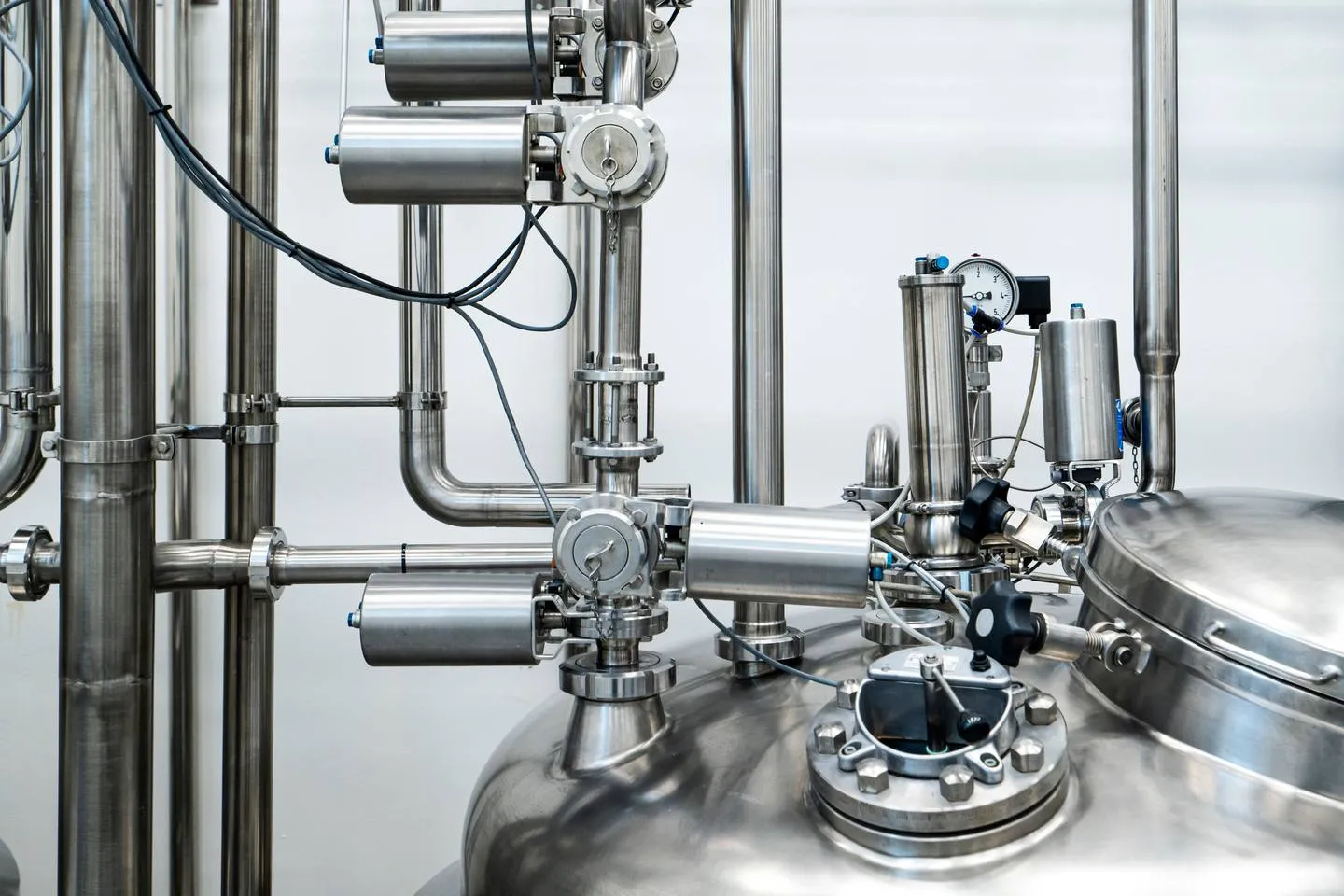
The usual answer is stainless, sloped and sealed:
- Enclosures and signals: one practitioner describes a food plant where “all the electrical enclosures were stainless steel NEMA 4X with sloped tops” and every analog sensor ran on 4-20 mA.
- A hygienic enclosure: Hammond’s sanitary wallmount enclosure is Type 4X, 304 stainless with continuously welded seams ground smooth, and has a top sloped 25 degrees “to shed water and washdown fluids”. It ships without pre-drilled mounting holes so that welded or stainless stand-off mounting keeps the rating, and lists NSF/ANSI 169 and IP69K.
- Moving controls out: builders also move controls out of the wet zone. Sidel’s EvoFILL Can replaces the mechanical drive between filler and seamer with servomotors, so the filling area needs no lubrication. An “integrated pneumatic box on each filling valve means no pneumatic pipes in the filling environment”.
None of this makes a cabinet hygienic on its own. In Joltek’s view, an IP69K rating, stainless steel and a sloped roof still leave room for ledges, exposed threads, hollow supports and unsealed cable entries, which is exactly what EHEDG’s sensor guideline asks designers to consider in the splash area.
How do allergen changeovers and CIP work in the control system?
An allergen changeover is a cleaning and verification sequence between products with different allergens. Clean-in-place automates the cleaning by circulating timed rinses, caustic, acid and sanitizer through closed equipment. The PLC sequences and records each step, and in some plants it checks tagged change parts before the line can restart.
The rules on allergens
FDA recognizes nine major food allergens: milk, eggs, fish, crustacean shellfish, tree nuts, peanuts, wheat, soybeans and sesame. Sesame was added by the FASTER Act, effective January 1, 2023. Part 117 treats allergen cross-contact as a hazard in two places:
- Plant-wide practices: production procedures must not “contribute to allergen cross-contact”, and equipment must be taken apart for cleaning “insofar as necessary”.
- Preventive controls: food allergen controls must protect food from cross-contact “during storage, handling, and use” and make labeling correct.
Unlike process controls, allergen and sanitation controls do not have to be validated, although nothing stops a plant from validating them. When an allergen or sanitation control is not properly implemented, the plant may make a timely correction instead of running the full corrective action procedure.
FDA’s draft allergen guidance defines changeover as “procedures used to prepare the processing line when different products are produced on the same processing line”. Its example wet cleaning sequence runs in eight steps:
- Pre-clean.
- Pre-rinse.
- Detergent and scour.
- Post-rinse.
- Prepare for inspection.
- Pre-operational inspection.
- Sanitize.
- Assemble.
The guidance treats checking water temperature during cleaning as monitoring and calibration as verification. It lets a plant monitor the steps of a cleaning process without swabbing every surface.
In February 2026, FDA heard “widespread agreement” from stakeholders that allergen thresholds are best applied to validating cleaning of shared equipment, rather than to finished-product testing. That is a summary of stakeholder views, not an FDA position.
What the recall data shows
FDA says milk is the most common cause of recalls for undeclared allergens. Joltek’s count of FDA’s recall enforcement data shows:
- The share: recall events citing an “undeclared” substance were 30.8 to 38.5 percent of all FDA food recall events each year from 2021 to 2025. That count includes non-allergens such as sulfites.
- 2025 by allergen: 163 events named an allergen. Milk appeared in 54, soy and wheat in 37 each, tree nuts in 35 and sesame in 18, and 78 of the 163 were Class I.
Clean-in-place
CIP rests on four factors, often drawn as Sinner’s circle after the Henkel chemical engineer who summarized them in 1959:
- time;
- mechanical action;
- chemistry;
- temperature.
Raising one lets another come down. A CIP recipe is those four numbers per step, held and recorded by a PLC.
Dairy writes the most into its rules. The Pasteurized Milk Ordinance sets four requirements for CIP:
- Recording: each CIP circuit needs a temperature recorder in the return line. An approved alternative recorder must log “cleaning cycle time and temperature, cleaning solution velocity or cleaning pump operation and the presence or strength of cleaning chemicals for each cleaning cycle.”
- Tanks: storage tanks must be emptied and cleaned at least every 72 hours unless an extended run is approved.
- Record keeping: cleaning records must be kept for two years.
- Electronic records: CIP records kept electronically must meet the ordinance’s own criteria and 21 CFR Part 11.
Meat and poultry plants run pre-operational sanitation with daily monitoring and records. EHEDG publishes guidance on CIP installations and on cleaning validation. Full CIP takes time: Tetra Pak puts a full cycle on a UHT line at 70 to 90 minutes.
Verifying the changeover in the PLC
Some plants put the changeover itself under PLC control. In allergen environments Vladimir has worked in, the mechanical change parts carried RFID tags that the PLC read, and the changeover logic checked them before the line could run. A wrong part or a missing part stopped the restart.
Changeover is also an availability loss in the OEE model, and no public benchmark for changeover time in food plants exists. The useful figure is the plant’s own, measured from line state data rather than estimated.
Who supplies the controls, software and machines?
Three groups supply a food plant’s automation: control platform vendors such as Rockwell, Siemens, Emerson and Schneider; machine builders such as Tetra Pak, GEA, Krones, KHS, JBT Marel and Syntegon; and the integrators and distributors around them. No public source measures market share, so plants should judge suppliers by support, not share.
Control platforms
The major platform vendors all sell into food and beverage:
- Rockwell Automation reported fiscal 2025 sales of $8,342,000,000. It names Siemens, ABB, Schneider Electric, Emerson, Mitsubishi Electric, Honeywell and Dassault Systemes as major competitors across its markets.
- Siemens’ food and beverage page cites a program with Heineken to cut energy and CO2 at 15 breweries and malt houses.
- Emerson reported fiscal 2025 net sales of $18,016,000,000 and pitches “scalable, hygienic, and reliable automation” for food plants.
- Schneider Electric pairs EcoStruxure and AVEVA software for food plants. The brewery control specialist ProLeiT now brands itself “ProLeiT by Schneider Electric”.
- Beckhoff reported 2025 sales of 1,240,000,000 euros.
Rockwell’s 10-K adds a detail that matters on the plant floor: “In North America, a large percentage of our sales are through distributors.” A plant’s first call is often a distributor, not the vendor.
Vendor pages carry customer stories, not market share. Mitsubishi Electric’s food page calls the company “the number one automation vendor in the world market” without a source or a figure. Joltek’s research found no primary-source market share for PLCs, DCSs, SCADA or MES in food and beverage.
SCADA, MES and OEE software
Above the PLCs, the published food plant projects lean on a handful of products:
- Ignition and Sepasoft in the plants named earlier.
- OEE and MES products: Sepasoft’s OEE module, AVEVA, Siemens Opcenter and Parsec TrakSYS.
- A retirement date: Rockwell says FactoryTalk Metrics “will be discontinued and no longer available after September 2028”, with Plex MES as its recommended path. Plants running Metrics for OEE have a date to plan around.
Machine builders
| Builder | Latest annual revenue | Notes |
|---|---|---|
| Tetra Pak | 12,350,000,000 euros (2025) | 174 billion packages sold |
| Krones | 5,663,800,000 euros (2025) | Beverage and liquid food lines |
| GEA Group | 5,495,000,000 euros (2025) | Food, beverage and pharma systems |
| JBT Marel | $3,798,200,000 (2025) | Includes Marel from January 2025 |
| Middleby | $3,201,200,000 (fiscal 2025) | Food Processing segment $850,200,000 |
| Bühler Group | CHF 2,752,600,000 (2025) | Grain, chocolate and food processing |
| Syntegon | 1,750,000,000 euros (fiscal 2025) | Includes pharma |
Company-wide revenue, not food and beverage revenue or market share. No revenue figure was found for KHS, Sidel, Multivac, Ishida or Heat and Control.
Integrators and distributors
Who writes the code is often not who sold the machine. In the plants Vladimir has worked in, builders deploy the equipment and subcontract integrators to write and validate the code. Distributors supply hardware after deployment. For the practical side, see bringing a new OEM machine into a plant and how machine builders and integrators split the work.
The integrators named in published food and beverage case studies include Vertech, Wunderlich-Malec, Stone Technologies and Actemium. No public source ranks integrators by food and beverage work. The Control System Integrators Association’s Pulse report for the second quarter of 2026 covers all industries:
- median utilization was 52 percent;
- median backlog fell from 134.9 to 125.4 days.
The largest food and beverage companies
The buyers are large and their filings are public. They set the standards their plants buy against.
| Company | Latest annual revenue |
|---|---|
| PepsiCo | $93,925,000,000 (2025) |
| Archer-Daniels-Midland | $80,269,000,000 (2025) |
| Tyson Foods | $54,441,000,000 (fiscal 2025) |
| The Coca-Cola Company | $47,941,000,000 (2025) |
| Mondelez International | $38,537,000,000 (2025) |
| General Mills | $18,424,600,000 (fiscal 2026) |
| Keurig Dr Pepper | $16,603,000,000 (2025) |
| Smithfield Foods | $15,531,000,000 (2025) |
| Hormel Foods | $12,106,200,000 (fiscal 2025) |
| Conagra Brands | $11,281,600,000 (fiscal 2026) |
| Molson Coors | $11,140,800,000 (2025) |
Selected US-listed producers, from their annual reports. Fiscal years differ.
Do food plants need computer validation like pharma?
Mostly no. Records kept under FDA’s preventive controls rule are exempt from 21 CFR Part 11, and food “validation” means proving a preventive control works, not validating software. But Part 11 does reach some food records: low-acid canning, juice HACCP, infant formula, supplements and the PMO’s electronic cleaning records.
Part 11 is FDA’s rule for electronic records and signatures. In drug manufacturing it brings system validation, access limits, time-stamped audit trails and authority checks. Food is a patchwork:
| Records kept under | Part 11 | What the rule says |
|---|---|---|
| Preventive controls (Part 117) | Exempt | Exempt unless another rule also requires the record |
| Food defense (Part 121) | Exempt | Same exemption |
| Traceability (Subpart S) | Exempt | Same exemption, in the rule itself |
| Low-acid canned food (Part 113) | Applies | Records “may be maintained electronically, provided they are in compliance with part 11” |
| Juice HACCP (Part 120) | Applies | Computerized records “in accordance with part 11” |
| Seafood HACCP (Part 123) | Integrity controls | Appropriate controls for electronic data and signatures, without naming Part 11 |
| Meat and poultry (FSIS) | Integrity controls | Controls “to ensure the integrity of the electronic data and signatures”; Part 11 is an FDA rule |
| Grade A milk CIP records (PMO) | Applies | Must meet the ordinance’s criteria and 21 CFR Part 11 |
| Dietary supplements (Part 111) | Applies | “All electronic records must comply with part 11” |
| Infant formula (Part 106) | Applies, plus system validation | Electronic records comply with Part 11, and every automatic system must be validated before product made with it is released |
Infant formula is the closest food comes to pharma. Its makers must keep records of every computer system: what it does, a copy of the software, its validation, who may change it, and every modification and revalidation.
For contrast, the drug rule 21 CFR 211.68 requires controls so that only authorized people change master records, checks on input and output, and a backup of data. FDA’s data integrity guidance expects drug data to be “attributable, legible, contemporaneously recorded, original or a true copy, and accurate (ALCOA)”.
In food, “validation” mostly means something else. Under 21 CFR 117.160, it means “obtaining and evaluating scientific and technical evidence” that a preventive control, properly implemented, controls the hazard. The question is whether the cook step kills the pathogen, not whether the software was tested.
In practice, food plants validate machines when they arrive. In the plants Vladimir has seen, setpoints are set and validated during startup, the vendor acceptance test and the factory acceptance test, then handed to the plant. For how to run that test well, see factory acceptance testing.
What did investigations find in food plants?
The worst food plant incidents of the past two decades trace back to controls and data as often as to people: dust that conveyors let build up, a defrost program that skipped a step after a power outage, a single level sensor with no backup, and an ammonia system with no process historian to explain what went wrong.
| Incident | What happened | Controls lesson |
|---|---|---|
| Imperial Sugar, Port Wentworth, Georgia, 2008 | Sugar dust explosions killed 14 workers. The first began in an enclosed belt conveyor where new cover panels let dust build up, and an overheated bearing most likely ignited it | Conveying equipment was “not designed or maintained to minimize the release of sugar and sugar dust” |
| Didion Milling, Cambria, Wisconsin, 2017 | A dust explosion and fire killed five of the 19 workers on shift | The CSB called for dust hazard analyses, minimum transport velocity in dust collection, deflagration venting and suppression, and management of change |
| Millard Refrigerated Services, Theodore, Alabama, 2010 | Hydraulic shock on restart after a seven-hour power outage released 32,100 pounds of ammonia; 32 people were hospitalized | A programming error let the system skip coil bleeding, with “a lack of restricted access to control system modifications” |
| Foundation Food Group, Gainesville, Georgia, 2021 | Liquid nitrogen overflowed from an immersion freezer, and six workers died of asphyxiation | A single level measurement with no backup, and no oxygen monitoring or alarm |
| Cuisine Solutions, Sterling, Virginia, 2024 | About 275 pounds of ammonia were released, and 33 workers were taken to hospitals | Alarms reached an empty control room, and no historian recorded the refrigeration process |
| ConAgra Foods, Garner, North Carolina, 2009 | A natural gas explosion killed four workers | The CSB called for purging gas piping outdoors and for combustible gas detection |
| Abbott Nutrition, Sturgis, Michigan, 2022 | Cronobacter in the plant environment led to a recall and a national infant formula shortage | Process controls did not cover all stages, CIP dry-out steps were not validated, and there were 310 water events |
Three of these turned on control logic and data, and they repay a closer read.
Millard Refrigerated Services. The CSB’s safety bulletin traces the 2010 release to the restart after an outage:
- The error: a programming error let the system go from soft gas straight to refrigeration mode without bleeding the coil. It went undetected because the normal sequence never exercised it.
- The trigger: an operator’s manual clearing of an alarm interrupted the defrost cycle.
- The enabler: the CSB cited “a lack of restricted access to control system modifications”.
Its key lessons are controls lessons: bleed coils automatically on restart, set pump-out times long enough, and password-protect overrides and sequence changes.
Foundation Food Group. The CSB found the cause was “the failure of the immersion freezer’s liquid level control system to accurately measure and control the liquid nitrogen level”, after a bubbler tube deformed. The design let “the failure of a single level measurement device” cause an uncontrolled release. The room had no atmospheric monitoring to detect the oxygen-deficient air, shut off the nitrogen and warn people. Nitrogen is not covered by OSHA PSM or EPA RMP, so no process safety rule forced the question.
Cuisine Solutions. The CSB’s 2025 report found three failures in the alarms and data:
- Alarms: “none of the alarms from the ammonia detection sensor system inside the production areas of the plant activated”. One sensor alarmed only at an HMI in the refrigeration control room, where no one was present, and “there was no planned corrective action in response to this alarm, either by automatic control or in an operating procedure”.
- Data: the plant “did not record historical process data for the ammonia refrigeration system beyond food storage, chiller, or freezer temperatures required for food safety concerns”, so the CSB could not determine what caused the overpressure.
- The fix: the CSB recommended a process data historian and ammonia-specific alarms. For what that system involves, see a process historian.
The pattern connects to the architecture section. In the plants Vladimir has worked in, refrigeration and hazardous utilities usually arrive with their own OEM control system. Millard and Cuisine Solutions are lessons about exactly those systems: their logic, their access control, their alarms and their data.
Food safety outbreaks carry controls lessons too, though fewer are documented in official findings:
- Boar’s Head, 2024: the CDC counted 61 people ill in 19 states and 10 deaths in a Listeria outbreak, and every deli product from the Jarratt, Virginia plant was recalled. NPR reported that the USDA report found meat and fat residue “from the previous day’s production on the equipment, including packaging equipment”.
- Blue Bell, 2015: a Listeria outbreak counted by the CDC at 10 people ill and three deaths ended with Blue Bell recalling all of its products.
How exposed are food plants to cyberattacks?
Food companies have been hit hard, but mostly through business systems rather than plant controls. Mondelez, Molson Coors, JBS, Dole, Americold, UNFI and Asahi lost ordering, shipping or invoicing for days to weeks. Many plants kept producing on paper. CISA now warns about internet-exposed HMIs and PLCs in the sector.
| Company, date | What stopped, in the company’s words | Disclosed effect |
|---|---|---|
| Mondelez, June 2017 | The “ability to ship and invoice” for the last four days of the quarter; manufacturing continued | Revenue growth cut by 2.3 points; $7,100,000 of incremental expenses |
| Molson Coors, March 2021 | “Brewery operations, production, and shipments” | All breweries producing again 15 days after the first filing; $2,000,000 of one-time costs net of insurance |
| JBS USA, June 2021 | Operations in North America and Australia | Most plants expected to be operational the next day |
| Maple Leaf Foods, November 2022 | A system outage with operational and service disruptions | At least C$23,000,000 in the quarter |
| Dole, February 2023 | Ransomware that disrupted its Fresh Vegetables and Chilean businesses | $10,500,000 of direct costs |
| Americold, April 2023 | Operations taken offline at the cold storage company | $24,400,000 of charges over nine months |
| UNFI, June 2025 | The “ability to fulfill and distribute customer orders” at the grocery distributor | An estimated $350,000,000 to $400,000,000 of lost sales |
| Asahi, September 2025 | Order and shipment operations in Japan; orders went manual | Electronic ordering back after about nine weeks; lead times normal by February 2026 |
None of these filings says whether plant control networks were attacked. What stopped was mostly ordering, shipping and invoicing. Asahi’s own review found the attacker entered through network equipment at one of its sites about ten days before the disruption, then gained administrator rights at the main data center.
That matches what Vladimir has seen from the inside. In most plants, the floor is not tied to MES or ERP, so when those systems go down, production keeps running, more slowly and on paper. The exposure is real but lopsided: a plant that can make product but cannot take orders or ship it still loses sales, as UNFI’s estimate shows.
The agencies now point at the plant floor as well:
- The FBI: a 2021 FBI notice warned that the sector is “increasingly reliant on smart technologies, industrial control systems, and internet-based automation systems”. It described a US bakery halted for about a week after ransomware arrived through a managed service provider.
- Complaint counts: the FBI’s 2025 Internet Crime Report counted 89 ransomware complaints from the food and agriculture sector. Those are complaints, not all incidents.
- Hacktivists: a December 2025 CISA advisory describes pro-Russia hacktivists reaching HMIs through internet-facing VNC connections “often through default or weak passwords” and changing setpoints. It names food and agriculture among the targeted sectors. Its first mitigation: “Reduce exposure of OT assets to the public-facing internet.”
- Unitronics PLCs: CISA’s advisory on Unitronics PLCs names food and beverage manufacturing among the sectors that use them. Compromised devices “either had a default password in place or no password”.
The plant-floor fixes are known: an asset inventory, segmentation between business and plant networks, controlled remote access for OEMs, and no default passwords. For the standard behind them, see ISA/IEC 62443 for plant leaders. For the two most common gaps in food plants, see locking down remote access for OEMs and segmenting a brownfield plant network.
What is changing for food plants from 2026 to 2028?
Several forces land on food plants at once: Section 232 tariffs that raised can and machinery costs, GLP-1 drugs trimming grocery spending, FDA’s push to remove synthetic dyes by the end of 2026, packaging EPR laws in several states, new SQF and FSSC editions, and a 2028 traceability deadline.
Tariffs. Proclamation 11021 set Section 232 duties of 50 percent on aluminum, steel and most copper articles, and 25 percent on listed derivative products, from April 6, 2026. The can makers felt it first:
- Prices: Packaging Dive reported the Midwest aluminum premium passing $1 a pound.
- The industry’s view: the Can Manufacturers Institute’s president said “We expect greater price increases in 2026 than we saw last year.”
- Dairy: a September 2026 proclamation excludes certain Canadian dairy products from import.
- The buyers: Conagra’s 10-K says “We have seen tariff impacts on the costs of our ingredients, packaging”.
GLP-1 drugs. A Cornell study of about 150,000 households found that within six months of starting a GLP-1 medication, households cut grocery spending by an average of 5.3 percent. Savory snack spending fell about 10 percent, with similar drops in sweets and baked goods, while yogurt, fresh fruit and nutrition bars rose. The study is observational. Conagra’s 10-K says weight loss medication “has caused, and may continue to cause, shifts in consumer preferences”. For a plant, a demand shift arrives as reformulations, new pack sizes and more changeovers.
Dyes and additives. In April 2025, HHS and FDA announced work with industry to eliminate six petroleum-based dyes by the end of 2026. That is a voluntary target, not a legal deadline. FDA’s pledge tracker lists General Mills and Conagra converting their US retail portfolios by the end of 2027. FDA’s revocation of Red No. 3 for food takes effect January 15, 2027, and FDA has proposed requiring notification of GRAS determinations. Each reformulation is a recipe change. Where the recipe includes a process control, the change can trigger revalidation under Part 117.
Packaging EPR. Extended producer responsibility laws make brand owners pay for packaging waste:
- California: CalRecycle received the producer responsibility organization’s plan on October 13, 2026.
- Oregon: the program has been running since July 2025.
- Colorado: the state approved its plan in December 2025.
- Other states: Maine, Maryland, Minnesota and Washington follow on slower schedules.
In Joltek’s reading, lighter or different packaging lands on the line as new form-fill-seal tooling, case packer formats and checkweigher setups.
Labor. Average hourly earnings in food manufacturing were $28.97 in September 2026, up from $27.99 a year earlier. The two largest occupations are packaging and filling machine operators (168,370) and food batchmakers (144,690). Tyson lists “labor shortages and increased turnover” among its risk factors. Conagra says it has “committed to investing in automation, connected data, improved equipment, and artificial intelligence”.
Automation investment. The International Federation of Robotics reports that US robot installations in food and beverage rose 30 percent to 2,900 units in 2025. North American robot orders for food and consumer goods rose 17 percent in the first half of 2026.
| Date | What changes |
|---|---|
| November 6, 2026 | FDA public meeting on lot-level traceability |
| End of 2026 | HHS and FDA voluntary target for removing six petroleum-based dyes |
| January 1, 2027 | Earliest effective date for SQF Edition 10 |
| January 15, 2027 | Red No. 3 revocation takes effect for food |
| January 2027 | Extended support ends for Windows Server 2016, common under SCADA and historians |
| April 30, 2027 | Last date for FSSC 22000 Version 6 audits; Version 7 upgrade audits begin May 1 |
| May 10, 2027 | RMP backup power for release monitoring, unless EPA’s 2026 proposal changes it |
| July 20, 2028 | FSMA 204 enforcement bar ends |
| September 2028 | FactoryTalk Metrics no longer available |
How do you modernize an older food plant without stopping production?
In stages, inside the windows the plant already has. Food plant modernization means replacing obsolete controllers, drives and networks such as DeviceNet, ControlNet and DH+ around sanitation shifts and planned shutdowns. A project can take a week or several years, depending on how much downtime the plant can afford and when the budget arrives.
Vladimir has worked on brownfield projects that replaced old drives, old networks and obsolete controllers, and removed DeviceNet, ControlNet and DH+. Such projects take anywhere from one week to many years, depending on when the plant can stop and on the budget.
The lifecycle dates that drive most food plant projects:
- Rockwell: the PLC-5 controllers “are now discontinued”. The SLC 5/05 64K controller was discontinued on March 31, 2024. Rockwell’s SLC 500 migration path moves to CompactLogix 5380 while “maintaining the I/O wiring systems”.
- Siemens: a parts distributor reports that the S7-300 and ET 200M reached type discontinuation as of October 1, 2025, with assemblies available only in spare-part quantities. Siemens’ own 2015 migration guide already warned that “The risk for old plants increases continuously due to the difficult spare parts supply situation”.
- Windows: Microsoft ended Windows 10 support on October 14, 2025. Windows Server 2016 leaves extended support in January 2027. Those servers often outlive the PLCs they serve.
- Tetra Pak’s intervals: Tetra Pak’s lifecycle guidance gives typical replacement intervals of five to ten years for PLCs and seven to ten years for HMIs. It recommends a phased upgrade that starts with the PLC in a CIP station.
In a food plant, a like-for-like swap can still be a regulated change:
- FDA plants: the plant must reanalyze its food safety plan when a significant change creates a potential new hazard. It must also validate any changed preventive control before the change is operative.
- Meat and poultry: a change in “processing methods or systems” triggers a HACCP reassessment.
- Grade A dairy: the regulator must test the pasteurizer PLC with the vendor’s procedures whenever a seal is broken.
- Retorts: a new retort controller must still prevent unauthorized changes. Its temperature device must be designed so that “the accuracy of the device is not affected by electromagnetic interference”.
- Records: after any migration, the seven-day record review depends on the new historian or recorder still producing the record.
So the pace is set by sanitation windows and validation, not by engineering hours alone. That is Joltek’s reading of the rules and of Vladimir’s projects. One engineering firm’s published project shows the approach. To fit a short window on a sold-out cooking and chilling line, Foth used shop fabrication and modular installation, and says the new CIP design “reduced sanitation downtime by 70%”.
Margins rarely allow anything else:
- Tyson: an operating margin of 2.0 percent in fiscal 2025, with beef at negative 5.2 percent and pork at negative 3.4 percent.
- Conagra: “significant costs to upgrade, maintain, and expand production” at its facilities.
A sequence that works in most food plants:
- Inventory every controller, drive, network and PC, with its lifecycle status and who owns its code.
- Mark which ones touch a preventive control, a critical control point, a pasteurizer or a PSM-covered system.
- Convert code with the vendor’s tools and keep field wiring where the platform allows it.
- Plan each cutover inside a sanitation window or shutdown, with a tested rollback.
- Agree the validation or reassessment with quality, and in a dairy with the regulator, before the window opens.
Ten questions, about two minutes
Ready to change a controller in a food plant?
Answer for the change you are planning. Each answer opens the next question, and the end shows the gaps to close first.
- Do you know which preventive controls, critical control points or kill steps this controller touches? A changed process control must be validated before it runs product, and FSIS plants must reassess HACCP when systems change.
- Has quality agreed whether the change needs revalidation or a HACCP reassessment, before work starts? Agree it before the window opens, not after the line is back up.
- Have you checked whether the change touches a sealed pasteurizer PLC, a retort controller or ammonia refrigeration? A broken PMO seal brings a regulator retest, retort controls must still block unauthorized changes, and PSM requires management of change.
- Will the new system produce every food safety record, with actual values and times, from the first batch? Part 117 records are reviewed within seven working days, and that review depends on the new historian or recorder.
- Do you have the current program, and the right to change it, for every machine involved? Builders deploy the machines and often subcontract the code, so the plant may not hold what it needs.
- Does the cutover fit inside a sanitation window or planned shutdown, with time left to test? In a food plant, the pace of a change is set by sanitation windows and validation, not engineering hours alone.
- Is there a tested way back: the old program, hardware and wiring able to run the line again? Keeping the field wiring, as vendor migration kits allow, makes a rollback realistic.
- Are the setpoints operators may change separated from the ones they must not touch? FDA's food defense rule asks plants to consider an inside attacker, and few HMIs enforce the difference.
- Will new panels, sensors and drives survive the washdown where they sit, and can they be cleaned? An IP69K rating shows a device survives the hose. Hygienic design asks whether it can be cleaned.
- Are remote access paths and default passwords dealt with on every new controller and HMI? CISA has warned about internet-exposed HMIs and default passwords in the food and agriculture sector.
For a full method, see planning a PLC platform migration and the SLC 500 migration guide.
Which KPIs matter in a food plant, and what are the benchmarks?
OEE, changeover time, giveaway, sanitation time and energy per unit are the numbers food plants run on. Public benchmarks are thin: self-reported OEE averages range from 53 to 68 percent, the 85 percent “world class” figure was framed for discrete plants, and no public benchmark exists for changeover or sanitation time.
| KPI | Public benchmark | What exists |
|---|---|---|
| OEE | Thin and self-reported | A vendor dataset (53 percent) and an old survey (68 percent) |
| Changeover time | None found | Measure it from line state data |
| Sanitation time | None found | One project claim of a 70 percent cut |
| Giveaway | No industry rate | NIST rules set the legal floor; the overfill is the packer’s choice |
| Energy per unit | Sector totals only | EIA and Census figures by sub-segment |
| Water per unit | Beverages only | Industry roundtable ratios |
OEE. The famous 85 percent comes from Nakajima’s ideal of 90 percent availability, 95 percent performance and 99 percent quality. OEE.com notes that these goals “apply to discrete manufacturing (as opposed to process industries)”, which matters for a hybrid food plant. Two measured figures exist:
- A vendor dataset: Evocon’s data from more than 3,500 connected machines puts average food and beverage OEE at 53 percent, with 4 percent of plants at 85 percent or above.
- A survey: a 2016 Food Engineering survey had processors reporting 68 percent against a 74 percent target.
No industry association publishes a food OEE benchmark. For how to measure it properly, see how food plants measure OEE.
Changeover and sanitation. No public benchmark for changeover time, or for the share of time lost to sanitation, was found. The figures in circulation come from vendors. One engineering firm credits a CIP redesign with cutting sanitation downtime by 70 percent on one line, with no baseline given.
Giveaway. Net content rules fix the floor, and the packer decides how far above it to run:
- The average: NIST Handbook 133, the model procedure states use, does not let a lot’s average fall below the labeled quantity.
- Single packages: it treats packages short by more than the maximum allowable variation as “unreasonable errors”.
- Overfill: it “does not specify limits of overfilling”, which “is usually controlled by the packer for economic, compliance, and other reasons”.
Every gram above the label is giveaway, and the filler’s target weight and the checkweigher’s tolerance decide how much.
Energy and water. Federal data gives sector totals:
- Energy use: EIA’s 2022 manufacturing energy survey puts US food manufacturing at 1,235 trillion Btu, 57 percent of it natural gas and 22 percent net electricity.
- Electricity cost: in 2024, food manufacturers bought 74,557,948,000 kilowatt-hours for $7,328,985,000. With purchased fuels, that is about 1.1 percent of shipments.
- Water: only beverages have a public benchmark. The Beverage Industry Environmental Roundtable reports that its members’ water use ratio fell 8 percent from 2017 to 2022. Older BIER averages put breweries at 3.49 liters of water per liter of beer and bottlers at 1.93.
Labor productivity. The BLS reports that output per hour in food manufacturing fell 5.1 percent in 2024 and 2.1 percent in 2025, while unit labor costs rose 7.8 and 5.6 percent.
The benchmark that matters most is the plant’s own. Rated speeds degrade, as Vladimir has seen on packaging equipment over the years. So the first KPI work is measuring what the line actually does, machine by machine, from PLC data.
Where should a food plant start?
Start with what the plant already has: an inventory of controllers, OEM machines and networks, a list of which rules reach which equipment, and the line data the plant trusts. Then fix what washdown and age are breaking, before buying new software. The rules and the machines set the priorities.
Five first moves:
- Inventory the controls. List every PLC, drive, HMI, network and server, with its version, its lifecycle status and who owns its code: the plant, a builder or an integrator.
- Map the rules to the equipment. Use the table in the rules section: which controllers hold critical limits, which are pasteurizer or retort controls, which refrigeration controls fall under PSM, and which records each one produces.
- Find the data the plant trusts. Start with machine states from the PLCs on the constraint machine, not manual logs. For a structured way to do it, see a digital maturity assessment for food plants.
- Fix what washdown and age are breaking. Enclosures, connectors and cable entries that let water in, drives and controllers no longer sold, and networks no one can troubleshoot.
- Sequence the rest. Put each change into a sanitation window or shutdown, with validation and, in a dairy, the regulator planned up front.
Joltek’s plant systems assessment does the first and last moves in one fixed-scope engagement: an installed-base register with lifecycle status, scored by production risk and sequenced against the plant’s shutdown windows. For how Joltek works with food and beverage plants more broadly, see automation and modernization support for food plants.
Food plant automation glossary
Forty terms a newcomer meets in a food plant, with the rule or standard behind them where one exists.
All 40 terms, A to Z
- 3-A
- 3-A Sanitary Standards, Inc., a not-for-profit whose standards and 3-A Symbol program set hygienic design criteria for dairy and food equipment.
- Allergen cross-contact
- The unintentional incorporation of a food allergen into a food. Allergen controls must prevent it during storage, handling and use, and keep labels correct.
- Ammonia refrigeration
- Industrial cooling that uses anhydrous ammonia as the refrigerant. OSHA's PSM standard and EPA's RMP rule apply at 10,000 pounds.
- Aseptic processing
- Filling commercially sterile, cooled product into presterilized containers and sealing them with a presterilized closure in an atmosphere free of microorganisms.
- CCP (critical control point)
- A step in a food process where control is essential to prevent or eliminate a food safety hazard, or reduce it to an acceptable level.
- Changeover
- The time from the last good unit of one product to the first good unit of the next, including cleaning, adjustment and startup. An availability loss in OEE.
- CIP (clean-in-place)
- Cleaning product-contact surfaces in place by circulating or spraying chemical solutions and rinses through them, without taking the equipment apart.
- Commercial sterility
- The condition reached by heat, or by water activity control plus heat, that leaves food free of organisms able to grow at normal storage temperatures.
- Critical limit
- The maximum or minimum value, such as a cook temperature or time, to which a parameter must be controlled at a control point.
- CTE (critical tracking event)
- Under FSMA 204, an event such as receiving, transformation or shipping of a listed food, for which key data elements must be kept.
- EHEDG
- The European Hygienic Engineering and Design Group, which publishes guidelines on hygienic equipment and factory design, including CIP installations, sensors and robots.
- End-of-line coder
- A printer or laser at the end of the line that marks each package or case with a date, lot or time code, so the plant can trace it to its run.
- Flow diversion device
- The valve on a pasteurizer that sends milk back automatically when temperature falls below the legal limit, so under-processed product cannot move forward.
- FSMA 204
- FDA's Food Traceability Rule, 21 CFR Part 1 Subpart S, requiring extra traceability records for listed foods. Congress has barred enforcement before July 20, 2028.
- Giveaway
- Product delivered above the labeled net quantity. Net content rules set the legal floor; how far above it to run is the packer's choice.
- HACCP
- Hazard Analysis and Critical Control Point: a written plan that identifies food safety hazards, sets control points, and requires monitoring, corrective actions and records.
- HTST (high-temperature short-time)
- Continuous milk pasteurization in a plate heat exchanger and holding tube. The legal minimum is 161 degrees F for 15 seconds.
- Hygienic design
- Designing equipment and rooms without niches, pockets or hard-to-clean surfaces, so they can be cleaned and inspected thoroughly, as set out by 3-A and EHEDG.
- IIAR
- The Institute of Ammonia Refrigeration, whose standards cover ammonia system design (IIAR 2), inspection and maintenance (IIAR 6), operating procedures (IIAR 7) and existing systems (IIAR 9).
- IP69K
- A rating for enclosures that withstand close-range, high-pressure, high-temperature water jets. It comes from the road-vehicle standard ISO 20653 and is not a hygiene rating.
- KDE (key data element)
- Under FSMA 204, a piece of information tied to a critical tracking event, such as the traceability lot code, that must be recorded and provided to FDA on request.
- Kill step
- A validated step such as cooking, retorting or pasteurizing that reduces a pathogen by a stated number of logs, such as 6.5 for cooked beef.
- Lethality treatment
- A process, such as cooking or an antimicrobial, that eliminates or reduces pathogens to make a meat or poultry product safe to eat.
- Lot code
- A code that identifies food produced during a period of time. Under FSMA 204, a traceability lot code uniquely identifies one traceability lot.
- Metal detector
- An in-line sensor that finds metal in product and triggers a reject. FDA treats hard or sharp objects of 7 to 25 mm in ready-to-eat food as adulterating.
- OEE (overall equipment effectiveness)
- Availability times performance times quality: the share of planned production time that produced good product at full speed.
- PackML
- A standard set of machine states, modes and tags (ISA-TR88.00.02) so packaging machines from different makers report status, stops and counts the same way.
- Palletizer
- A machine that stacks cases or layers of packages onto a pallet in a set pattern, at the end of the packaging line.
- Pasteurization
- Heating every particle of a dairy product in properly operated equipment to a set temperature and holding it there for a set time.
- PCQI (preventive controls qualified individual)
- A person trained or experienced in risk-based preventive controls who prepares the food safety plan and oversees validation and record review.
- PMO (Pasteurized Milk Ordinance)
- The model ordinance states adopt to regulate Grade A milk farms and plants, including pasteurization and the pasteurizer's public-health controls.
- Produced and consumed tags
- A way for controllers on the same network to share data: one PLC produces a tag at a set rate and others consume it. Common between machines on food lines.
- PSM (process safety management)
- OSHA's standard, 29 CFR 1910.119, for preventing catastrophic releases of highly hazardous chemicals such as ammonia, including the integrity of controls and alarms.
- Retort
- A closed vessel used for thermal processing, most often to heat-sterilize sealed cans, pouches or cartons under steam or water pressure.
- RFID change part
- A change part, such as a guide, star wheel or format part, carrying an RFID tag that the PLC reads to confirm the right part is fitted before restart.
- RTE (ready-to-eat)
- A meat or poultry product that is edible without further preparation to achieve food safety, such as sliced deli meat or a hot dog.
- Sanitation SOP
- Written sanitation procedures that every USDA-inspected meat and poultry plant must develop, carry out daily and keep records of.
- SMED (single-minute exchange of die)
- A method for shortening changeovers by doing setup work while the line still runs and simplifying what must be done while it is stopped.
- UHT (ultra-pasteurized)
- Dairy product processed at or above 280 degrees F for at least two seconds, for extended shelf life. Tetra Pak gives 137 to 142 degrees C for UHT milk.
- Water activity (aw)
- A measure of free moisture in a food: its water vapor pressure divided by that of pure water at the same temperature.
Frequently asked questions
What is food and beverage automation?
Food and beverage automation is the set of PLCs, drives, sensors, HMIs and plant systems that run food and drink plants, from receiving ingredients to palletizing finished goods. Most plants are hybrid: a process area cooks, pasteurizes or mixes under food safety controls, then packaging machines from many builders fill and pack at high speed.
Is IP69K the same as hygienic design?
No. IP69K comes from a road-vehicle standard, ISO 20653, and shows that a device survives close-range, high-pressure, hot water jets. Hygienic design asks whether a surface can be cleaned and inspected, and is set by 3-A standards, EHEDG guidelines and FDA and USDA equipment rules. A device can pass IP69K and still trap soil.
Does 21 CFR Part 11 apply to food plants?
Mostly not. Electronic records kept under FDA’s preventive controls rule, the food defense rule and the FSMA 204 traceability rule are exempt from Part 11. But some food records must comply: low-acid canning and juice HACCP records, infant formula and dietary supplement records, and the Pasteurized Milk Ordinance’s electronic cleaning records.
When does the FSMA 204 traceability rule take effect?
The 2022 rule set a compliance date of January 20, 2026. Congress then barred FDA from spending funds to enforce it before July 20, 2028, and FDA proposed moving the compliance date to that day. As of October 2026 the extension was still a proposal, and FDA was holding meetings on lot-level flexibility.
What does the Pasteurized Milk Ordinance require of a pasteurizer PLC?
A PLC that provides public health control of an HTST or HHST pasteurizer must be dedicated to that pasteurizer and cannot be commanded by another computer or HMI. Its outputs must be hard-wired, it must scan inputs and outputs at least once a second, its program must sit in ROM, and the regulator seals its program access.
Why do so few food plants use PackML?
PackML is a voluntary technical report, ISA-TR88.00.02-2022, also published as the OPC UA specification OPC 30050. It gives packaging machines a common set of states and tags. Each machine builder still writes its own code, and most food lines Vladimir has seen connect machines with plain Ethernet tags and message instructions instead. PackML is rare on those lines.
The machine is the unit of automation
Food and beverage automation is less about choosing a platform than about living with three facts:
- The machines come from many builders, each with its own PLC and its own idea of how to talk to the line.
- The rules reach the control system through records, sanitation and a handful of hard requirements. The pasteurizer PLC is the strictest.
- The washdown is relentless. Electronics that survive a spec sheet do not always survive a sanitation crew.
A plant that maps which rule reaches which equipment, and knows which machine’s code it actually owns, can modernize in the windows it has without surprising its regulator or its sanitation team. Joltek’s plant systems assessment builds the installed-base half of that map: every controller, HMI, drive, network and server, its lifecycle status and the production it puts at risk. A free modernization consultation is the simplest place to start.
Photos: bottling hall photo by Czeva, via Wikimedia Commons, licensed CC BY-SA 4.0; resized and with two maker logos removed, and this adapted version is shared under the same license. Other photos by Anna Shvets and Policarpo Brito (Pexels).

References and further reading
- Grade "A" Pasteurized Milk Ordinance, 2025 Revision · US Food and Drug Administration, June 2026Appendix H, section VI sets the criteria for computerized public health controls on HTST and HHST pasteurizers.
- 21 CFR Part 117, Current Good Manufacturing Practice, Hazard Analysis, and Risk-Based Preventive Controls for Human Food · Electronic Code of Federal Regulations
- 21 CFR Part 113, Thermally Processed Low-Acid Foods Packaged in Hermetically Sealed Containers · Electronic Code of Federal Regulations
- 21 CFR Part 121, Mitigation Strategies to Protect Food Against Intentional Adulteration · Electronic Code of Federal Regulations
- 9 CFR Part 417, Hazard Analysis and Critical Control Point (HACCP) Systems · Electronic Code of Federal Regulations
- 21 CFR Part 1, Subpart S, Additional Traceability Records for Certain Foods · Electronic Code of Federal Regulations
- Challenges and Solutions in Lot-Level Food Traceability; Public Meeting (91 FR 64656) · US Food and Drug Administration, October 2026
- Public Law 119-37, section 780 · US Government Publishing Office, November 2025
- Safe Food for Canadians Regulations (SOR/2018-108) · Justice Laws Website, Government of Canada
- 29 CFR 1910.119, Process safety management of highly hazardous chemicals · Electronic Code of Federal Regulations
- 3-A Sanitary Standards · 3-A Sanitary Standards, Inc.
- EHEDG Guideline Catalogue · European Hygienic Engineering and Design Group
- ISA-88 Series of Standards · International Society of Automation
- ISA-TR88.00.02-2022, Machine and Unit States: An Implementation Example of ISA-88.00.01 (PackML) · International Society of Automation
- Cuisine Solutions Ammonia Release, investigation report · US Chemical Safety and Hazard Investigation Board, September 2025
- Key Lessons for Preventing Hydraulic Shock in Industrial Refrigeration Systems (Millard Refrigerated Services) · US Chemical Safety and Hazard Investigation Board, January 2015
- Form FDA 483, Abbott Nutrition, Sturgis, Michigan · US Food and Drug Administration, March 2022
- 2024 Annual Integrated Economic Survey tables · US Census Bureau
- Rockwell Automation Annual Report on Form 10-K, fiscal 2025 · US Securities and Exchange Commission
- Pro-Russia Hacktivists Conduct Opportunistic Attacks Against US and Global Critical Infrastructure (AA25-343A) · Cybersecurity and Infrastructure Security Agency, December 2025