
octoplant Use Cases by Industry: Automotive, Pharma, Food and Utilities
octoplant Automotive Guide: Robot and PLC Program Control at Scale
octoplant in automotive plants: why robot-dense lines need program control, what Bosch and thyssenkrupp Presta report, and where it gets hard.
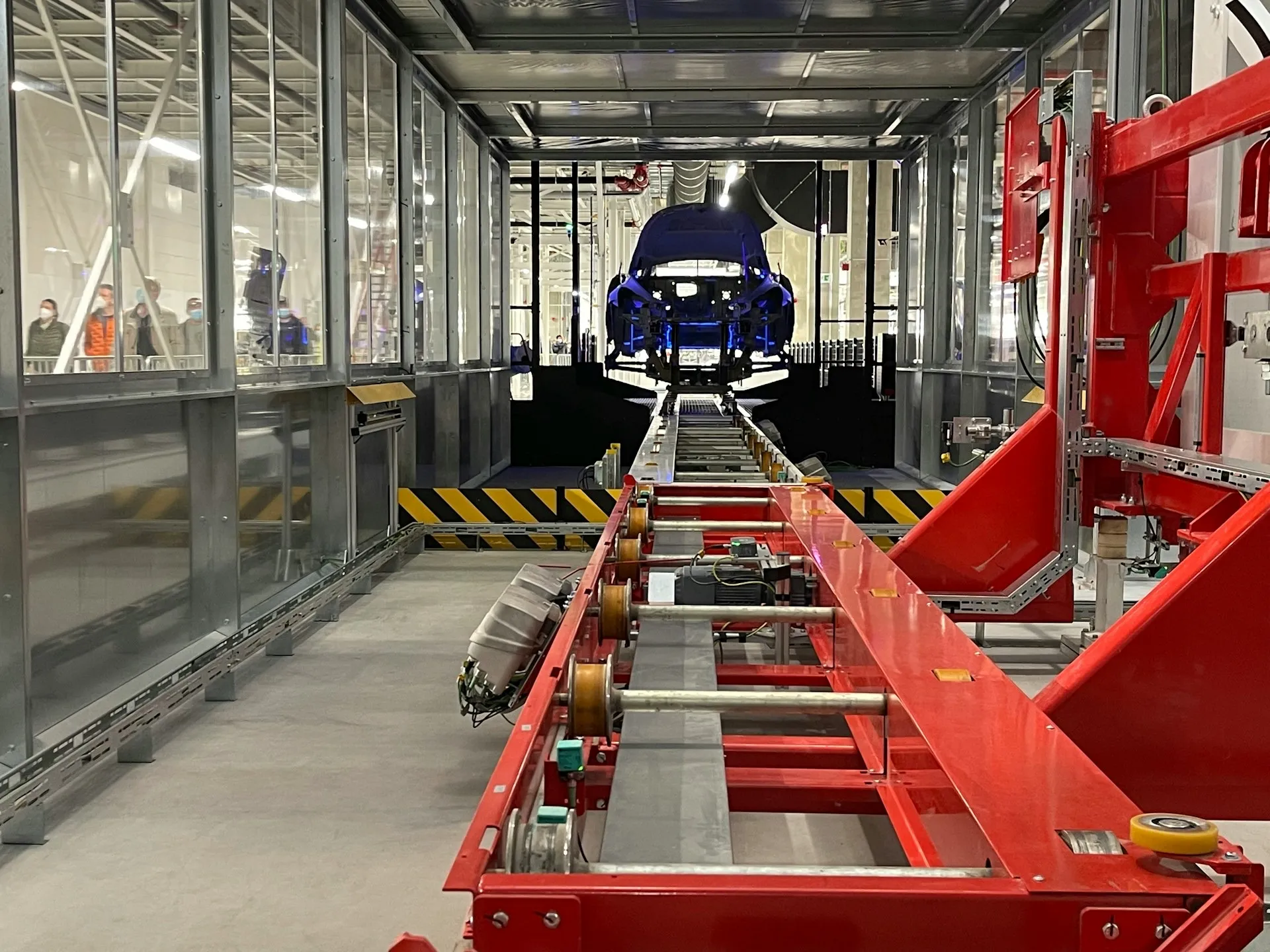
octoplant automotive use comes down to one fact about car and component plants: they are the densest concentration of programmable devices in manufacturing. A single body shop can run hundreds of robots, each with its own program, sequenced by PLCs from more than one vendor, with safety controllers, servo drives and HMIs on every cell. When one of those devices fails and its current program cannot be found, the line stops, and in just-in-time supply the stop travels downstream to the customer within hours. This page explains why that makes program control a production issue in automotive, what AMDT’s public automotive case studies report, and where rollouts get hard. It sits under octoplant use cases by industry in our independent AMDT overview.
Why automotive lines lose track of their programs
Robot programs change all the time, for good reasons. A fixture wears, a stamping tolerance shifts, a gripper is replaced, and a technician touches up a few points to keep weld or sealer placement in spec. Each touch-up is legitimate. Each one also makes the last backup a little older, and on a line with 300 robots, “a little older” across every controller adds up to a backup set nobody would trust.
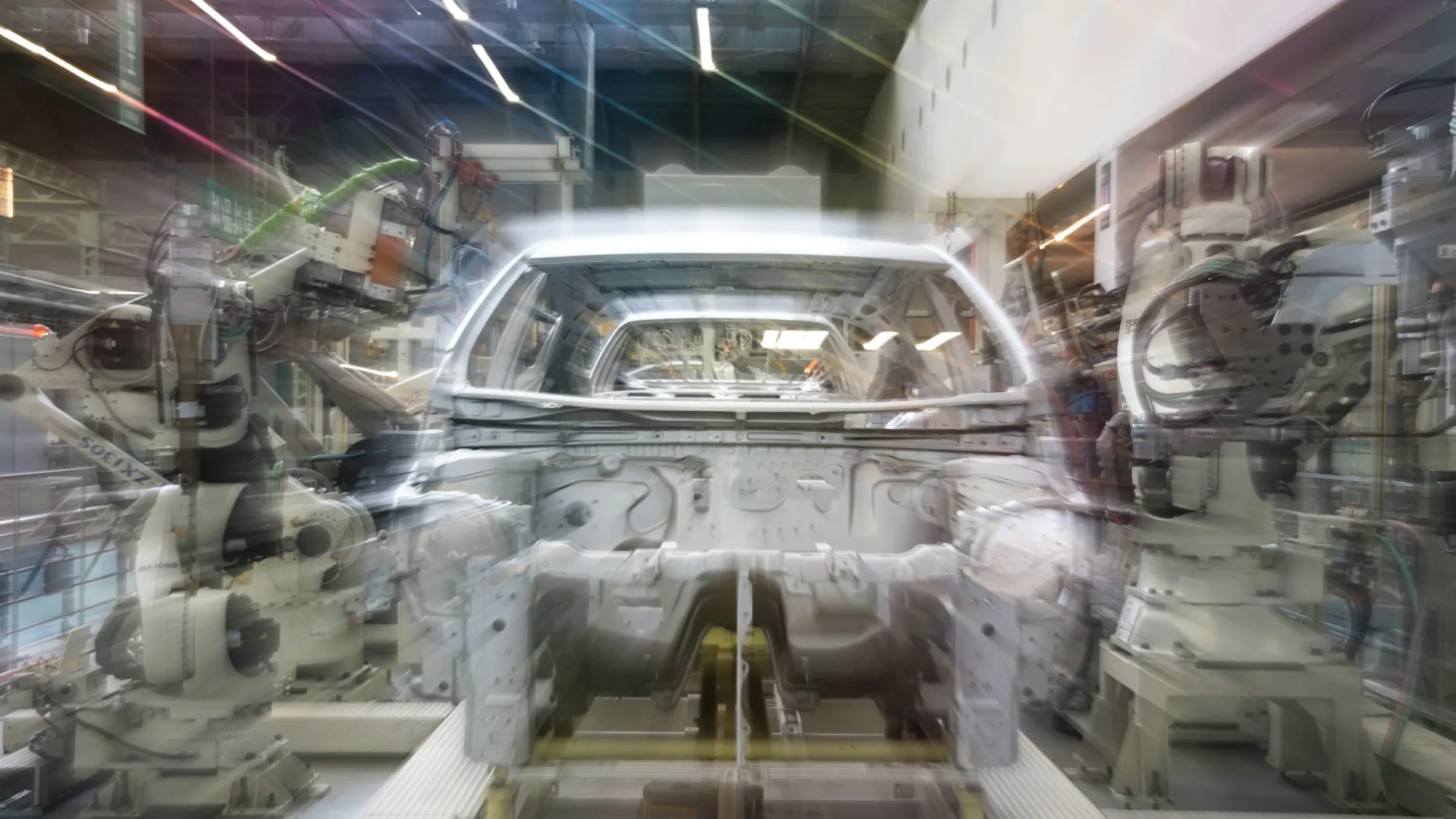
Model launches multiply the change rate. AMDT’s own automotive page describes the pressure as “new vehicle platforms, electrification, model variants, automation upgrades, and software-defined production” (AMDT). During a launch, integrators, robot vendors and plant engineers all change code on the same line, often from their own laptops.
The estate is mixed. A plant built in stages may run two PLC brands, three robot brands and several generations of each. AMDT notes that global OEMs and tier suppliers “operate heterogeneous automation estates built over decades.” A tool that covers one vendor leaves the rest of the line exposed.
The cost of a stop is contractual. For a supplier feeding an assembly plant, a stopped line risks missed shipments and penalties, not just lost output. That is why recovery time, not compliance, usually carries the automotive business case.
Illustrative scenario. A robot controller in a framing cell fails at 03:00. The spare is on the shelf. The question is which program to load: the one on the network share dated eight months ago, or the one on a contractor’s laptop from the last model change. With a current backup the answer takes seconds and the cell is back within the shift. Without one, the team reloads the old program, re-teaches paths and runs quality checks, and the line may lose most of a day.
octoplant automotive coverage, asset by asset
| Asset | What changes, and how often | What a lost program costs | Where octoplant fits |
|---|---|---|---|
| Robot controllers | Path touch-ups weekly or daily; full program changes at model launch | Re-teaching paths, quality re-checks, hours to days | Scheduled backup, compare against the approved version, restore. See robots, CNC and drives |
| Line and cell PLCs | Logic edits during launches and breakdowns | The sequence for a whole zone is unknown | Version control with check-in and check-out |
| Safety controllers | Rare, controlled changes | A safety program that cannot be verified cannot be trusted | Compare and audit trail; validation stays with the plant |
| Servo drives | Parameter changes after motor or gearbox swaps | A replaced drive that will not run the axis | Parameter backup where the drive family is supported |
| HMIs | Screen and alarm edits | Operators lose screens or alarm text | Project backup and versioning |
The common thread is that the device holds the truth and the server holds a guess. octoplant’s scheduled jobs upload from the device and compare it against the approved version, so the guess is checked against reality on a schedule. That is the mechanism described on change detection.
How multi-plant groups organise it
Large automotive groups do not buy one installation; they build a service. Bosch’s description of its “B4M: Backup for Manufacturing” service is the clearest public example of that pattern (AMDT).
The public octoplant automotive case studies
Bosch. The B4M service puts octoplant at the core of backup and recovery across Bosch’s production sites, run centrally by Bosch Digital and replacing the predecessor versiondog. Each site runs a local installation, a central installation provides the standards, the network is segmented into defined zones, and synchronised component catalogues keep system IDs consistent so new plants can be brought in from templates (AMDT). The case study gives no plant or device counts.
thyssenkrupp Presta. The steering-systems maker runs 24 plants in Europe, the US and China and, as AMDT publishes it, “restarts that used to take several hours can now be realised in just a few minutes”, while unwanted changes are detected early. Its project manager is quoted: “In case of an emergency, we can restore entire production lines within minutes and maintain the supply chain” (AMDT). Note the framing: supply-chain continuity and avoided penalties, not compliance.
Volkswagen Anhui. This is the clearest public example of the pattern at a single new plant. According to AMDT’s account, the plant wanted one approach to program management across its three production shops before the plant opened, and went live in the welding, paint and final assembly shops in September 2022. Programs from critical equipment are backed up on a schedule to a central server and compared against defined reference versions, so the team can see whether a monitored device has changed and which elements differ. Device compatibility was tested before the network architecture was finished. The story gives no device counts or measured recovery times.
What the three stories share. None of them leads with compliance. Bosch leads with one standard across many plants, thyssenkrupp Presta with restart time and contractual penalties, and Volkswagen Anhui with removing manual backups from the maintenance team’s day. That is the order in which an automotive business case usually lands.
Why program control matters more at automotive scale
The arithmetic is what sets automotive apart. A plant with 20 controllers can keep a usable backup set through discipline alone. A plant with 600 robots and PLCs cannot: if each device has a small chance of an unrecorded change each week, then at any moment dozens of devices hold programs that differ from their backups, and nobody knows which. Automated upload and compare is the only way the backup set stays current at that size.
The second factor is cost per minute. When a stopped line costs, say, $20,000 an hour (illustrative), the difference between a two-hour restore and a twelve-hour rebuild pays for a lot of software. Our manufacturing downtime guide shows how to put a real number on that for your own plant.
Where it gets hard
- Alert noise from legitimate touch-ups. Robots change every week. Without a rule for which changes need approval and which are routine, change alerts become background noise and stop being read.
- Launch periods. The moment the change rate is highest is when integrators work from their own machines. Writing check-in rules into the integrator’s contract matters more than the tool.
- Safety programs. A compare shows that a safety program changed. Revalidating it remains a plant and integrator responsibility.
- Coverage gaps. Weld controllers, vision systems and specialised process equipment may or may not be on AMDT’s current matrix. Check each family; the list is gated behind myAMDT.
- Restore is not tested by default. A backup that has never been loaded into a spare controller is still a hypothesis. See disaster recovery.
Plants that already plan a controls refresh can fold program control into the same project; our control system modernization service covers that sequencing. For the contrast with a lower-volume, more mixed-vendor sector, see octoplant in food and beverage.
Related: octoplant use cases by industry · Food and Beverage · Robots, CNC and Drives · AMDT hub
Frequently asked questions
Can octoplant back up industrial robots?
AMDT lists robots among the asset types octoplant covers, and partner pages name ABB, COMAU, FANUC, Kawasaki, KUKA, Mitsubishi, OMRON, Stäubli and Yaskawa as examples. Those lists may lag the current matrix, which sits behind the myAMDT login, so confirm your exact controller generation and software version with AMDT before you plan a rollout.
Which automotive companies use octoplant?
AMDT publishes case studies from Bosch, whose global Backup for Manufacturing service is built on octoplant, and from thyssenkrupp Presta, which reports faster line restoration across 24 plants. It also publishes a story on Volkswagen Anhui. Logos on AMDT's industry pages are not case studies and say nothing about scope.
Why do robot programs drift from their backups?
Robot paths are touched up constantly: a fixture wears, a part tolerance shifts, a tool is replaced, and a technician adjusts a few points to keep quality in range. Each touch-up is legitimate, but unless the change is uploaded and stored, the backup ages every week. Scheduled uploads close that gap.
How long does it take to restore a line after a robot controller failure?
It depends almost entirely on whether a current, tested program exists. With one, a replacement controller can be reloaded in a fraction of a shift. Without one, teams rebuild paths by hand, which can take days. thyssenkrupp Presta reports moving restoration from several hours to minutes, as AMDT publishes it.
Is octoplant suitable for a single automotive supplier plant?
Yes. AMDT sells a Core edition for up to 50 devices on a single site and larger Plus and Premium editions. A tier 2 plant with a few dozen robots and PLCs gets the same recovery and change detection value; it simply does not need the multi-site standards pattern that Bosch describes.
References and further reading
- Automotive · AMDTAMDT's own framing of change pressure and mixed automation estates in automotive.
- Global Manufacturing Backup at Bosch. · AMDTThe B4M service architecture: local installations, a central standard, network zones and a shared component catalogue.
- thyssenkrupp Presta: From standstill to restart in minutes. · AMDT
- How AMDT Solution Helps Volkswagen Anhui Manage Data. · AMDTScheduled backup and compare against reference versions across body, paint and final assembly.
- octoplant - Data Security for all Automation Devices · iOpen (AMDT partner)A partner's list of example robot, CNC and drive families. It may lag AMDT's gated matrix.